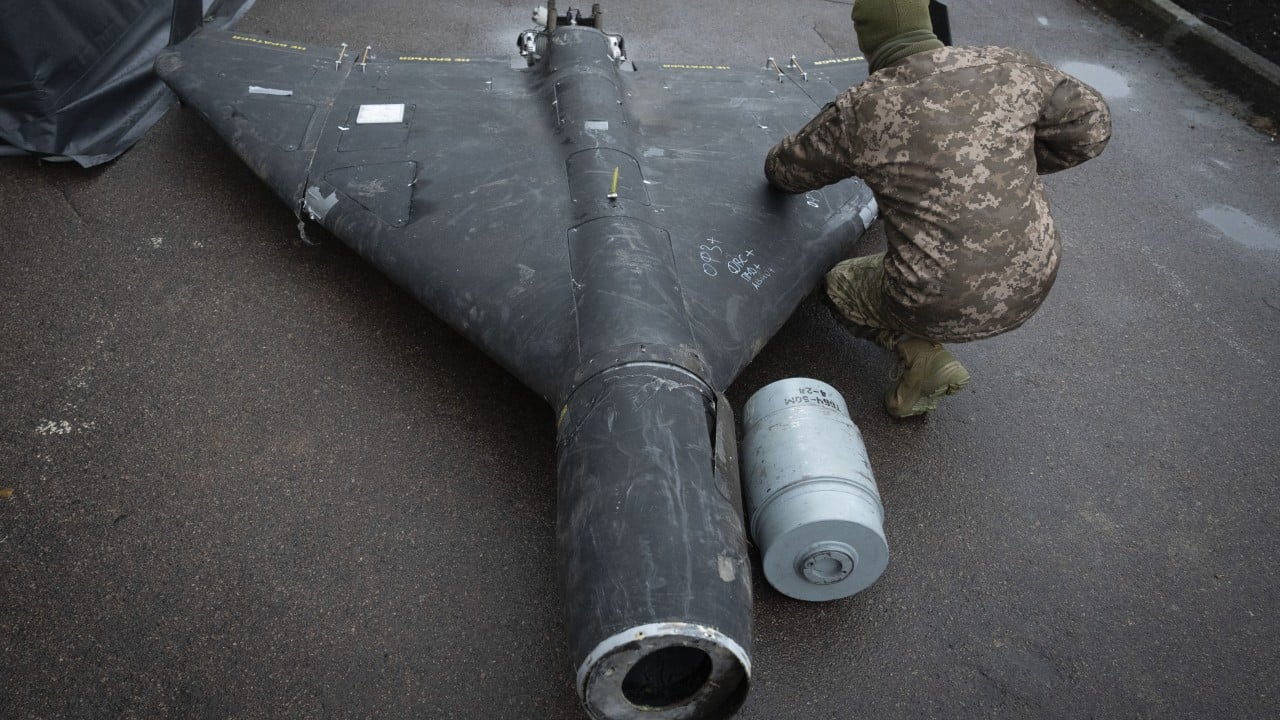
The United States is currently seeking a strategic technological exchange with Ukraine to neutralize Iranian-manufactured loitering munitions that are destabilizing the Middle East. President Volodymyr Zelensky has confirmed that Washington is looking to tap into Ukraine's hard-won experience in Downing the Shahed series of drones, which have become a primary tool of attrition for Russian forces and Iranian-backed proxies alike. This is not a request for generic diplomatic cooperation. It is a desperate hunt for the specific electronic warfare signatures and physical interception tactics that Ukrainian engineers developed in the mud of the Donbas and the skies over Kyiv.
For three years, Ukraine has served as the world’s most intense laboratory for unmanned aerial vehicle (UAV) warfare. While Western defense contractors theorize about "counter-UAS" solutions in controlled desert testing ranges, Ukrainian soldiers are actually killing these machines every single night. The Pentagon now realizes that the same Shahed-131 and 136 models hitting Ukrainian power grids are the same ones threatening American assets and international shipping lanes in the Red Sea. The transfer of this "battlefield-proven" data is now a matter of urgent national security for the U.S. and its allies in the Gulf.
The Shahed Problem from Kyiv to the Red Sea
The Iranian Shahed drone is a masterpiece of low-cost, high-impact engineering. It does not rely on sophisticated, expensive sensors. Instead, it uses a combination of civilian-grade GPS and inertial navigation systems to fly toward fixed coordinates. Because they are cheap—often estimated at $20,000 to $50,000 per unit—they are deployed in swarms.
Western air defense systems were never designed for this. A single Patriot missile, costing roughly $4 million, is a statistically poor trade against a plastic drone that costs less than a used mid-sized sedan. Ukraine learned this lesson early and painfully. To survive, they had to stop using their most expensive missiles on these "mopeds in the sky" and pivot toward a layered defense.
This layered approach is exactly what the U.S. wants to replicate. By studying the wreckage of thousands of downed drones, Ukraine has mapped out the specific vulnerabilities in the Shahed's flight controller. They know exactly which frequencies to jam to force the drone into a "lost link" state, and they have mastered the art of "spoofing"—sending fake GPS signals that trick the drone into thinking it is miles away from its actual location, causing it to crash harmlessly in a field.
Why the Pentagon is Playing Catch Up
There is a persistent myth that the U.S. military is always a decade ahead of everyone else. In the realm of low-altitude, slow-speed drone defense, that is demonstrably false. The American military-industrial complex spent forty years focusing on stealth fighters and hypersonic missiles. They were caught flat-footed by the rise of the "poverty-tier" cruise missile.
Ukraine’s innovation was born of necessity. They created a decentralized network of "Mobile Fire Groups"—pickup trucks equipped with heavy machine guns, thermal imaging, and acoustic sensors. These teams are linked by a custom software tablet that aggregates data from thousands of microphones scattered across the country. When a microphone picks up the distinct lawnmower-like buzz of an Iranian engine, the system calculates the flight path and alerts the nearest truck.
This acoustic detection network is a breakthrough. Traditional radar often struggles to differentiate a slow-moving, composite-material drone from a large bird or ground clutter. Ukraine’s acoustic solution is passive, meaning it doesn't emit signals that an enemy can track, and it is incredibly cheap to scale. American advisors are reportedly looking at how this decentralized sensor mesh can be deployed around U.S. bases in Iraq and Syria, where drone attacks have become a weekly occurrence.
The Reverse Engineering Pipeline
The cooperation Zelensky mentioned involves a deep dive into the physical remains of the Shahed. Ukrainian intelligence services have been meticulously cataloging every Western-made component found inside these drones. Despite heavy sanctions, Iranian procurement networks still manage to source microchips, voltage regulators, and spark plugs from companies based in the U.S., Europe, and Japan.
By sharing this "tear-down" data, Ukraine allows the U.S. Treasury Department to close the loopholes in the global supply chain. If the Pentagon knows exactly which specific serial number of a Swiss-made GPS module is being used in a drone that hit a cargo ship, they can trace that part back through the distributors to find where the leak is happening. This is forensic warfare at its most granular level.
Tactical Innovation versus Theoretical Defense
Beyond the hardware, there is the matter of "Electronic Warfare (EW) doctrine." In the Middle East, U.S. forces have often relied on high-powered jammers that clear the entire spectrum. The problem is that these jammers also blind friendly communications and civilian aviation.
Ukraine has perfected "surgical jamming." They have identified the precise millisecond-long windows where the Shahed attempts to re-sync its navigation. By hitting only those windows, they can drop the drone without disrupting the entire local cellular network. This level of finesse only comes from defending against tens of thousands of launches. It is a level of expertise that no amount of simulator training can provide.
The Human Cost of the Learning Curve
We must acknowledge that this data is written in blood. Every "successful" interception tactic shared with the U.S. was preceded by a failure that likely resulted in a destroyed apartment building or a darkened hospital. The Ukrainians are not just sharing technical manuals; they are sharing the tactical wisdom earned through the largest aerial bombardment of a European nation since 1945.
The Geopolitical Trade
Zelensky’s openness about this request suggests a quid pro quo that goes beyond simple gratitude. Ukraine needs more than just the "thanks" of the American taxpayer. They need the very high-end systems that the U.S. is currently holding back. By proving that Ukrainian technical data is essential for the protection of U.S. troops in the Middle East, Kyiv gains significant leverage in its requests for long-range ATACMS missiles and advanced EW suites of their own.
It turns the relationship from one of "charity" to one of "mutual defense." If Ukraine can demonstrate that its innovations are saving American lives in the Persian Gulf, the political resistance in Washington to sending more sophisticated aid begins to crumble.
Countering the Iranian Expansion
Iran has noticed this exchange. Tehran is currently iterating on its designs, attempting to add basic optical sensors to the Shahed so it can "see" targets even when its GPS is jammed. This creates a feedback loop where the battlefield in Ukraine dictates the security of the Strait of Hormuz. The drones being shot down over Odesa today are the prototypes for the drones that will be used in a potential conflict between Israel and Hezbollah or the Houthis and the Saudi coalition.
Integrating the "Acoustic Umbrella"
The most immediate takeaway for U.S. forces is the integration of the Ukrainian "Sky Fort" or similar acoustic detection systems. The U.S. has historically relied on the Sentinel radar and the Coyote interceptor. While effective, these are "high-end" solutions that are difficult to deploy in the sheer volume needed to cover every outpost.
Ukraine’s model suggests that a $500 microphone and a smartphone running a specialized app can be as effective as a $500,000 radar unit for the specific task of tracking Shaheds. This "democratization" of air defense is a bitter pill for traditional defense contractors to swallow, but it is the only way to win a war of attrition.
The U.S. military is currently testing several of these "low-cost sensor" concepts at the Yuma Proving Ground, but the data coming out of Ukraine is the real-world validation they need to bypass the typical ten-year procurement cycle.
The Reality of the New Drone Era
We are no longer in an era where air superiority is defined solely by who has the most F-35s. Air superiority is now being contested at 1,000 feet by plastic wings and modified lawnmower engines. The U.S. asking Ukraine for help is a historic role reversal. It marks the end of the era where the West had a monopoly on military innovation.
The Ukrainian experience proves that in modern conflict, the ability to adapt in weeks is more valuable than the ability to plan for decades. The Pentagon is not just buying data; they are trying to buy the Ukrainian mindset of rapid, iterative survival. If they fail to integrate these lessons, the U.S. will remain vulnerable to a $20,000 drone that can bypass a billion-dollar carrier strike group.
The defense of the Middle East now depends on how well American generals can learn from Ukrainian sergeants. There is no middle ground in a drone war; you either evolve at the speed of the software, or you become a target for the next swarm.
Move the acoustic sensor arrays to the perimeter and ensure the EW signatures are updated with the latest Ukrainian frequency captures before the next moonless night.