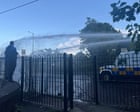
The British government has a massive problem on its hands, and it isn't just the sheer number of small boats crossing the English Channel. It's the ethics of what happens on the other side of the water.
Under a massive £660 million border security agreement between the UK and France, French riot police deployed along the northern coast are officially authorized to use water cannons, batons, and CS gas against asylum seekers. Think about that for a second. The UK mainland outright banned water cannons over a decade ago because they cause serious physical harm and ruin any notion of policing by consent. Yet, British taxpayers are funding an enforcement strategy that relies on those exact tools just a few miles away on French beaches.
This isn't an underground rumor. It is the direct consequence of a high-stakes political bargain. Prime Minister Keir Starmer and Home Secretary Shabana Mahmood are under intense pressure to stop the boats before the next election cycle. They've opted for a "payment-by-results" model, pumping hundreds of millions of pounds into French law enforcement. If the tactics don't work, some of the funding stops. That creates a brutal incentive structure where French forces must show results by any means necessary, turning sandy beaches into active conflict zones.
The Brutal Reality of Beachfront Enforcement
Human rights organizations are calling this a sickening escalation. They're right. A water cannon doesn't just wet you down; it fires a high-velocity stream capable of knocking a grown adult flat on their back, causing broken bones, internal injuries, or worse. Deploying these machines on uneven sand against desperate people, including families and children, is a recipe for disaster.
The deal itself, which runs through March 2029, splits the cash into two pots. There's a core £501 million payment to strengthen existing beach controls, and an extra £160 million dangling as a performance bonus if crossings drop. To get that bonus, France has deployed two new elite units.
The first is the Compagnie de Marche, a 75-officer squad designed to break up boat launches and seize smuggling gear before it hits the water. The second is a permanent, 50-officer riot unit from the Compagnies Républicaines de Sécurité (CRS). The CRS is famous in France for its aggressive crowd control methods. They don't mess around. They've been given a green light to use public order powers—meaning water cannons, heavy batons, and tear gas—to scatter crowds of migrants and confront the smuggling gangs that control the dunes.
Hypocrisy Across the Channel
The obvious friction point here is the glaring double standard in British policing. Back in 2015, Theresa May, serving as Home Secretary, blocked the use of water cannons in England and Wales. She made it clear that these devices have a genuine capacity to cause medical harm. While Northern Ireland still holds a small fleet of them for severe riots, they're viewed as a weapon of absolute last resort.
Now, the UK finds itself in a position where it's bankrolling a system that ignores those exact safety thresholds. When pressed on the matter, Home Office insiders quickly pass the buck, claiming that specific policing tactics are entirely a matter for the French authorities. That's a convenient legal shield, but it doesn't hold up under public scrutiny. You can't hand someone a massive bag of cash, demand specific numeric results, and then look away when they use brutal tactics to deliver your quota.
We've already seen what this looks like on the ground. Last summer, French police were caught on camera using batons and CS gas in the shallow surf around Calais and Dunkirk, trying to puncture dinghies and scatter crowds. Leaked messages from past years even showed some officers joking about sinking migrant boats. Adding water cannons to this volatile mix increases the likelihood of a fatal incident on the shore.
Smugglers are Adapting Faster Than Governments
The government keeps insisting that these harsh measures are working. They point to data showing that joint operations stopped around 40% of attempted crossings during certain peak weeks in May. They claim tens of thousands of launches have been blocked since the political guard changed in London.
But look closer at the numbers. Thousands of people are still making the crossing anyway. The reason is simple: people smugglers don't care about police tactics. They just change their business model.
Instead of launching massive groups from predictable beachheads, smugglers now use "taxi boats." They send an empty dinghy down the coast with a single pilot, and migrants rush into the water from multiple hidden points to scramble aboard while the boat is moving. This keeps the crowds small until the final second, making it incredibly tough for beach patrols to spot them. When the police do show up, the scene turns chaotic instantly. The presence of highly militarized riot squads means that instead of a controlled interception, you get a violent scramble in the dark.
Moving Beyond the Beachfront Crackdown
Throwing money at beach enforcement is a short-term political band-aid. It doesn't fix the underlying mechanics of why people cross the Channel. If the UK genuinely wants to undermine the human smuggling networks, it has to shift its focus from brute force to structural fixes.
First, there needs to be a dramatic expansion of verified, safe legal routes for asylum seekers to apply for UK protection from within Europe. Smugglers thrive because they hold a monopoly on access; break that monopoly, and their client base evaporates. Second, the backlogs in the UK asylum processing system need urgent clearing so decisions are made in weeks, not years, removing the limbo that drives irregular movement. Finally, the joint intelligence units need to track the financial supply chains of smuggling kingpins deeper into mainland Europe, stopping the supply of engines and boats before they ever reach the French coast.
Relying on riot squads and water cannons might make for tough political talking points, but it won't solve a humanitarian crisis. It just makes the coastline more dangerous for everyone involved.