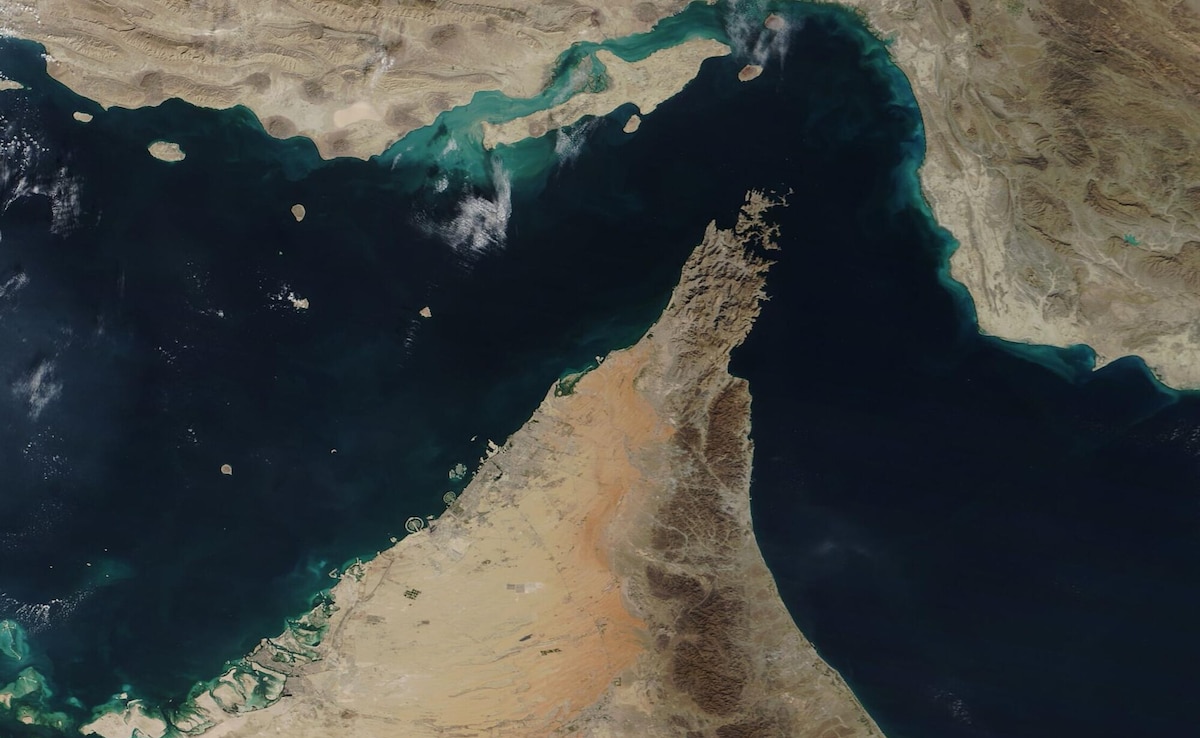
Captain Elias stands on the bridge of a VLCC—a Very Large Crude Carrier—watching the dawn break over the jagged, sun-scorched cliffs of the Musandam Peninsula. To his left lies Oman; to his right, across a deceptively narrow strip of turquoise water, lies Iran. At its tightest point, the Strait of Hormuz is only twenty-one miles wide.
That is less than the distance of a marathon.
For Elias, this isn't a geopolitical "flashpoint" or a "strategic maritime artery." It is a hallway. A narrow, crowded, high-stakes hallway through which 20% of the world’s petroleum consumption must pass every single day. If that hallway closes, the lights in Tokyo flicker. The price of bread in Cairo spikes. The global economy, a beast of infinite complexity, suddenly finds its carotid artery under a thumb.
For decades, Gulf nations have dreamt of a back door. They have poured billions into pipelines, desert ports, and massive infrastructure projects designed to bypass this geological bottleneck. They want to breathe. They want to export their lifeblood without wondering if a single skirmish or a stray mine will bankrupt their next fiscal year.
But the desert has a way of humbling even the most ambitious architects.
The Iron Law of Geography
Imagine you are trying to move a mountain of sand using a single drinking straw. That is the fundamental physics problem facing any nation trying to bypass Hormuz.
The world’s appetite for oil is gargantuan. We are talking about roughly 20 million barrels of oil passing through the Strait every twenty-four hours. To move that much volume via land requires a network of pipelines so vast and so high-pressure that they become some of the most complex machines ever built by human hands.
Saudi Arabia has the East-West Pipeline, a 745-mile steel vein stretching from the Abqaiq plants to the Red Sea port of Yanbu. It is a marvel. It can move five million barrels a day. The United Arab Emirates has the ADCOP pipeline, which snakes through the dunes to Fujairah, bypassing the Strait to reach the Gulf of Oman.
On paper, the math looks promising. If you add up the theoretical capacity of every bypass pipeline in the region, you get about 6.5 to 7 million barrels per day.
Now, do the subtraction.
If the Strait of Hormuz closes tomorrow, there is a 13-million-barrel-per-day deficit that simply cannot be moved. There are no more straws. The rest of that oil stays in the ground, and the global market enters a state of cardiac arrest. This isn't just a logistical hiccup. It is a structural reality that cannot be out-engineered by a single generation of construction.
The Ghost in the Pipe
The struggle isn't just about volume; it’s about the brutal chemistry of the desert.
A pipeline isn't a "set it and forget it" solution. It is a living, breathing, vulnerable entity. The heat of the Arabian Peninsula expands the steel during the day and contracts it at night. Sand—fine as flour and abrasive as diamonds—finds its way into every seal and turbine.
Then there is the matter of security. A tanker at sea is a moving target, protected by international waters and naval escorts. A pipeline is a static, thousand-mile-long bullseye. It crosses borders. It traverses remote, unpopulated wastes where a small group with a few pounds of explosives can cause a billion-dollar catastrophe in seconds.
When experts warn that bypassing the Strait is "no easy task," they aren't just talking about the cost of the pipes. They are talking about the fragility of the alternative. Relying on a pipeline means trading a maritime risk for a terrestrial one. It means trusting that every inch of a cross-country route remains secure, stable, and functional every second of the year.
The Fujairah Gamble
Travel down to the port of Fujairah. Here, the air smells of salt and heavy fuel oil. Massive storage tanks sit like giant white mushrooms against the backdrop of the Hajar Mountains. This was supposed to be the "Great Escape."
Fujairah sits outside the Strait. It faces the open Indian Ocean. If you can get your oil here, you are home free. You’ve cheated the bottleneck.
But look closer at the docks. To make Fujairah a true replacement for Hormuz, you would need to recreate the entire infrastructure of the Persian Gulf’s northern ports—the loading arms, the refineries, the deep-water berths—on a coastline that is already at its limit.
Capacity is a stubborn ghost. You can build the tanks, but can you build the speed? The efficiency of the Strait is its scale. It allows the world’s largest ships to move in a continuous, rhythmic pulse. Diverting that pulse to a single coastal point creates a new kind of bottleneck: a logistical one. Ships wait. Costs rise. The "bypass" becomes a traffic jam of a different flavor.
The Invisible Stakes of the Status Quo
Why does this matter to someone who doesn't own an oil field?
Because the world is built on "just-in-time" delivery. Your local gas station doesn't have a month’s supply of fuel in the tanks beneath the pumps. It has a few days. The refinery supplying them doesn't have a warehouse of crude; it has a constant stream coming off a ship.
When we talk about the "difficulty" of bypassing Hormuz, we are really talking about the cost of insurance for modern civilization.
If the Gulf nations could easily bypass the Strait, the geopolitical leverage of the region would shift overnight. The "oil weapon" would be blunted. The strategic calculations of superpowers would change. But as long as that twenty-one-mile gap remains the only viable exit for the majority of the world's energy, the world remains tethered to a very specific, very dangerous piece of water.
The Human Element in the Engine Room
Back on the bridge with Elias, the sun is now high and punishing. He monitors the AIS—the Automatic Identification System—which shows dozens of triangles huddled together in the shipping lanes. Each triangle is a ship. Each ship is a story.
There are Filipino engineers in the engine rooms, sweating in 120-degree heat to keep the massive pistons turning. There are Norwegian captains, Indian deckhands, and American naval officers watching from a distance. They are all part of a fragile human chain that ignores the "experts" and the "warnings" because they have a job to do.
They know what the analysts in glass towers often forget: geography is a permanent boss.
You can dig trenches. You can weld steel. You can sign treaties. But the earth has its own ideas about where the water flows and where the ships must go. We have spent half a century trying to find a way around those twenty-one miles, and yet, every evening, the tankers still line up like iron beads on a string, waiting to enter the hallway.
The dream of a total bypass is a seductive one. It promises safety. It promises independence. But for now, and for the foreseeable future, it remains just that—a dream. The reality is much heavier, made of salt, sand, and the terrifying realization that some bottlenecks are simply too big to outrun.
The tanker moves forward. The cliffs of Musandam loom close enough to touch. Elias adjusts the throttle, feeling the vibration of the engines beneath his boots. There is no other way through. There is only the Strait.