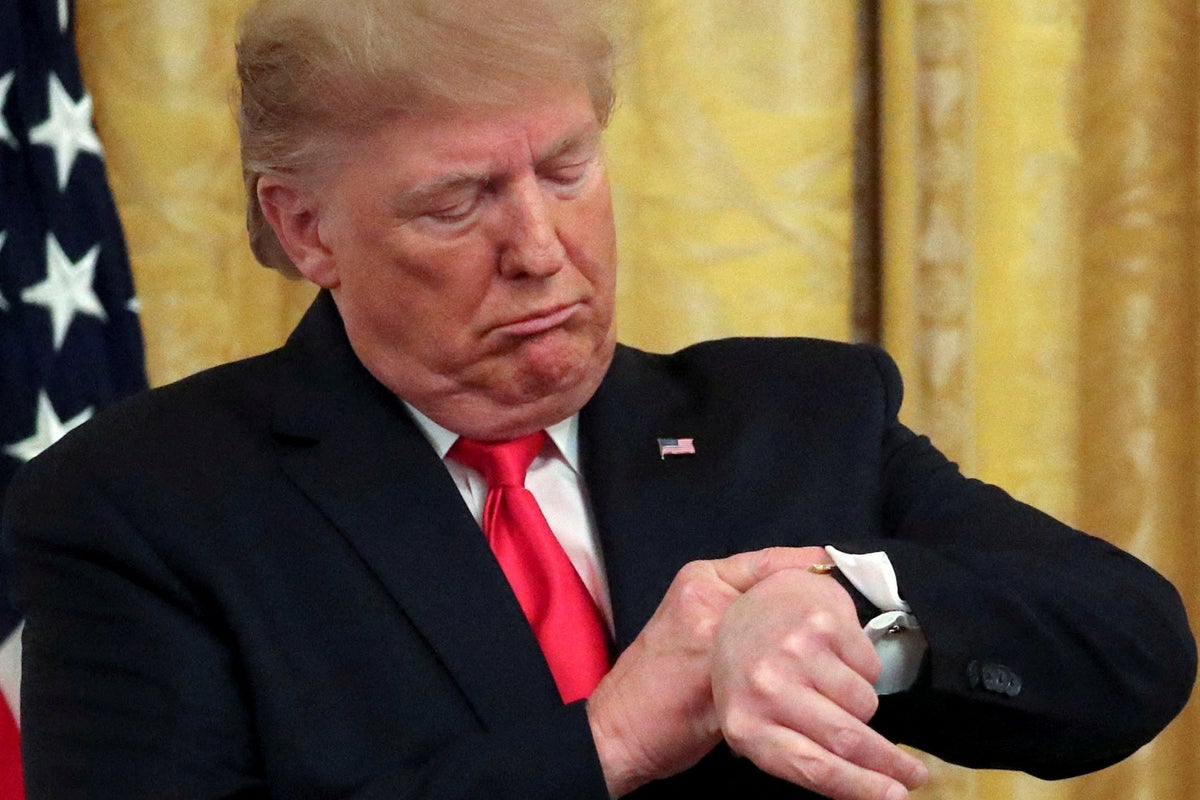
The clock on the wall doesn't just tick. It judges.
For a small business owner watching their life’s work evaporate during a lockdown, or a family waiting for a healthcare plan that won’t bankrupt them, time is a physical weight. It sits in the stomach like lead. When a leader leans into a microphone and promises a solution in "two to three weeks," that weight momentarily lifts. It’s a specific window. It’s long enough to sound like a plan is in motion, yet short enough to keep hope on life support.
But what happens when the twenty-first day passes and the horizon hasn't moved?
Donald Trump has mastered the art of the three-week window. It is his go-to temporal refuge. From the complexities of tax reform to the intricacies of Middle East peace and the terrifying unknowns of a global pandemic, the "two to three week" promise has become a recurring character in the American political drama. It isn't just a deadline. It is a psychological tool designed to bridge the gap between a crisis and the next news cycle.
The Anatomy of the Short Term Promise
Consider a hypothetical citizen named Elias. Elias runs a dry-cleaning business in a mid-sized American city. In March 2020, as the world began to shutter, Elias sat in his empty shop, the smell of starch and steam fading, replaced by the cold scent of disinfectant. He heard his president say that the country would be "opened up and just raring to go by Easter."
Easter was roughly three weeks away.
To Elias, that wasn't just a date on a calendar; it was a survival metric. If the crisis ended in three weeks, he could float the rent. He could keep his one employee, a grandmother named Martha, on the payroll. He could breathe. The promise of a three-week resolution functions as a sedative. It calms the immediate panic, preventing the kind of systemic collapse that occurs when people believe a situation is permanent.
However, the three-week mark came and went. Then another. Then six months.
The pattern stretches back far before the pandemic. In 2017, the promise was about the "phenomenal" tax plan. It was coming in two or three weeks. Later that year, a massive infrastructure bill—the kind that would fix the crumbling bridges Elias drove over every morning—was also just two or three weeks away. The timeline is never accidental. It is the sweet spot of human patience.
The Illusion of Momentum
Why two to three weeks? Why not ten days or a month?
Modern psychology suggests that humans perceive time in chunks. A week is a cycle. Two weeks is a sprint. Three weeks is the limit of our ability to hold our breath. By framing a solution within this window, a speaker creates an illusion of intense activity behind a closed door. It suggests that the heavy lifting is done and all that remains is the "polishing."
Imagine a kitchen in a high-end restaurant. The waiter comes to your table and says the food will be out in two minutes. You wait. Five minutes pass, and you are annoyed. But if the waiter says, "The chef is just finishing the sauce, it’ll be about fifteen minutes," you settle in. You order another drink. You give the kitchen the benefit of the doubt because they provided a specific, believable window that implies craftsmanship.
In the political arena, this "sauce-finishing" phase is used to deflect scrutiny. When reporters asked about the "very substantial" report on Melania Trump’s immigration status in 2016, the answer was a familiar one: a press conference would be held in the next couple of weeks. It never happened. When the subject was the replacement for the Affordable Care Act, the "full and very complete" plan was always just a fortnight or three weeks from being unveiled.
The stakes of these delays aren't just political points. They are human.
The Cost of the Shifting Horizon
When a deadline is missed, the vacuum is filled with uncertainty. For those living on the edge of the economy, uncertainty is a toxin.
Take the 2019 threat to close the southern border. The ultimatum was clear: Mexico must stop the flow of migrants, or the border would be closed in one week. Then, the timeline shifted. It became a one-year warning, or perhaps a few weeks, depending on the day's rhetoric. For the truck drivers carrying perishable produce across the line, that shifting window meant the difference between a paycheck and a literal truckload of rotting tomatoes.
They couldn't plan. They couldn't invest. They just waited, eyes glued to a ticker, trapped in a perpetual state of "almost."
This is the hidden cost of the three-week mirage. It erodes the fundamental utility of language. When words are used to buy time rather than to mark it, the value of a promise depreciates. We become a society of skeptics, conditioned to believe that "soon" means "never," and "two weeks" means "whenever the heat dies down."
The Repeating Loop
The list of "three-week" promises is exhaustive. It covers:
- The release of audited tax returns.
- The plan to defeat ISIS.
- The investigation into voter fraud.
- The "major" announcement on the opioid crisis.
- The secret plan to lower prescription drug prices.
Each of these topics represents a deep, aching wound in the American psyche. These are not abstract policy debates; they are the things people talk about over dinner when they think the kids aren't listening. When a solution is promised in a short, specific window, it offers a momentary hit of dopamine. The problem feels solved because the countdown has begun.
But the countdown often leads to a reset, not a resolution.
Consider the 2020 push to reopen schools. The administration pressured the CDC to issue new guidelines, promising they would arrive in—you guessed it—a few weeks. Parents across the country, exhausted by the grind of remote learning and the isolation of their children, clutched at that timeline. They used it to set expectations for their bosses and their families.
When the guidelines were delayed, or when they arrived and were criticized as being politically altered, the emotional fallout was devastating. It wasn't just a policy failure. It was a betrayal of the internal calendars we all keep.
The Persistence of Hope
We keep falling for the three-week window because we want to believe in the "Big Reveal." We are a culture raised on the "Grand Opening" and the "Final Act." We love the idea that a genius is working in a basement somewhere, about to emerge with a blueprint that fixes everything.
It is a narrative of the hero’s return.
But real change is tectonic. It is slow, grinding, and often ugly. It doesn't happen in three-week bursts of activity. It happens through years of boring committee meetings, incremental legislative tweaks, and painful compromises. That reality, however, doesn't win a news cycle. It doesn't stop a shouting match on a cable news panel.
The "two to three week" promise is a shield. It protects the speaker from having to admit the truth: I don't know yet, or This is going to take years, or I can't do this alone.
The Final Tally
Elias eventually closed his dry-cleaning shop.
The three-week promises stretched into a year, and the math simply stopped working. He doesn't blame the timeline alone, but he remembers the feeling of waiting for a Tuesday that never came. He remembers how the hope offered in those short-term bursts felt like a cruelty once it became clear the horizon was moving at the same speed he was.
We live in a world of immediate gratification, where we can order a book and have it on our porch by sunset. We have been conditioned to expect quick fixes. But the most profound crises—the ones that define our health, our safety, and our economy—do not respect the quarterly filing or the campaign schedule.
They require more than a temporary sedative.
The three-week window will likely remain a staple of the political lexicon. It is too effective to abandon. But for those watching the clock, for the Eliases and the Marthas of the world, the tick-tock of the wall clock is starting to sound different. It sounds less like a countdown to a solution and more like the steady, rhythmic pulse of a dream that is being deferred, fourteen days at a time.
Empty promises don't just disappear. They accumulate. They build a wall of salt between the governed and the governors, until eventually, the only thing left to see is the glare of the desert sun on a horizon that refuses to get any closer.



