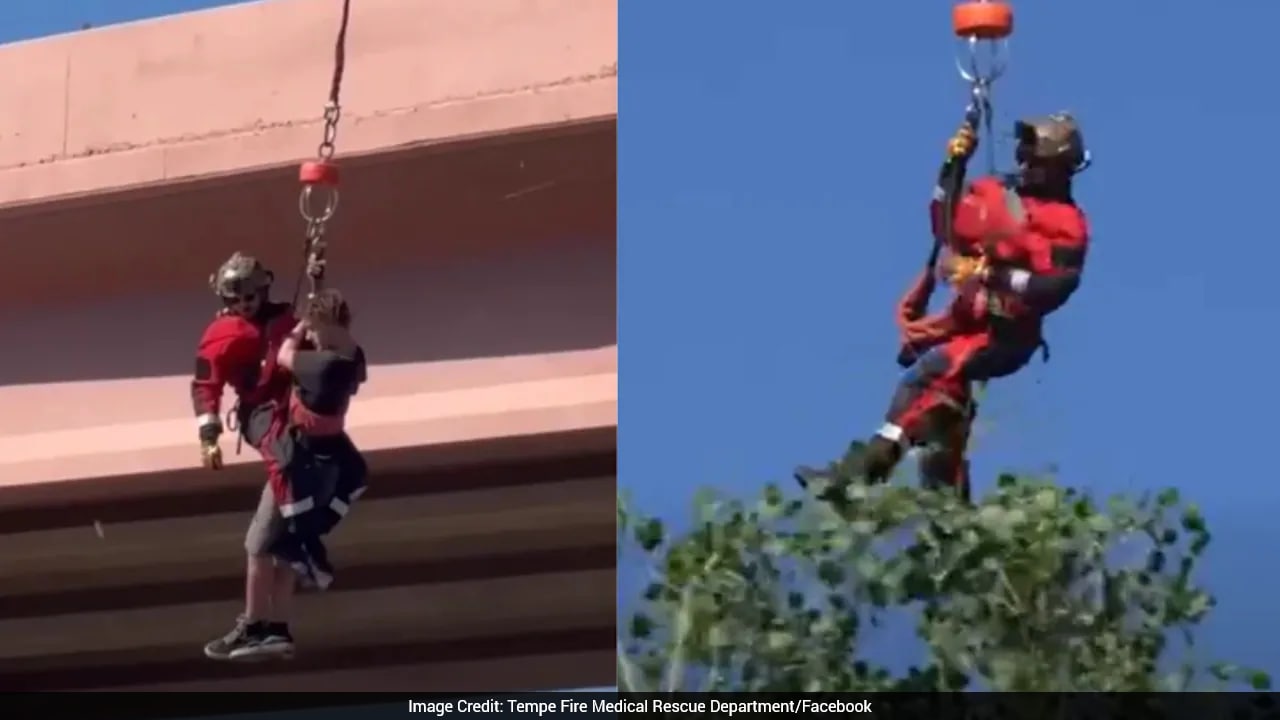
When an unnamed man spent twelve hours clinging to the branches of a tree above a surging Arizona river before rescue crews finally pulled him to safety, local headlines treated the incident as a miraculous stroke of luck. It was not luck. Surviving half a day suspended over high-velocity desert floodwater is a study in human endurance, hydrological violence, and the razor-thin margin between standard outdoor recreation and a fatal swiftwater entrapment.
Most wire reports stop at the hoist. They give you the duration, the basic geography, and a sigh of relief from the responding fire district. What they leave out is why a desert river turns lethal in minutes, why swiftwater rescues routinely take half a day to execute safely, and what actually happens to the human body when trapped in the canopy above a torrent. Meanwhile, you can find related developments here: Stop Calling Persian Gulf Tanker Attacks Black Swans.
The Illusion of the Dry Wash
People who do not live in the American Southwest look at a topographical map of Arizona and see sand, scrub, and dry creek beds. That visual deception kills tourists and locals every single year. Desert soil—particularly the sun-baked caliche and hardpan clay common across the Sonoran and Mojave regions—does not absorb water. It repels it.
When a convective storm cell dumps two inches of rain onto a mountain watershed thirty miles upstream, the water does not percolate into the aquifer. It sheets off the rock faces like rain off a tin roof, funneling into narrow canyons and established river channels with terrifying speed. Down in the valley, the sky can be cloudless. The air can be bone dry. Yet a wall of brown, debris-choked water is already moving down the corridor at fifteen to twenty miles per hour. To see the bigger picture, check out the detailed report by Reuters.
By the time a hiker, angler, or off-road driver hears the low-frequency rumble of rolling boulders—often described by survivors as sounding like an approaching freight train—the exit routes are already submerged. Climbing a tree is rarely a calculated tactical decision. It is a last-second vertical panic response when horizontal escape becomes impossible.
The Hydraulic Trap Beneath the Branches
Once a person climbs into a cottonwood, mesquite, or tamarisk tree to escape rising water, they enter a deceptive stalemate. They are out of the main current, which creates an immediate sense of temporary safety. In reality, they are sitting directly above one of the most dangerous environments in rescue operations.
Fast-moving floodwater carries immense kinetic energy. Water weighs roughly 62.4 pounds per cubic foot. When a river surges to flood stage, tens of thousands of cubic feet pass a single point every second. A current moving at just six miles per hour exerts the same force on a human body as wind blowing at over two hundred miles per hour. Nobody swims through that. You do not fight it, and you do not cross it.
Worse still is what the water carries. Desert floodwaters are thick with suspended silt, uprooted trees, jagged boulders, and barbed wire washed out from upstream ranchland. This debris turns the river into a liquid battering ram. When that debris catches against the trunk of the very tree keeping a victim alive, it creates what swiftwater technicians call a strainer.
A strainer allows water to pass through while trapping solid objects—including people—against the upstream face with thousands of pounds of hydraulic pressure. If a victim slips from a branch into a strainer, the current pins them underwater instantly. Even if the victim stays high in the canopy, the relentless battering of floating logs against the trunk threatens to undercut the root ball in the saturated riverbank soil. A tree that looks like a fortress at hour one can topple into the channel by hour six.
Why Twelve Hours Is Not a Failure of Response
To the casual reader, a twelve-hour rescue sounds like bureaucratic delay or operational incompetence. Why does it take half a day to pull one person out of a tree?
Because sending rescuers into high-velocity floodwater without absolute mechanical advantage is how you end up with dead firefighters. Swiftwater rescue operates on a strict, unforgiving hierarchy of risk: reach, throw, row, go. You never put a human rescuer in the water if you can reach the victim with a pole, throw them a rope bag, or bring a specialized craft to their position.
When a river is at peak flood stage, standard inflatable rescue boats (IRBs) are often useless. Heavy debris will shred a pontoon in seconds, and powerful hydraulic eddies can flip a motorized craft before it clears the launch bank.
Rescuers arriving on scene first have to establish containment—putting spotters downstream with throw bags in case the victim falls before rigging is complete. Next, they have to assess the hydrology. If the water is still rising, launching an offensive rescue may be suicidal. Sometimes, the safest tactical decision is to wait for the hydrograph to peak and begin receding, even if that means keeping the victim in the tree through the night.
The Mechanics of a High-Line or Helicopter Hoist
When ground teams cannot boat across, they generally have two options, both of which require massive logistical setup:
- Tensioned High-Line Systems: Technicians must anchor heavy-duty ropes to bombproof points on both sides of the river. Getting a line across a wide, roaring channel often requires a pneumatic line-thrower or a drone, followed by hours of hauling heavy static lines, setting up mechanical advantage pulley systems, and tensioning the track so a rescuer can be sent out over the torrent in a harness.
- Aviation Hoist Operations: Bringing in a helicopter sounds simple on paper. In practice, hovering over a river canyon at night or during active weather is one of the highest-risk maneuvers a pilot can fly. Rotor wash violently whips the tree branches, threatening to knock the victim out of their grip before the rescue swimmer can even reach them. Furthermore, tall canopies prevent a clean vertical drop, forcing the flight crew to find a clear window or wait for daylight to safely navigate power lines and canyon walls.
Twelve hours is the time it takes to solve an engineering problem where a single mathematical error kills both the victim and the rescuer.
The Physiological Toll of Suspension Trauma and Cold
While crews rig lines or wait out the crest, the clock is running against the victim's biology. You do not have to be submerged in ice water to die of hypothermia in Arizona.
Even in warmer months, desert temperatures drop sharply after sundown. Combine a thirty-degree ambient temperature drop with wet clothing, evaporative wind chill coming off the cold mountain runoff, and zero ability to move around to generate body heat. Shivering begins within minutes. Within a few hours, violent shivering gives way to cognitive impairment, slurred speech, and loss of fine motor control.
When your fingers lose dexterity, your grip strength evaporates. Holding onto a rough bark limb requires constant isometric muscle contraction. Over twelve hours, lactic acid builds up, muscles cramp, and micro-tears form in the forearms and shoulders.
At the same time, sitting motionless in a cramped fork of a tree restricts venous return from the lower extremities. Blood pools in the legs, dropping blood pressure to the brain and triggering orthostatic intolerance—essentially a form of suspension trauma. The victim gets dizzy. They nod off. In a tree above a flood, falling asleep is a death sentence. Surviving twelve hours in that position requires an almost unnatural level of mental discipline to stay awake while your body systematically shuts down peripheral functions to protect its core.
The Overlooked Factor of Communications Blackouts
Another factor rarely analyzed in brief news blurbs is how victims in these scenarios even manage to trigger a rescue—and why initial response times can stretch before boots ever hit the mud.
Arizona's river corridors—the Salt, the Verde, the Gila, the Agua Fria, and countless unnamed washes—carve through deep topographical dead zones. Cell towers sit along highways and population centers, not down inside granite gorges. A person trapped in a tree often has zero cellular signal.
If they do not carry a satellite messenger or a Personal Locator Beacon (PLB), they are entirely reliant on someone noticing they are overdue, or a passerby spotting them from a high bridge or overlook. Even when a call does get out via satellite SOS, the initial coordinates only tell dispatchers where the person is—not the condition of the access roads. Floods that swell rivers also wash out forest service roads, bury low-water crossings under boulders, and force rescue vehicles to hike miles through rough terrain carrying eighty-pound packs of ropes, dry suits, and hardware.
What Actually Keeps You Alive When the Water Rises
If you spend time near Southwestern waterways, relying on good weather at your trailhead is a rookie mistake. Survival comes down to decisions made hours before you ever step near the bank.
Check the upstream watershed forecast, not just your local zip code. If storms are building fifty miles north at higher elevations, stay out of the canyon bottoms. When you are along a river corridor, constantly identify high ground—rock ledges, steep canyon walls, or substantial elevation well above the visible high-water mark indicated by old driftwood tangled in the brush.
If water does trap you and a tree is your only option, climb as high as the structural integrity of the trunk allows. Do not stop just above the current; floodwaters can surge several feet in a matter of minutes. Use a belt, backpack strap, shoelaces, or strips of clothing to physically lash your torso or waist to the main trunk. If hypothermia or exhaustion knocks you unconscious at hour eight, that crude harness is the only thing keeping you out of the river until the helicopters arrive.