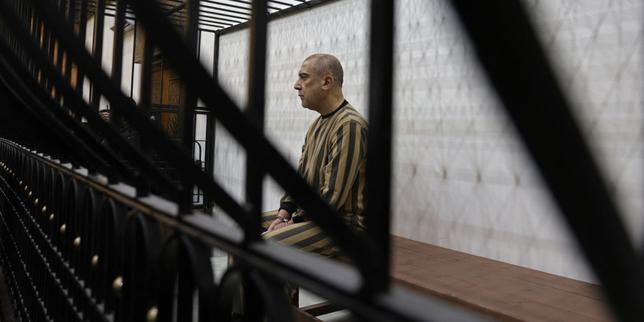
Everybody loves a courtroom drama. The international press corps is currently beside themselves over the latest verdicts against former cogs in the Assad machinery, framing these foreign tribunals as the dawn of transitional justice for Syria. It makes for clean television. It plays well on social feeds. It offers a soothing, moral narrative where bad men sit in European dockrooms while gavel-wielding judges restore balance to the universe.
It is also a masterclass in self-deception.
While legal NGOs pop champagne over convictions handed down thousands of miles away from Damascus, the actual architecture of power in Syria remains completely untouched. Transitional justice is not a foreign court handing down decades-old sentences to low-level intelligence clerks who retired to Berlin or Stockholm. True transitional justice requires an intact state, a functioning monopoly on violence, and a defeated regime that has surrendered its archives. None of these conditions exist.
Treating these scattered trials as a genuine proxy for Syrian accountability is worse than useless. It is a narcotic that allows Western governments to pat themselves on the counter-terrorism back, pretend they are solving a humanitarian crisis, and ignore the grim geopolitical reality on the ground.
The Myth of Universal Jurisdiction as State Reconstruction
Let us dismantle the core dogma of the human rights industry: the belief that universal jurisdiction can substitute for domestic reckoning.
When a court in Koblenz or Paris sentences a minor Syrian security official for crimes against humanity, legal purists cheer. They call it global justice in action. I call it jurisdictional tourism.
Universal jurisdiction is designed to catch the uncatchable. It is an emergency brake for when international tribunals fail. But weaponizing it as the primary vehicle for a nation’s post-conflict reconciliation is a category error. It mistakes criminal punishment for institutional transformation.
Imagine a scenario where every single mid-level bureaucrat who stamped a detention order under the Baath party is hunted down across Europe and thrown into a German prison. Does that rebuild a shattered judiciary in Homs? Does it clear the landmines in Daraa? Does it reintegrate five million displaced citizens into a functioning economy?
No. It creates an institutional vacuum. More importantly, it substitutes the theatrical performance of European jurisprudence for the brutal, messy labor of local political settlement. It tells the Syrian population that their salvation will arrive via a translated indictment read by a judge in a wet northern European city, rather than through domestic political evolution. That is not justice. That is colonialism with a legal degree.
The Archive Problem No One Wants to Discuss
Talk to any career diplomat who has actually spent time negotiating civil conflicts, and they will tell you the dirty secret of modern human rights law: documentation without leverage is just expensive paper.
The trials making headlines rely heavily on defectors who smuggled out thousands of photographs, or survivors who happened to make it across the Mediterranean. This is courageous work. I have met the investigators who spent months catalogoring digital evidence in damp basements. Their dedication is real.
Yet, treating these cherry-picked prosecutions as systemic accountability ignores the structural impunity of the actual architects of the conflict. The commanders who ordered barrel bombings, the foreign patrons who funded militias, and the intelligence chiefs who designed the torture cells are either still embedded in regional power structures or sheltered by geopolitical stalemates.
By hyper-focusing on the low-hanging fruit—the guards, the interrogators, the paper-pushers—international justice provides convenient scapegoats. It allows the upper echelons of the regime to point at their fallen subordinates and say, "Look, bad apples were punished." It sanitizes the institutional core by sacrificing the periphery.
The Danger of Catharsis Without Consequence
We need to talk about the psychological hazard of outsourced retribution.
When victims of state violence watch a trial unfold in a language they do not speak, governed by legal codes they did not draft, a strange psychological displacement occurs. It offers immediate emotional catharsis, followed by a crushing political hangover.
For over a decade, I have watched diaspora communities invest their remaining emotional capital into legal processes over which they have zero democratic control. Every guilty verdict is broadcasted as a turning point. And yet, six months later, the humanitarian aid budgets shrink, normalization with remaining regional power brokers accelerates, and the physical security of citizens inside Syria remains entirely dependent on local warlords and militia commanders.
Catharsis is not policy. When foreign courts handle the heavy lifting of a nation's historical trauma, the local population is reduced from active political agents to passive spectators of their own history.
The Uncomfortable Alternatives
If universal jurisdiction is a placebo, what does actual accountability look like? It is uglier, slower, and far less photogenic than a European courtroom.
Real transitional justice requires recognizing that total victory is a myth in a fractured state. It requires local truth commissions backed by community security guarantees, property restitution mechanisms that do not rely on a corrupt land registry, and community-led vetting processes that distinguish between coerced survival and active sadism.
None of this can be imported via cargo plane from The Hague.
We must stop treating foreign courtrooms as moral proxies for our own geopolitical cowardice. Western nations love universal jurisdiction because it costs them nothing. It requires no military intervention, no difficult diplomatic compromises, and no long-term financial commitment to state-building. It is moral outsourcing at its finest.
The next time a press release drops announcing another symbolic conviction of an ex-Assad functionary, do not ask how many years he received. Ask how that sentence changes the daily life of a single mother trying to feed her children in Idlib.
If the answer is nothing, stop calling it justice. Call it what it actually is: an expensive illusion designed to help us sleep at night.