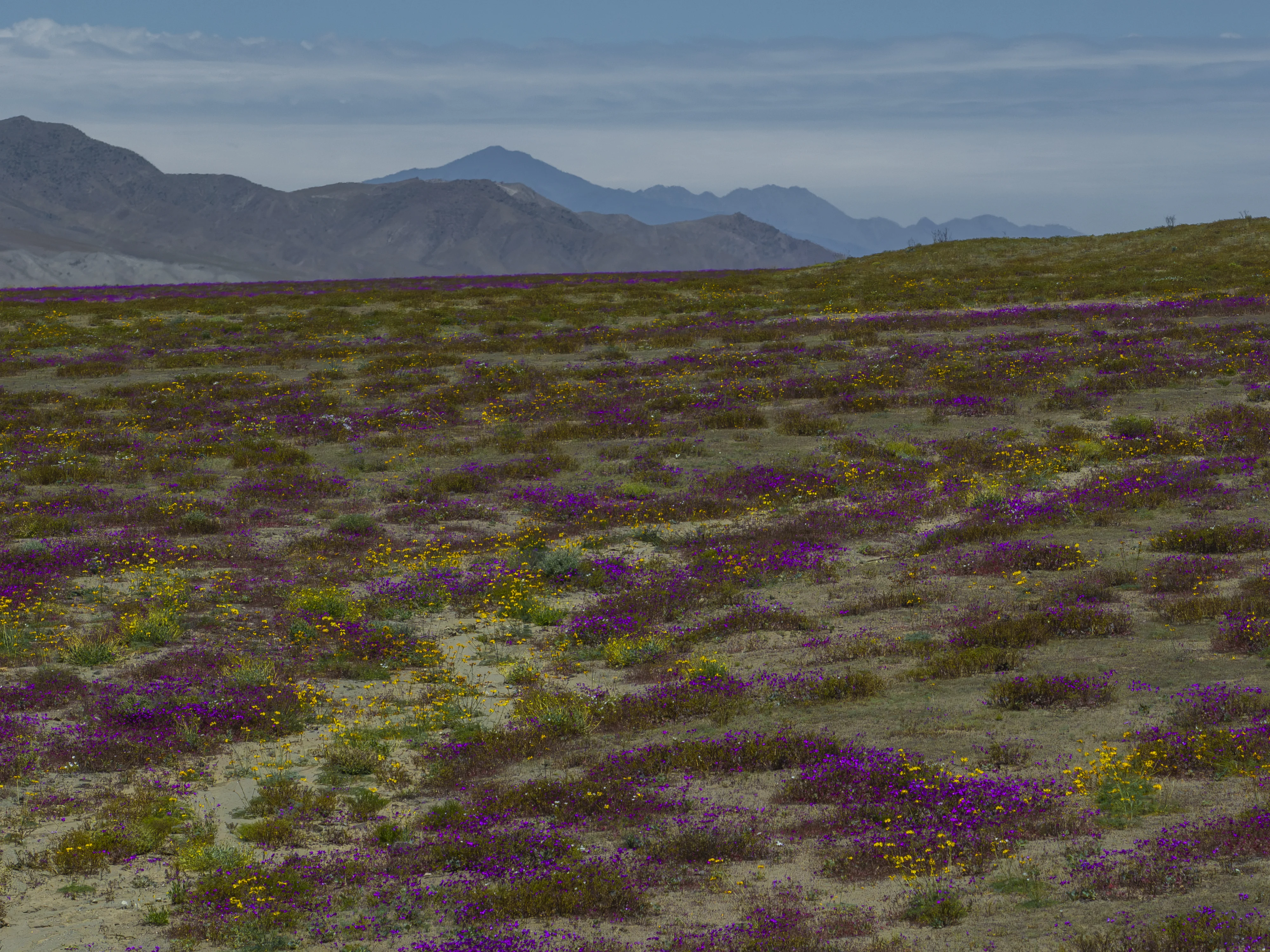
Most people picture the Atacama Desert as a lifeless stretch of cracked red earth and blinding salt flats. Honestly, for about 95% of the year, that mental image is completely accurate. Some weather stations in northern Chile have gone decades without recording a single drop of measurable rain. Yet every few years, something wild happens along the Pacific coast between Vallenar and Copiapó.
Heavy winter rains trigger the desierto florido—the Atacama flowering desert—turning miles of arid scrubland into a carpet of violet, yellow, and white blossoms. When Chile's Atacama erupts in its biggest floral display in decades, news outlets flood social media with photos of endless pink plains. Those viral photos create a massive misconception. Travelers book last-minute flights expecting a permanent botanical garden, only to show up two weeks late to dry twigs and dusty rocks.
If you're planning to witness this phenomenon, or you're trying to understand the ecology behind one of Earth's rarest botanical events, you need the actual facts on the ground.
Why the Atacama Desert Erupts Into Flowers
It isn't magic. It's a biological survival strategy pushed to its absolute limit.
Beneath the crust of the Atacama soil sits a dormant seed bank made up of more than 200 native plant species. Most of these seeds and bulbs are endemic, meaning they don't grow anywhere else on the planet. They have thick, tough outer coats designed to withstand blistering UV radiation, freezing desert nights, and years of zero moisture.
To break that dormancy, a light drizzle won't cut it. Botanists and local rangers at Chile's National Forestry Corporation (CONAF) point out that the region needs a specific threshold of winter rainfall—typically at least 15 millimeters (around 0.6 inches) falling across the coastal desert between May and August. When heavy cold fronts push inland from the Pacific, often supercharged by the El Niño-Southern Oscillation (ENSO), that water finally penetrates the hardpan soil.
Once the moisture hits, the clock starts ticking.
Different species wake up at different speeds. Bulbous plants like the añañuca (red and yellow desert lilies) and huilli (white lilies) usually punch through the dirt first because they already have stored energy underground. A few weeks later, annual seeds germinate. The most famous of these is the pata de guanaco (Cistanthe grandiflora), a hardy succulent that produces vibrant fuchsia petals and covers entire hillsides in deep magenta.
Here is the catch that most travel blogs leave out. The blooms don't happen everywhere at once.
Because the Atacama spans multiple microclimates—from coastal fog zones (camanchaca) to inland plains at higher elevations—the floral display moves like a slow wave. Coastal areas around Huasco and Llanos de Challe National Park tend to peak first, usually in late August or September. Inland valleys south of Copiapó often hit their stride in October, sometimes lingering into early November if temperatures stay mild.
The Viral Photos vs Reality on the Ground
Let's be honest about travel photography. Telephoto lenses compress distance.
When you see a magazine spread showing an unbroken ocean of purple flowers stretching to the Andes, the photographer was likely lying flat on their stomach with a 200mm lens, compressing scattered patches of blooms into a solid wall of color. If you stand up and look around with your naked eye, you see patches of brilliant wildflowers separated by gravel, sand, and dry bushes.
It's still breathtaking. You just shouldn't expect a manicured Dutch tulip field.
There's another detail people miss when major blooms happen outside the standard spring window. Occasionally, freak off-season weather systems dump rain on the desert in autumn or early winter, triggering rare, smaller blooms in places like Pampa del Tamarugal further north. While the historic, multi-decade superblooms—like the massive events recorded in 2015, 2017, and 2022—happen in the southern spring (September through November), abnormal climate shifts have made exact predictions harder for researchers at institutions like the University of La Serena and Pontificia Universidad Católica de Chile.
How Tourism Is Threatening the Desierto Florido
Whenever a big bloom makes international headlines, thousands of visitors descend on the Atacama Region within days. Unfortunately, most of them have no idea how fragile desert ecology actually is.
You see it every single bloom cycle. Drivers pull off Route 5 (the Pan-American Highway) and carve illegal tire tracks straight through fields of pata de guanaco just to get a better selfie with their 4x4 truck. People lie down in flower beds to shoot TikTok videos. Some even dig up bulbs to take home as souvenirs.
This isn't a harmless mistake. It causes multi-year ecological damage.
- Soil compaction: Heavy vehicles crush the top layer of desert crust, preventing future rainwater from seeping down to dormant seeds.
- Seed destruction: Trampling flowers before they go to seed robs the soil of the next generation's seed bank. When a plant is crushed before pollination, that genetic line disappears from that patch of dirt.
- Root damage: Desert perennials survive droughts through delicate, sprawling root networks just beneath the surface. Foot traffic snaps them easily.
In response to severe overcrowding during recent record blooms, Chilean authorities established the Desierto Florido National Park in 2023, protecting over 57,000 hectares of prime habitat south of Copiapó. Rangers now patrol hotspots heavily, and local municipalities issue steep fines for off-road driving or picking native flora.
Where to Actually See the Blooms Without Ruining Them
If you want to experience the Atacama superbloom responsibly, skip the random roadside pull-offs along the highway and head to established conservation zones with marked trails.
Llanos de Challe National Park
Located along the coast north of Huasco, this park is arguably the single best place to see the desierto florido. Because it sits right against the Pacific Ocean, coastal fog keeps the air cooler and extends the lifespan of the flowers. You'll find dense concentrations of garra de león (lion's claw), a rare, endangered red flower that grows nowhere else on Earth. Stick strictly to the wooden boardwalks and marked dirt paths.
Chañaral de Aceituno and Carrizal Bajo
Drive south from Llanos de Challe along the coastal road toward Carrizal Bajo. The coastal wetlands here contrast sharply with the surrounding desert scrub, and during wet years, the hills backing the beaches erupt in yellow coronilla del fraile and violet suspiros. As a bonus, Chañaral de Aceituno is one of Chile's premier spots for seeing bottlenose dolphins and Humboldt penguins right offshore.
Totoral and Caleta Pajonales
Between Copiapó and Vallenar, the inland plains around the tiny historic village of Totoral offer massive, sweeping views of magenta pata de guanaco fields. Because this area sits slightly further from the cooling ocean breeze, the flowers bloom intensely for a shorter window. Go early in the morning before the harsh midday sun washes out the colors and causes certain petals to close up to conserve moisture.
Practical Rules for Planning a Last-Minute Trip
You can't plan a desierto florido trip a year in advance. Anyone telling you otherwise is guessing. You have to watch the winter weather reports out of northern Chile between June and August.
- Track CONAF updates directly. Don't rely on generic travel agencies. Follow the official social media channels and press releases from CONAF Atacama and Sernatur (Chile's National Tourism Service). They publish weekly reports detailing exact percentages of flowering across specific sectors.
- Fly into Copiapó (CPO), not Calama (CJC). This is a classic geography mistake. San Pedro de Atacama—where most tourists go for geysers and salt flats—is roughly 800 kilometers (500 miles) north of the main desierto florido zone. You want to fly into Desierto de Atacama Airport near Copiapó or La Serena (LSC) to the south, then rent a vehicle.
- Pack for massive temperature swings. Even in October, coastal mornings in Huasco can be chilly, damp, and windy at 10°C (50°F), while inland valleys hit 28°C (82°F) with zero shade by 1:00 PM. Bring layers, high-SPF sunscreen, and more water than you think you need.
- Stay on established tracks. Walk single-file on existing dirt paths. Never step off the trail to get closer to a flower, and keep your car on graded gravel roads or paved highways.
Book flexible flights and refundable accommodations in Copiapó, Vallenar, or Bahia Inglesa the moment winter rains surpass 15 millimeters in July or August. Keep an eye on CONAF's September bloom maps, pack your macro lens alongside a wide-angle, and time your arrival for the coastal-to-inland transition so you catch the desert at peak color before the summer heat puts it back to sleep.