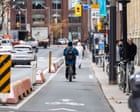
The Court of Appeal for Ontario recently handed down a decision that sent shockwaves through urban planning echo chambers: the provincial government is legally free to rip out downtown Toronto bike lanes. Predictably, activist groups and legal purists are hyperventilating. They want you to believe that asphalt management is a human rights crisis.
They are entirely wrong. For a deeper dive into this area, we suggest: this related article.
The lazy consensus dominating media coverage frames this legal battle as a choice between human survival and populist vehicular pandering. Last year, a lower court actually ruled that removing bike lanes violated the Canadian Charter of Rights and Freedoms, reasoning that taking away painted lines and plastic bollards increased the risk of injury, thereby infringing on security of the person. Think about the slippery slope of that logic for a second. If altering road infrastructure to prioritize moving vehicles over bicycles is a constitutional violation, then every single traffic bottleneck, every poorly timed light, and every unpaved pothole in the country is suddenly a matter for the Supreme Court.
The Court of Appeal rightly tossed that absurd premise. A unanimous three-judge panel made it clear: the legislature is as free to establish bicycle lanes as it is to remove them. There is no constitutional right to a specific configuration of concrete curbs. To get more context on this development, in-depth analysis can be read at BBC News.
The Fallacy of Constitutionalizing Concrete
Let us clear away the legal theatrics and look at the core misconception. Activists treat municipal engineering as moral scripture. If you support bike lanes, you are enlightened; if you question their placement on major economic arteries like Bloor, Yonge, or University, you are an enemy of progress.
This is a category error of the highest order. Road design is a trade-off, not a human right. Every inch of right-of-way allocated to one mode of transit is taken away from another. When cities cram protected cycling tracks onto high-volume arterial corridors without accounting for overall system throughput, they do not magically eliminate cars; they compress them. They turn multi-lane thoroughfares into parking lots, spiking idling emissions and throttling emergency response times.
To say that questioning this configuration violates the Charter is an insult to actual constitutional law. Section 7 protects citizens from arbitrary state-imposed deprivations of life and liberty, not from the inconvenience of traffic engineering revisions or the relocation of recreational pathways. Conflating public policy preferences with fundamental freedoms is a lazy way to bypass the ballot box when you cannot win an argument on its merits.
The Real Problem With Urban Dogmatism
I have watched cities spend millions of dollars on ideologically driven infrastructure projects that ignore how people actually move through a metropolitan region. Municipal governments install expensive installations based on wishful thinking, assuming that if you build it, gridlock will somehow evaporate.
It does not. It concentrates the friction.
When you prioritize a seasonal mode of transit used by a small fraction of commuters during freezing winters over mass transit and commercial logistics, you break the city's circulatory system. Delivery trucks have nowhere to stop. Emergency vehicles crawl. Small businesses dependent on commercial drop-offs watch their customer bases evaporate because parking has been legislated out of existence.
The Ontario Court of Appeal decision does not ban bike lanes. It returns the decision-making power to where it belongs: elected legislatures accountable to voters, rather than unelected judges weaponizing human rights law to enshrine urban planning fads.
If cycling advocates want protected lanes on Bloor or Yonge, their job is to convince the public and win political mandates, not run to court to declare their preferred traffic pattern a sacred text. Real urban resilience requires balancing all users—transit riders, pedestrians, drivers, and cyclists—instead of pretending that one group holds a monopoly on moral virtue.
Stop treating asphalt as an amendment to the Constitution. Build smarter, plan for actual data instead of utopian fantasies, and let elected governments manage the pavement.