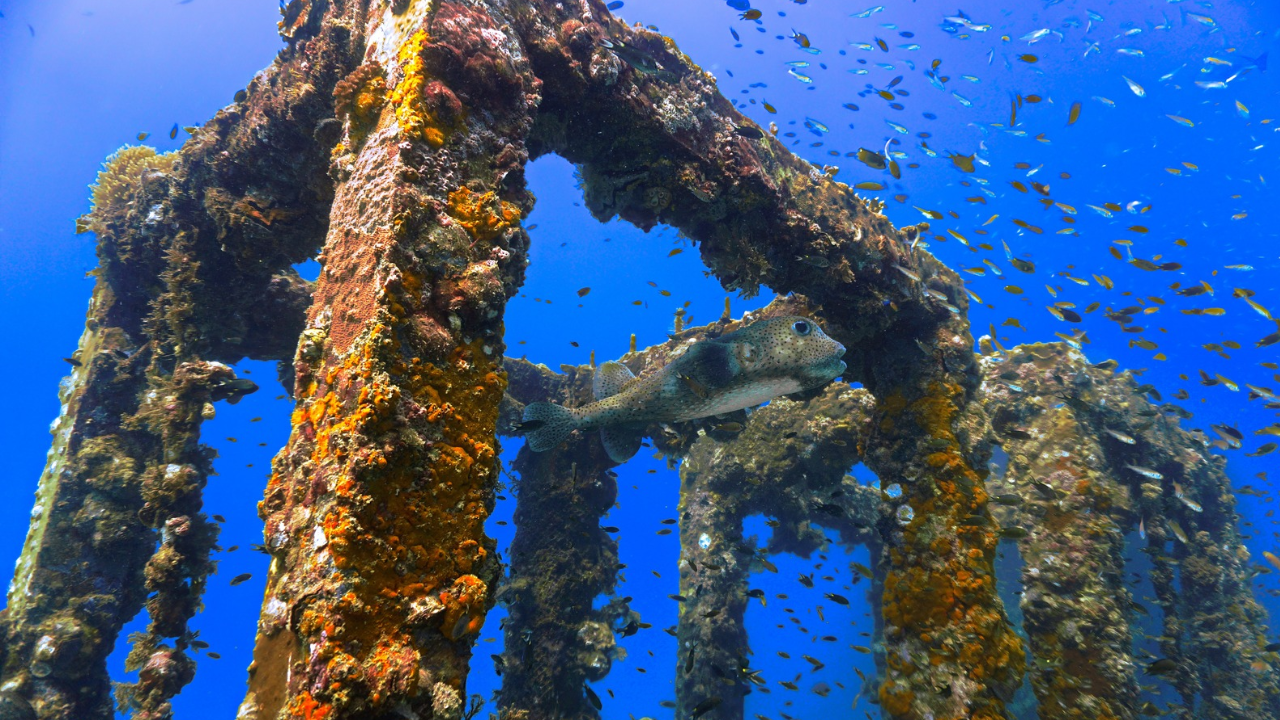
Everyone loves a good recycling story. Take a crumbling, 6,620-foot concrete eyesore in Texas—specifically the old Queen Isabella Causeway—smash it into pieces, barge it out into the Gulf of Mexico, and drop it onto the seafloor. Suddenly, a massive civil engineering disposal headache becomes a "320-acre artificial reef." The press releases write themselves. Local officials cut ribbons. Anglers cheer.
Stop applauding. You are looking at an accounting trick disguised as marine biology. Recently making news lately: What Most People Get Wrong About Islamic Gifts in English Property Disputes.
When state agencies and infrastructure contractors celebrate sinking demolished bridges, they are selling a convenient fiction: that dumping industrial waste into the ocean automatically creates thriving ecosystems. In reality, artificial reefs made from demolition debris often function less like ecological nurseries and more like underwater dinner bells that accelerate overfishing, alter natural sediment transport, and let taxpayers foot the bill for cheap waste disposal.
I have spent years watching coastal engineering firms and state departments turn demolition contracts into environmental PR wins. The playbook never changes. Landfilling 40,000 tons of reinforced concrete costs a fortune in tipping fees, trucking, and fuel. Barging it twelve miles offshore and pushing it overboard under the banner of "habitat restoration" slashes disposal costs while unlocking federal conservation grants. It is brilliant financial engineering. Calling it pure ecological restoration is a stretch. Additional insights on this are explored by NBC News.
The Production Versus Attraction Trap
To understand why the celebratory headlines miss the mark, you have to understand the single biggest debate in marine fisheries management: the production versus attraction hypothesis.
Mainstream coverage of the Texas bridge reef assumes a simple equation: More concrete = more fish. A diver goes down six months after deployment, sees thousands of red snapper swarming the sunken girders, and declares victory.
That diver is falling for an optical illusion.
Fish are thigmotactic—they are naturally drawn to physical structure for shelter from currents and predators. When you drop a massive pile of concrete onto a flat, featureless mud bottom in the Gulf of Mexico, you do not magically conjure new fish into existence. You act as a magnet. You pull existing fish populations away from dispersed, harder-to-find natural habitats and concentrate them into one neat, GPS-pinpointed target.
- Attraction: Gathering existing biomass into a dense cluster.
- Production: Increasing the actual carrying capacity of the environment, resulting in net new fish survival and reproduction.
Dr. James Cowan, a prominent fisheries oceanographer who spent decades studying red snapper in the Gulf of Mexico, repeatedly warned that artificial reefs often act as ecological traps. When you concentrate dispersed fish onto a known coordinate published on a state wildlife website, you do not save the species. You make them infinitely easier for commercial and recreational boats to wipe out.
If an artificial reef merely aggregates fish so anglers can catch their bag limits in twenty minutes instead of four hours, you haven't built a sanctuary. You have built a more efficient slaughterhouse.
Concrete Is Not Coral
Let’s look at the actual material being dumped off the Texas coast. A demolished highway bridge is not limestone. It is Portland cement, aggregate, and thousands of tons of steel rebar.
Natural reefs in the Gulf—like the Flower Garden Banks—are complex, three-dimensional calcium carbonate structures built over millennia by living organisms. They feature millions of micro-crevices, varying porosities, and chemical compositions that encourage larval settlement from hard corals, sponges, and bryozoans.
Demolished bridge spans are flat, dense, and chemically alkaline. While barnacles, hydroids, and algae will quickly colonize the surface—creating what marine biologists call a "fouling community"—a concrete slab rarely develops the true structural complexity of a natural reef.
Furthermore, concrete bridges are engineered to withstand saltwater corrosion for decades, which means the steel rebar inside is treated or heavily encased. Once the concrete is fractured during demolition, that steel is exposed directly to seawater. Over the next thirty to fifty years, oxidation takes over. The rebar rusts, expands, and spalls the concrete apart from the inside out. The "permanent" 320-acre reef slowly crumbles into low-relief rubble, losing the vertical profile that made it attractive to pelagic fish in the first place.
Imagine a scenario where a municipality dumped 50,000 tons of broken concrete into a national forest and called it a "rock garden habitat for bears." Environmental regulators would rightly lose their minds. Yet because the ocean has a surface that hides the mess, dumping civil infrastructure into the Gulf gets a green halo.
What About the Mud?
The lazy consensus also treats the natural Gulf seafloor as an empty, worthless wasteland. Press releases routinely describe the drop zones as "barren sand and mud flats" that are "improved" by adding hard substrate.
This is terrestrial bias. Because humans cannot easily see life buried inside benthic mud, we assume nothing lives there.
In reality, the soft-bottom benthic ecosystems of the Texas shelf are teeming with polychaete worms, mollusks, crustaceans, and flatfish. These organisms form the foundational food web for shrimp—one of the most economically vital fisheries in the Gulf—as well as red drum and sea trout.
When you drop thousands of tons of concrete onto 320 acres of soft bottom, you instantly crush and smother the existing benthic community. Worse, you change the hydrodynamics of the seafloor. Bottom currents hit the massive concrete slabs, creating turbulence and scouring away the surrounding sediment. This altered flow disrupts larval transport and changes the grain size of the seabed for hundreds of yards around the reef perimeter. You are trading an invisible, functioning ecosystem for a visible, artificial one.
Answering the Wrong Questions
If you search online for news about the Texas bridge reef, you will see people asking predictable questions: How many fish will this create? or When can I go dive on it?
Those questions accept the premise that dumping the bridge was an unalloyed good. Here are the questions taxpayers and anglers should actually be asking.
Did this project include a mandatory, multi-year fishing moratorium?
If a state spends millions to deploy an artificial reef to "rebuild fish stocks" and immediately opens it to hook-and-line fishing, the conservation argument collapses. True production requires time without predation pressure from humans. Without strict no-take zones on at least half of any newly deployed reef acreage, the project is purely a recreational fishing subsidy, not an ecological restoration effort.
Who is liable when the concrete moves?
The Gulf of Mexico is a hurricane alley. Category 4 and 5 storms generate massive bottom surge even at depths of 80 to 100 feet. History shows us what happens to artificial reefs during major hurricanes: they move. They scatter. Sometimes, pieces of bridge rubble end up miles away, snagging commercial shrimp trawls and destroying tens of thousands of dollars in nets. State "Rigs-to-Reefs" and bridge-reef programs routinely absolve themselves of liability once the material hits the bottom, passing the hidden cost onto commercial fishermen.
Why wasn't the concrete crushed and recycled on land?
Crushed concrete aggregate (RCA) is a valuable construction commodity. It is used every day as a base layer for new highways, parking lots, and drainage systems. Recycling a demolished bridge on land reduces the need to quarry virgin limestone, cuts trucking emissions, and keeps industrial materials in a closed loop. The only reason the Texas bridge ended up in the ocean is that marine barging was cheaper than land-based crushing and hauling for that specific coastal location.
The Uncomfortable Trade-Off
I am not arguing that artificial reefs are entirely useless. In regions where natural hard-bottom habitat has been destroyed by historical dredging or bottom trawling, carefully engineered artificial structures can help jumpstart localized biodiversity. Divers love them. Charter boat captains rely on them to keep their businesses afloat when fuel prices spike and they cannot afford to run eighty miles offshore to natural banks.
If you are a recreational fisherman in South Padre Island or Port Isabel, this 320-acre reef is fantastic news for your weekend plans. Your fuel burn goes down, and your catch rate goes up.
The problem is not the reef itself; it is the intellectual dishonesty surrounding it. We need to stop letting state agencies and construction conglomerates masquerade cost-cutting waste disposal as heroic environmentalism.
If Texas wants to build a fishing park out of an old bridge to boost coastal tourism and save money on landfill fees, fine. Say that. Put it on the sign at the boat ramp. Just stop pretending that throwing garbage into the Gulf of Mexico is saving the ocean.


