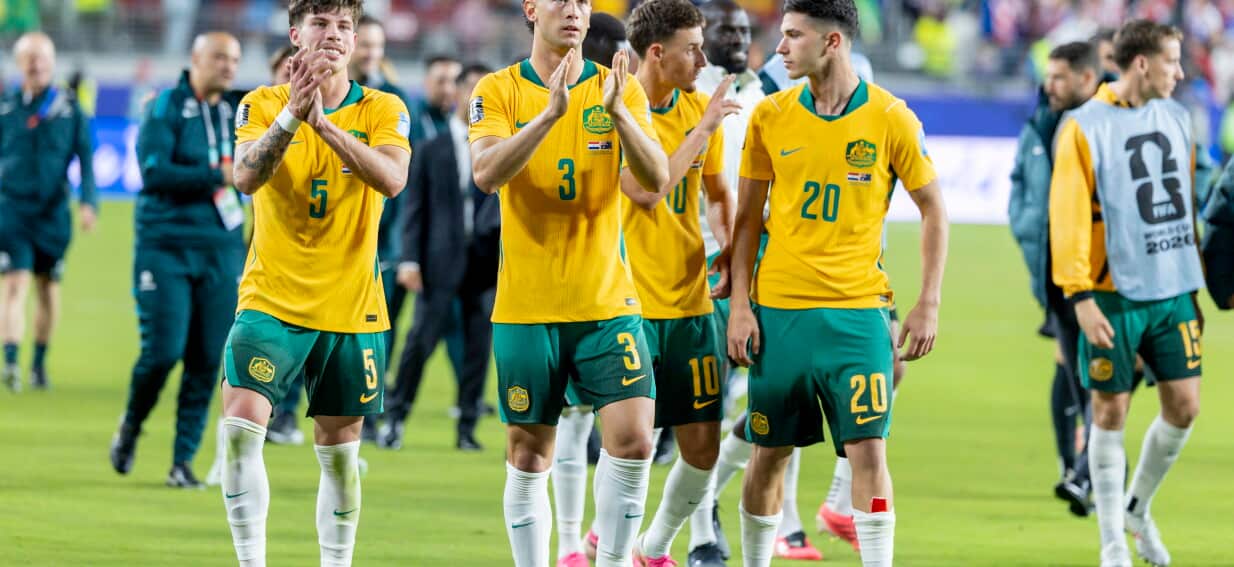
The Socceroos have defied external expectations to book a high-stakes World Cup round of 16 date against Egypt following a chaotic final day in Group G. While casual observers will view Australia’s progression as a triumph of sheer willpower, the reality is far more calculated. This advancement was engineered through a rigid, risk-averse tactical system that prioritized structural defensive integrity over aesthetic appeal, exposing the limitations of opponents who relied too heavily on individual brilliance rather than collective shape. Australia managed to navigate the group stage by suffocating the space in their own defensive third and striking with clinical precision when transition opportunities arose.
Now, the focus shifts to a knockout match that presents a fascinating contrast in football philosophies. Egypt brings a distinct blend of elite individual attacking talent and deep tournament experience, offering a completely different tactical puzzle than the ones Australia solved in the group stage.
The Blueprint of Functional Football
To understand how Australia reached the knockout rounds, one must look past the emotional post-match celebrations and examine the underlying numbers. The Socceroos did not dominate possession in Group G. Instead, they actively surrendered the ball, averaging just 41 percent possession across their three group matches.
This was not a mistake. It was a deliberate strategy designed to minimize the risk of being caught out of position. By dropping into a compact mid-block that occasionally reverted to a deep 5-4-1 defensive shape, Australia denied their group opponents the vertical space needed to exploit them through the middle of the pitch.
The strategy relies heavily on horizontal discipline. The two defensive lines of four or five players move in unison, sliding toward the flank where the ball is located while the opposite-side winger drops back to cover the space behind the central midfielders. This approach forces opponents out wide, where the touchline acts as an extra defender.
Once the ball is forced into these wide areas, the Australian full-backs look to engage in physical duels, supported immediately by a tracking midfielder. It is exhausting, unglamorous work that requires peak physical conditioning and absolute concentration. A single mental lapse breaks the chain, but throughout Group G, the discipline held.
Overcoming the Creative Deficit
While defensive solidity secured the necessary points, Australia’s lack of a traditional, elite playmaker remains a significant vulnerability. In modern international football, teams that sit deep often struggle to transition into attack because the distance between their low defensive block and the opponent's goal is too great.
Australia bypassed this issue by targeting specific zones during transitions. Rather than attempting intricate passing combinations through a crowded midfield, the Socceroos utilized direct diagonal balls to the channels behind the opponent's advancing full-backs.
This directness serves two purposes. First, it immediately moves the point of attack away from Australia's defensive half, reducing the risk of a dangerous turnover close to their own goal. Second, it forces the opponent's central defenders to turn around and run toward their own goal, a physical action that disrupts defensive organization and creates chaotic, second-ball scenarios.
Australia's goals in the group stage originated almost entirely from these moments—scrappy sequences born from long diagonals, high pressing immediately after losing the ball in the final third, and meticulously drilled set-pieces. It is a functional style dictated by the profile of the current squad, which lacks a generational talent but possesses an abundance of athletic, disciplined runners.
The Egyptian Contrast
Egypt presents a completely different challenge than the European and South American sub-plots Australia faced in Group G. The North African giants are comfortable playing without the ball themselves, often employing a counter-attacking structure that mirrors Australia's defensive patience.
However, Egypt possesses a critical advantage that Australia lacks: world-class individual execution in tight spaces. When Egypt recovers the ball, they do not just clear it into channels; they look to isolate their elite wide forwards in one-on-one situations against opposition full-backs.
The Isolation Trap
Australia’s defensive system will face its ultimate test against this isolation tactic. In the group stage, Australian full-backs received constant cover from their midfielders. Egypt's tactical setup is designed precisely to pull those covering midfielders away from the flanks by utilizing late, central runs from deep-lying players.
If Egypt succeeds in drawing Australia's central midfielders out of the middle to help on the wings, space opens up directly in front of the Australian penalty box. This is the zone where knockout matches are won or lost, and Australia cannot afford to leave it unprotected.
Managing the Tempo
The midfield battle will likely dictate the nature of this match. Egypt excels at slowing the tempo of the game to a crawl, drawing fouls, and neutralizing the physical intensity that teams like Australia rely on.
If the Socceroos allow the match to become a stop-start affair, they play directly into Egypt's hands. Australia must find a way to maintain a high physical tempo during defensive phases without overcommitting bodies forward and leaving themselves exposed to the very counter-attacks Egypt uses to punish impatient opponents.
The Reality of Knockout Football
In the knockout rounds, the margin for error vanishes entirely. Teams can no longer rely on a favorable goal difference or a slip-up from another team in the group to save them. A single defensive error, a poorly timed tackle inside the penalty area, or a wasted opportunity from a set-piece sends a team home.
Australia’s pragmatic approach is built precisely for this environment. They are entirely comfortable playing in tight, low-scoring matches where a single goal decides the outcome.
The danger lies in conceding first. When a team built on a low defensive block falls behind, they are forced to alter their tactical identity. They must push players forward, open up spaces, and dictate the tempo of the game—actions this Australian squad is historically less equipped to perform.
The first 20 minutes against Egypt will reveal whether the Socceroos can impose their physical will on the match or if they will be forced into an expansive style of play that plays directly into the hands of Egypt’s elite transition attackers.
Replicating the Group G Chaos
To destabilize Egypt, Australia must replicate the high-variance situations that allowed them to scramble through Group G. This means maximizing every single set-piece opportunity, long throw-in, and corner kick.
In open play, Egypt's defensive organization is notoriously difficult to break down, but they have shown vulnerability when defending crowded penalty areas during dead-ball situations. Australia must use their superior average height and physical power to turn every set-piece into a chaotic scramble inside the Egyptian six-yard box.
This requires precise delivery from wide areas and aggressive, coordinated runs to the near post to disrupt the zonal marking schemes Egypt favors. It is not sophisticated football, but it is highly effective tournament football.
The Socceroos did not reach the round of 16 by trying to emulate the fluid passing styles of the world's elite nations. They reached this stage by embracing their identity as a disciplined, physically imposing unit that punishes opposition mistakes while refusing to make any of their own.
The Structural Burden on the Double Pivot
A significant portion of the tactical burden against Egypt will fall upon Australia's two central defensive midfielders. In the 4-2-3-1 or 4-4-2 shapes Australia utilizes, these two players act as the shield for the central defenders.
They must navigate a delicate balancing act throughout the 90 minutes. They cannot drop so deep that they allow Egypt's midfielders time and space to look for chipped passes over the top, yet they cannot press so high that they leave a massive gap between themselves and their own backline.
Against Egypt's specific attacking rotation, these two midfielders must communicate constantly with the central defenders to hand off marking assignments seamlessly. When an Egyptian forward drops deep to pick up the ball, an Australian center-back must resist the urge to follow them up the pitch, as doing so creates a hole that Egypt's inverted wingers are trained to exploit instantly with diagonal runs from the outside in.
Maintaining this structural rigidity under the intense pressure of a World Cup knockout match is what separates genuine contenders from teams that merely make up the numbers. Australia has proven they have the discipline to execute this game plan for 90 minutes; doing it under the psychological weight of single-elimination football is the next step in their development.