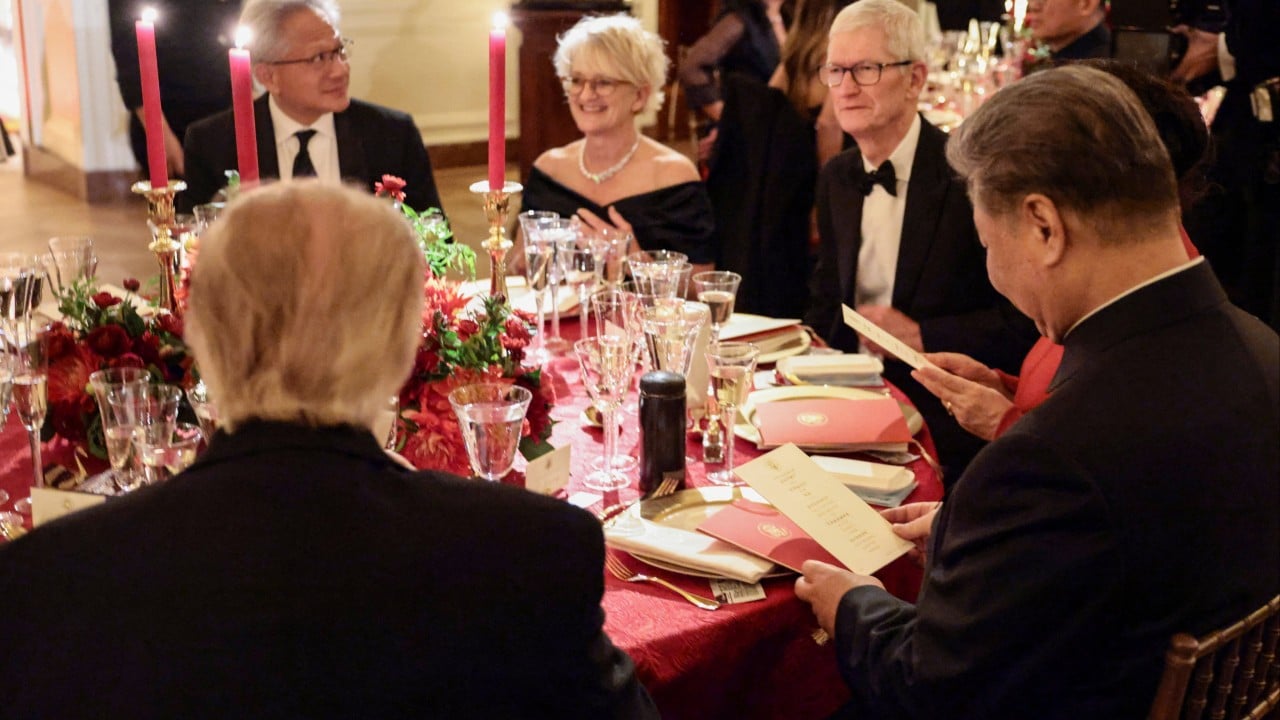
Silver clinked against fine china inside the White House dining room, but the real weight in the air had nothing to do with cutlery.
Outside, Washington was a blur of cold rain and hurried security details. Inside, two men sat down across from a spread designed to impress, soothe, or intimidate. Xi Jinping and Donald Trump. A dinner that the press corps reduced to soundbites and stock photo galleries, yet a room heavy with the kind of quiet that precedes a storm.
We forget that geopolitics is fundamentally human. We talk about tariffs as if they are weather patterns moving across a map, and about trade deficits as if they were abstract scratches on a spreadsheet. But sit at that table for a moment. Imagine the smell of the roast, the amber glint in the glasses, the rehearsed smiles that don't quite reach the eyes. Watch how two leaders of opposing superpowers size each other up between courses. One carries the mandate of a rising civilization confident in its long, historical arc. The other carries the mercurial energy of a populist billionaire convinced that every interaction is a negotiation won or lost.
Dinner is never just dinner when the stakes are measured in trillions of dollars and millions of jobs.
Consider what happened before the first glass was lifted. The delegations had spent months locking horns in Geneva, Beijing, and Washington. Bureaucrats had chewed through thousands of pages of text, arguing over intellectual property rights, soybean quotas, and currency manipulation. Every single line of those documents represented a real human cost. A factory floor falling silent in the Rust Belt. A tech startup in Shenzhen wondering if its market access would vanish overnight. A shipping container idling off the coast of California because the paperwork got tangled in a diplomatic standoff.
Yet, diplomacy at the highest level often defies the spreadsheets. It comes down to chemistry, ego, and the desperate hope for a win that can be broadcast home by morning.
When the cameras finally cleared and the heavy doors clicked shut, the performance ended and the actual work began. Trump, who has always viewed deal-making as a personal test of dominance, leaned across the white tablecloth. Xi, deliberate, patient, steeped in the bureaucratic endurance of the Chinese Communist Party, listened.
There is a profound vulnerability in that room that rarely makes the evening news. Neither man can afford to look weak. To blink first is to invite domestic political peril. Trump faces a relentless cycle of media scrutiny and a restless base that demands constant economic validation. Xi commands a massive, rapidly modernizing nation navigating an economic slowdown, real estate debt, and a skeptical global community. They are both prisoners of their own success.
And so, they ate. They talked. They traded barbs wrapped in polite diplomatic phrasing.
To understand why this evening matters, look past the headlines about trade truces and temporary suspensions of escalation. Look at the psychology. When two leaders break bread, they are performing an ancient ritual of mutual recognition. They are acknowledging that, for all the ideological distance between Beijing and Washington, total economic decoupling is a mutual suicide pact.
The immediate aftermath of that White House dinner revealed a familiar rhythm. Optimism surged on Wall Street. Stock futures ticked upward. Pundits declared a breakthrough. But anyone who has watched this dance before knows the truth. A dinner does not rewrite structural competition. A shared meal cannot dissolve decades of strategic mistrust, technological rivalry, and fundamentally incompatible visions of global order.
It simply buys time.
And time, in the grand chessboard of international relations, is the most valuable currency of all.
Think about the workers on both sides of the Pacific. In a soybean farm in Iowa, a grower looks out over his fields, wondering if the cargo ships will keep coming. In a manufacturing plant in Guangdong, an assembly line worker checks her phone for news of a tariff waiver that might secure her overtime pay for the next quarter. They are the invisible anchors of this entire spectacle. The dinner at the White House was supposed to be about them, yet they were as distant from that mahogany table as the moon.
That is the hidden cost of summit diplomacy. It personalizes power while anonymizing its consequences.
When the dessert plates were cleared and the motorcades roared back into the rainy night, the grand architecture of global capitalism remained entirely intact. The grievances were still deep. The ambitions were still clashing. But the temperature in the room had dropped just enough to keep the machinery turning.
History is rarely made in a single explosive moment. More often, it is forged in the quiet spaces between bites, in the unspoken agreements to keep talking even when the words ring hollow. The White House dining room went dark again, but the table remains set. And the world waits for the next course.