In the scorched corridors of Khartoum and the sprawling dust-choked camps of Darfur, sexual violence has ceased to be a byproduct of war and has instead become its primary engine. This is not a series of isolated crimes committed by rogue soldiers. It is a calculated, systematic strategy designed to shatter the social fabric of Sudan. International charities and local responders now describe a reality where rape is woven into the architecture of daily life, used by warring factions to displace populations, punish ethnic groups, and consolidate territorial control. While the global gaze shifts toward other geopolitical flashpoints, Sudan’s conflict has devolved into a campaign where the human body is the most contested battlefield.
To understand why this is happening, one must look past the superficial headlines of "chaos" and "tribalism." The current war between the Sudanese Armed Forces (SAF) and the Rapid Support Forces (RSF) is a fight for the state itself, and in such a fight, the total demoralization of the citizenry is a tactical objective. By targeting women and girls, the perpetrators aim to destroy the "honor" of families and communities, forcing them to flee their homes and never return. It is a low-cost, high-impact weapon of war that leaves scars long after the bullets stop flying.
The Logistics of Terror
The mechanics of this violence are terrifyingly predictable. In areas under the control of the RSF—a paramilitary group born from the Janjaweed militias—survivors report a pattern of home invasions and checkpoints where sexual assault is the price of passage. This isn't just about physical dominance. It is about a complete takeover of the private sphere. When a house is raided, the objective is rarely just theft; it is the permanent psychological occupation of the residents.
Reports from medical staff on the ground—who are often working in bombed-out clinics with zero electricity—indicate that the scale of the crisis is far larger than official numbers suggest. In a society where deep-seated social taboos surround sexual assault, for every one woman who seeks help, dozens more suffer in silence. This silence is part of the military strategy. Shame acts as a silencer, preventing the documentation of war crimes and ensuring that the victims remain isolated within their own communities.
The Failure of the Global Safety Net
International intervention has been a series of polite statements and toothless sanctions. While the UN and various NGOs sound the alarm, the actual resources reaching survivors are a pittance compared to the need. There is a massive gap between the rhetoric of "never again" and the reality of a logistics chain that cannot even get basic post-rape kits into the heart of Khartoum.
The humanitarian response is currently operating at a fraction of its required capacity. Funding for the Sudan crisis is consistently overshadowed by conflicts in Europe and the Middle East. This lack of capital doesn't just mean fewer food rations; it means a total absence of specialized psychological support and reproductive healthcare for victims who are often forced to carry pregnancies resulting from their assaults. We are witnessing the birth of a generation of children born of war, in a country that lacks the legal or social framework to protect them or their mothers.
Ethnic Cleansing by Another Name
In the Darfur region, the violence has taken on a chillingly familiar ethnic dimension. This isn't a new story, but it is a more brutal chapter. Masalit women are being targeted specifically to ensure that their ethnic group cannot maintain a presence on the land. The logic is simple and genocidal: by attacking the women, you attack the future of the tribe.
This is why the term "gender-based violence" often feels too clinical for the reality in Darfur. This is demographic engineering. When survivors describe their attackers, they often mention the racial slurs and the explicit intent to "change the bloodline" of the region. The perpetrators are not just venting frustration or acting out of a breakdown in discipline; they are following an ideology that views certain bodies as disposable and others as targets for elimination.
The Collapse of the Healthcare Infrastructure
Sudan’s doctors are among the most courageous individuals on the planet right now, yet they are being hunted. Hospitals have been occupied and turned into military barracks. Pharmacies have been looted. For a survivor of sexual violence, the first 72 hours are critical for the administration of Post-Exposure Prophylaxis (PEP) to prevent HIV and other infections. In much of Sudan, those 72 hours pass in hiding, under a bed or in a basement, while the streets outside remain a gauntlet of armed men.
The few remaining medical professionals are forced to operate in the shadows. They use encrypted messaging apps to coordinate the delivery of supplies and provide remote consultations. This underground railroad of medicine is the only thing standing between thousands of women and a slow death from infection or untreated trauma. But an underground railroad cannot replace a national health system. The destruction of Sudan's clinics is not "collateral damage"; it is a deliberate move to ensure that the civilian population has no safety net, making them more likely to flee and leave their assets behind for the taking.
The Economic Incentives of Rape
We must talk about the money. War in Sudan is a business, and sexual violence is a tool of economic displacement. When a village is targeted with systematic rape, the inhabitants flee. This leaves behind land, livestock, and gold mines—Sudan’s most precious resources. The RSF, in particular, has deep ties to the gold trade, and clearing land for extraction or grazing is much easier when the local population has been terrorized into leaving.
This is a form of primitive accumulation. The violence facilitates the transfer of wealth from the rural poor to the military elite. By analyzing the geography of the assaults, one can see a clear correlation between areas of high violence and areas of high economic value. This isn't a "senseless" war. It is a very sensible war if you are the one holding the gun and looking to seize a mine or a trade route.
The Myth of the Rogue Soldier
The SAF often claims that its soldiers are disciplined and that any abuses are the work of "uncontrolled elements." This is a convenient fiction. When sexual violence occurs across multiple fronts, involving different units over a period of months, it is a policy. The failure of the military hierarchy to prosecute its own soldiers is a tacit endorsement of the behavior. It sends a message to the rank and file that women’s bodies are part of the spoils of war.
On the other side, the RSF’s structure—built on personal loyalties and a lack of formal military law—creates an environment where atrocity is a bonding exercise for the militia. The lack of a clear chain of command is often cited as the reason for the violence, but in reality, the violence is the command. It is the method through which these groups assert their presence and prove their dominance over the territory they occupy.
The Social Cost of Displacement
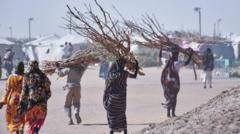
There are now millions of internally displaced persons (IDPs) in Sudan, and millions more who have crossed the borders into Chad, Egypt, and South Sudan. In these camps, the nightmare does not end. The lack of security in refugee settlements means that women are often attacked while gathering firewood or fetching water. The vulnerability of the displaced is exploited by human traffickers and local gangs, creating a secondary cycle of abuse that is just as devastating as the initial conflict.
The social fabric of Sudan is being rewoven into a pattern of permanent trauma. Children are growing up in environments where violence is the only constant. The elders, who traditionally served as the moral compass and the adjudicators of justice, find themselves powerless against teenagers with Kalashnikovs. This generational rupture is perhaps the most lasting damage of the war. How do you rebuild a nation when the very concept of trust has been methodically liquidated?
The Legal Void
The International Criminal Court (ICC) has open investigations into Darfur, but the ICC is a distant entity with no boots on the ground. Within Sudan, the legal system has effectively evaporated. There are no police to call, no judges to hear cases, and no jails to hold the guilty—unless those jails are being used to house political prisoners and activists.
This total impunity is the fuel that keeps the fire burning. If there is no consequence for the most heinous crimes imaginable, then there is no reason for the perpetrators to stop. The international community’s reliance on "monitoring" and "reporting" is an insult to the victims who need protection, not just a tally of their suffering. Data collection is not a substitute for intervention.
The Role of Local Resistance Committees
If there is any flicker of hope, it lies in the "Resistance Committees"—the grassroots networks of young people who originally organized the 2019 revolution. These groups have pivoted from political activism to survival logistics. They run "emergency rooms" that provide food, water, and basic medical care. They are the ones documenting the abuses, often at extreme risk to their own lives.
These committees represent a version of Sudan that refuses to be defined by the violence of the generals. They are the only legitimate authority left in many neighborhoods, and they are doing the work that the billion-dollar international aid industry has failed to do. However, they are exhausted, underfunded, and targeted by both the SAF and the RSF. Supporting these local actors is not just a moral imperative; it is the only practical way to ensure that any aid actually reaches the people who need it most.
The Silence of the Neighbors
Sudan’s neighbors have a complicated relationship with the conflict. Many are hosting refugees, but others are fueling the war by providing weapons and logistical support to their preferred faction. The flow of arms into Sudan is a direct contributor to the scale of the sexual violence. More guns mean more checkpoints, more raids, and more opportunities for abuse.
The regional powers are playing a high-stakes game of chess, using Sudan as the board. For them, the suffering of Sudanese women is a secondary concern to the preservation of their own strategic interests. Until the cost of supporting the warring factions outweighs the benefits, the weapons will continue to flow, and the bodies of the vulnerable will continue to be the primary currency of the conflict.
The Physical and Mental Scars
We must look at the long-term health implications of this crisis. Beyond the immediate trauma, Sudan is facing a massive surge in untreated STIs, chronic pelvic pain, and fistula cases. The psychological impact is even more profound. Post-traumatic stress disorder (PTSD) is not a strong enough term for a population that is living through a continuous, ongoing trauma.
There is a concept in psychology called "moral injury," where the betrayal of what is right by those in power leads to a deep, spiritual wounding. Sudan is a nation suffering from a collective moral injury. The people feel abandoned not just by their government, but by the world. This feeling of abandonment is a potent ingredient for future radicalization and further cycles of violence.
The Invisible Victims
While women and girls are the primary targets, we must also acknowledge the reports of sexual violence against men and boys, particularly in detention centers. This is used as a tool of torture and emasculation, designed to break the will of political opponents and suspected rebels. By broadening the scope of their violence, the warring factions ensure that no segment of society feels safe. It is total war, in the most literal and horrific sense.
The use of sexual violence against men is even more underreported than violence against women, due to the extreme stigma and the risk of further persecution. It serves as a stark reminder that this is not a crime of passion or a "lapse in judgment" by soldiers. It is a calibrated instrument of statecraft and militia-craft.
A Crisis of Will
The situation in Sudan is not a mystery. We know who the perpetrators are, we know where the violence is happening, and we know why it is being used. What is missing is the political will to treat this as a global emergency rather than a localized tragedy. The international community has perfected the art of the "deep concern" press release while doing nothing to disrupt the financial networks that keep the generals in power.
Every day that the world waits for a "political solution," more lives are destroyed. The peace talks in Jeddah and elsewhere have consistently failed because they prioritize the demands of the men with guns over the needs of the people they are killing. Real peace cannot be built on a foundation of impunity.
The Path Forward
The first step is to stop treating the SAF and the RSF as legitimate political actors and start treating them as the heads of criminal enterprises. This means aggressive, coordinated sanctions that target the gold trade and the banking channels used by the military elite. It means providing direct, unconditional support to the local Resistance Committees and medical networks that are actually doing the work on the ground.
Beyond the economics, there must be a physical protection mechanism. Whether through an African Union-led force or a UN peacekeeping mission with a robust mandate, the civilians of Sudan need more than just bags of grain; they need a space where they are not hunted. The "everyday life" of sexual violence must be broken by force, because it will not be stopped by persuasion.
Sudan is a warning. It shows what happens when the international order decides that a conflict is too complicated or too "peripheral" to solve. It shows how the human body can be repurposed as a tool of war when there are no consequences for the abusers. The women of Sudan are not just victims; they are the witnesses to a global failure. Their survival is the only true measure of our collective humanity, and right now, we are failing the test. Stop looking away.