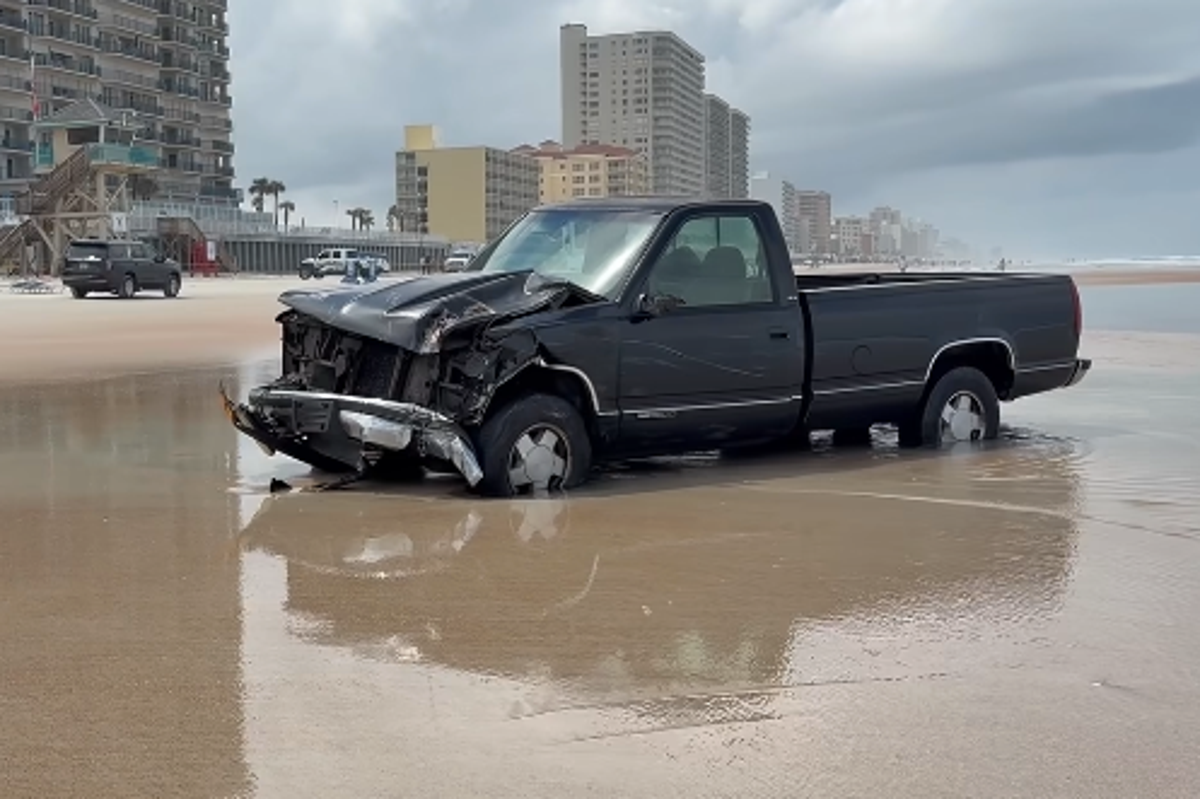
The fatal collision involving a commercial vehicle and a toll collection structure on a Florida highway exposes a systemic flaw in highway design: the reliance on active driver compliance rather than passive physical barriers to protect roadside personnel. Media coverage typically treats these events as isolated traffic accidents caused by driver error. However, a structural analysis reveals that these incidents are the predictable output of a failure in infrastructure isolation. When a high-mass kinetic vehicle intersects with a fixed, low-mass workspace, the energy transfer guarantees catastrophic structural failure and high mortality rates.
To systematically mitigate these risks, infrastructure engineering must move past the assumption of driver attentiveness and instead analyze toll plazas through the lens of kinetic energy containment, channelization geometry, and automated enforcement decoupling.
The Kinematics of Toll Plaza Collisions
The severity of a vehicle-to-structure impact is governed by the laws of classical mechanics, specifically the transfer of kinetic energy ($E_k$) defined by the formula:
$$E_k = \frac{1}{2}mv^2$$
In this equation, mass ($m$) and velocity ($v$) dictate the destructive potential of an oncoming vehicle. Because velocity is squared, minor increases in speed yield exponentially higher kinetic energy outputs.
When a commercial truck approaches a toll plaza, several variables alter the risk profile:
- Mass Differential: A standard passenger vehicle weights approximately 4,000 pounds, whereas a fully loaded commercial motor vehicle can weigh up to 80,000 pounds. This twenty-fold increase in mass fundamentally changes the structural requirements for containment barriers.
- Energy Dissipation Deficit: Toll booth structures are traditionally designed for weather protection, not impact resistance. Standard aluminum or fiberglass booths possess near-zero structural capacity to absorb or deflect kinetic energy, meaning the booth itself compresses upon impact, accelerating the deceleration forces experienced by the occupant.
- The Deceleration Vector: In a secure environment, barriers redirect vehicles parallel to the flow of traffic. In poorly channelized plazas, vehicles strike booths at perpendicular or oblique angles, forces that maximize energy transfer directly into the workspace.
The Three Pillars of Toll Plaza Vulnerability
Evaluating the safety of a roadside collection point requires analyzing three distinct operational pillars: Geometric Channelization, Structural Hardening, and Operator Exposure Time.
Geometric Channelization
The physical layout of a toll plaza dictates the approach behavior of incoming traffic. Traditional plazas feature a wide, fan-shaped approach that constricts into narrow lanes. This design introduces several failure points.
First, it forces drivers to make rapid lane-selection decisions under time pressure, increasing the cognitive load. Second, the abrupt transition from open highway speeds to localized bottlenecks creates a high-variance velocity environment where trailing vehicles frequently misjudge the deceleration rate of leading traffic. Third, if a vehicle experiences brake failure or driver incapacitation on the approach, the tapering geometry funnels the out-of-control mass directly into the collection islands.
Structural Hardening
Most legacy toll islands rely on a standard concrete curb, usually six to eight inches high, as the primary defensive barrier. While sufficient to redirect a low-speed passenger car executing a minor drift, these curbs act as launching ramps rather than deflectors when struck by large vehicles at highway speeds.
The absence of crash cushions (attenuators) at the upstream nose of the toll island represents a critical engineering gap. Without these sacrificial energy-absorbing systems, the rigid concrete island and the booth itself must absorb the entirety of the impact forces, leading to catastrophic fragmentation.
Operator Exposure Time
The risk function for a toll booth worker is directly proportional to human exposure hours within the impact zone. Legacy manual collection systems require human operators to remain inside a high-risk perimeter for eight-to-twelve-hour shifts.
Risk Index = Exposure Time × Traffic Volume × Velocity Variance
The presence of a human asset within the physical path of unshielded traffic runs counter to modern industrial safety principles, which dictate that hazards should be engineered out of the environment rather than managed through behavioral compliance.
Systemic Failure Mechanisms in Traditional Plazas
The breakdown of safety at a toll plaza typically follows a compounding trajectory where multiple minor system failures lead to a catastrophic event.
[Driver Distraction/Mechanical Failure]
               │
               ▼
[Inadequate Channelization / Velocity Variance]
               │
               ▼
[Deficient Upstream Attenuation (Low-Impact Curbs)]
               │
               ▼
[Structural Collapse of Unhardened Collection Booth]
The primary failure mechanism begins with a loss of vehicular control, frequently induced by distracted driving, operator fatigue, or mechanical braking failures. Once control is compromised, the infrastructure must act as the secondary fail-safe.
If the upstream approach lacks high-containment rolling barriers or stepped jersey barriers, the vehicle enters the toll lane unobstructed. The narrow width of standard toll lanes prevents evasive steering maneuvers, locking the vehicle onto a collision course with the collection booth. Upon contact, the unhardened booth suffers immediate structural deformation, collapsing the internal workspace and pinning the occupant.
Strategic Interventions and Infrastructure Modernization
Addressing these structural vulnerabilities requires a capital allocation strategy focused on removing human assets from high-risk zones and upgrading physical containment systems.
Accelerated All-Electronic Tolling (AET) Deployment
The most effective method for eliminating toll booth fatalities is the complete removal of the physical booth. Transitioning to All-Electronic Tolling removes human operators from the roadway entirely, shifting revenue collection to overhead gantry systems equipped with automated license plate recognition (ALPR) and radio-frequency identification (RFID) transponders.
This structural shift transforms the risk profile of the highway segment:
- Velocity Stabilization: AET eliminates the need for vehicles to decelerate or change lanes abruptly, removing the primary catalyst for rear-end and merging collisions.
- Asset Relocation: Human labor is moved from high-risk roadside booths to secure, climate-controlled remote data centers, dropping the operator exposure time variable to zero.
- Infrastructure Reduction: Removing concrete islands and booths widens the clear zone of the highway, providing out-of-control vehicles with adequate recovery areas.
Retrofitting Legacy Sites with High-Containment Barriers
For jurisdictions where immediate AET conversion is financially or politically unfeasible, legacy plazas must undergo structural hardening. This involves installing MASH (Manual for Assessing Safety Hardware) TL-4 or TL-5 rated crash cushions at the nose of every toll island.
These systems use compressible steel chambers or fluid-filled cylinders to systematically dissipate kinetic energy, slowing an errant vehicle over a controlled distance and reducing peak deceleration forces to survivable levels. Additionally, heavy-duty steel bollards anchored deep into the sub-base must be installed directly in front of the booth structures to act as a definitive physical block against high-mass vehicles.
Implementation Bottlenecks and Limitations
Deploying these interventions involves clear trade-offs. Converting to an entirely electronic system requires significant upfront capital expenditure for gantry construction, sensor integration, and back-end software development. Furthermore, AET systems introduce revenue leakage risks through unreadable license plates, out-of-state billing friction, and uncollected debt collection costs.
In contrast, retrofitting existing plazas with structural barriers is less capital-intensive but maintains the fundamental flaw of keeping human workers in close proximity to moving traffic. Hardened barriers can also increase the severity of injuries sustained by the occupants of the striking vehicle, shifting the liability profile from the infrastructure operator to the motoring public.
Technical Specifications for Next-Generation Infrastructure
Future highway designs must treat toll collection zones as high-hazard industrial environments. The table below outlines the engineering shifts required to transition legacy facilities into modernized, low-risk corridors.
| Engineering Vector | Legacy Infrastructure Specification | Next-Generation Standard |
|---|---|---|
| Primary Barrier Type | 6-inch vertical concrete curb | MASH TL-5 Rated Jersey Barrier |
| Energy Absorption | Rigid island nose (zero dynamic deflection) | SAC (Smart Cushion) Attenuator systems |
| Lane Geometry | Fan-shaped approach with high-angle constriction | Linear, single-option channelization corridors |
| Data Collection Method | Manual cash/card handling via human operator | Overhead multi-spectral gantry arrays |
| Clear Zone Buffer | Less than 5 feet of lateral clearance | Minimum 30-foot unobstructed recovery zone |
Definitve Systemic Realignment
Operating agencies must stop categorizing toll booth impacts as behavioral anomalies to be solved with better driver education or increased signage. The physics of highway transit dictate that driver error will occur continuously across a statistically significant sample size. Therefore, the infrastructure must be engineered to forgive the error without sacrificing human life.
The immediate tactical requirement for transportation departments is to conduct an inventory-wide kinetic risk assessment of all manual collection points. Plazas failing to meet modern energy-attenuation standards must either be retrofitted with deep-anchor bollard systems within the next fiscal cycle or prioritized for immediate decommissioning in favor of overhead electronic gantries. Continuing to place manual operators inside unhardened structural targets in high-velocity zones represents an unmanageable operational liability.