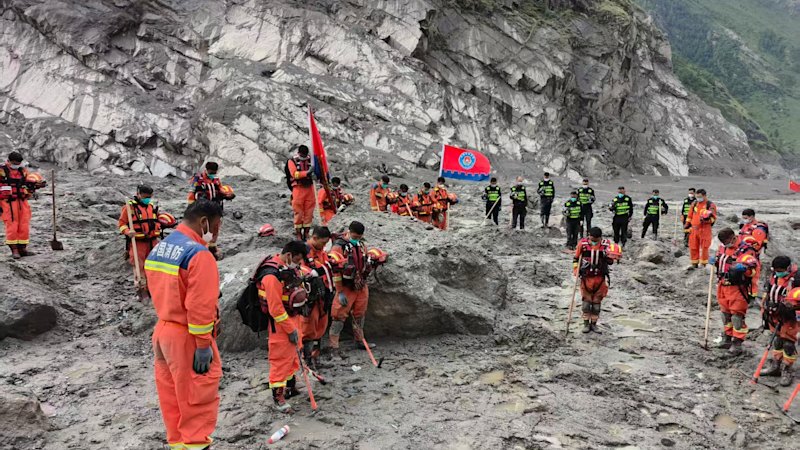
Crisis communication in high-stakes border regions operates under distinct protocols that prioritize institutional stability over unrestricted transparency. When a catastrophic glacial surge and subsequent flash flood devastated the Nepal-Tibet border zone, the immediate operational response by state authorities was matched by a sophisticated digital curation strategy. Rather than interpreting this information management solely through the emotional lens of concealment, a structural analysis reveals an intentional system designed to mitigate civil panic, protect strategic infrastructure narratives, and project operational competence.
The mechanism governing this environment relies on three distinct operational pillars: physical containment, digital friction, and narrative saturation.
The Geography of Physical Friction
Geographic isolation serves as the primary barrier to independent verification. The affected zone within Tibet—specifically around Gyirong County and the border port—exists within a heavily restricted administrative perimeter. Unlike standard domestic tourism or commercial transit zones, entry into the Tibet Autonomous Region requires specialized travel permits and pre-approved itineraries that apply equally to domestic and foreign actors.
This structural restriction creates a permanent logistical bottleneck for independent journalism:
- Access is bottlenecked by authorization gates managed at regional and national security levels.
- Telecommunications infrastructure in high-altitude mountain passes is inherently fragile, prone to immediate severance during seismic or hydrological events.
- Local populations operate under well-established legal and social frameworks that penalize unauthorized dissemination of sensitive operational media.
Consequently, any assessment of the damage relies almost entirely on state-sanctioned channels because independent observers cannot physically bypass these administrative and physical constraints without incurring severe legal and operational penalties.
The Economics of Digital Curation
The shift from blanket blackouts to high-tech content moderation marks a significant evolution in information management. When raw footage of the Gyirong Port disaster surfaced on domestic social media platforms, it bypassed initial automated text-based filters because it contained no prohibited keywords or overt political slogans.
The response by platforms demonstrated an advanced technical architecture:
- Automated video fingerprinting and image hashing identified the visual characteristics of the collapsed border infrastructure within hours.
- Content containing specific structural markers, such as national gates or damaged public works, was intercepted prior to widespread peer-to-peer distribution.
- Algorithms suppressed trending hashtags that connected the disaster timeline to recent infrastructure development or engineering maintenance schedules.
This digital curation functions as an economic shield for the state. By intercepting viral organic media, authorities prevent the formation of localized digital mobs and stop speculative narratives regarding structural integrity from destabilizing public confidence.
Narrative Saturation and Operational Substitution
An information vacuum threatens institutional legitimacy. To prevent public panic or external speculation from filling the void, authorities deploy a strategy of narrative saturation. This approach floods domestic channels with high-resolution, sterile, and highly structured official content before independent narratives can take root.
State-controlled media channels systematically emphasize specific operational metrics:
- Rapid deployment figures for military engineering units, emergency medical teams, and heavy excavation machinery.
- Aerial drone footage showcasing precise structural mapping and scientific explanations focusing exclusively on natural glacial collapses.
- Direct attribution of relief efforts to top-level political directives, framing the response through a lens of total institutional mobilization.
By substituting raw, chaotic citizen journalism with orderly visual records of recovery efforts, the administrative apparatus satisfies the public demand for information while simultaneously directing attention away from local infrastructure vulnerabilities.
Strategic Forecast for Cross-Border Information Management
Future environmental crises in politically sensitive borderlands will encounter identical administrative responses. As monitoring technology advances, the capacity for automated visual censorship will outpace the ability of external actors to verify on-the-ground realities independently. Observers analyzing these regions must evaluate state-released metrics not as absolute ground truth, but as controlled outputs of an optimized risk-mitigation system designed to protect state authority above all else.