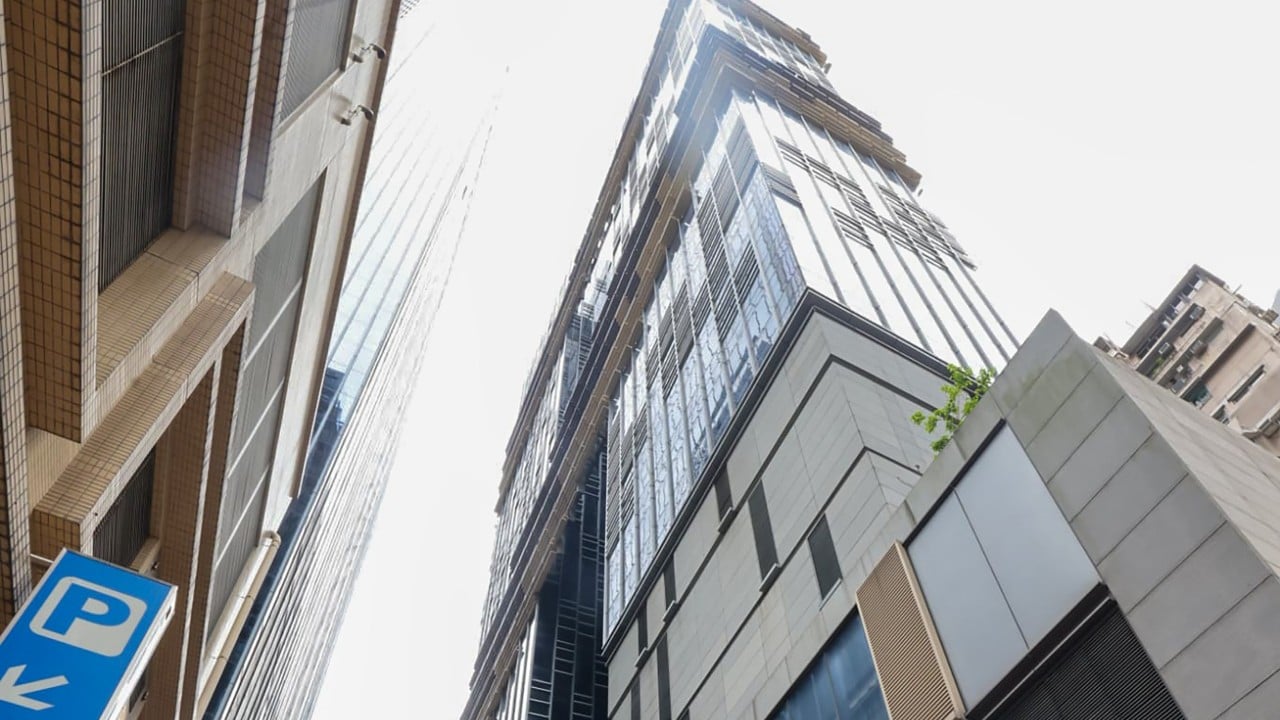
The physical reality of high-density urban environments creates a vertical risk profile that is rarely quantified until a catastrophic failure occurs. In the recent incident at a luxury hotel in Hong Kong, the transition of a human mass from a high-altitude pool deck to a crowded pedestrian thoroughfare represents a critical intersection of structural safety, kinetic energy transfer, and urban density hazards. Analyzing this event requires a departure from emotional reporting and an entry into the mechanics of gravitational potential energy and the failure of secondary containment systems.
The Kinematics of Vertical Descent in High-Density Zones
The severity of an incident involving a fall from height is governed by the conversion of gravitational potential energy into kinetic energy. For a human body falling from a significant elevation—such as a pool deck situated dozens of stories high—the impact force is not merely a function of weight but an exponential product of velocity.
The velocity ($v$) of the falling object can be modeled by the equation:
$$v = \sqrt{2gh}$$
Where $g$ is the acceleration due to gravity and $h$ is the height of the fall. At heights exceeding 100 meters, a body approaches terminal velocity, creating an impact force capable of shattering structural glass, deforming metal street furniture, and causing massive blunt force trauma to secondary targets.
In this specific case, the "plunge" was not a contained event. The primary fatality—the individual who fell—acted as a high-velocity projectile. The seven injuries reported on the ground level resulted from the transfer of this kinetic energy through two distinct mechanisms:
- Direct Contact Transfer: The immediate physical collision between the falling mass and individuals on the ground.
- Secondary Projectile Generation: The fragmentation of architectural elements (glass railings, concrete chips, or decorative fixtures) struck during the descent or upon impact, which then accelerated outward into the crowd.
The Failure of Perimeter Containment Systems
Luxury hotel pool decks are designed with a primary focus on aesthetics and "infinity" views, often utilizing glass balustrades or recessed gutters to minimize visual obstruction. From a safety engineering perspective, these structures must serve as a definitive barrier against both accidental and intentional falls. A breach of this perimeter suggests a breakdown in one of three safety layers:
Static Barrier Integrity
Most urban building codes require railings to withstand specific horizontal loads. In Hong Kong, these standards are rigorous due to typhoon-level wind requirements. However, static strength does not always account for dynamic, concentrated loads. If a barrier is designed to resist wind but not a sudden, focused impact at a specific height—such as a person leaning or climbing—the system fails.
Human Factors and Ergonomic Access
The height of the barrier relative to the center of gravity of the average adult is the most critical metric in preventing accidental over-toppling. When furniture (loungers, tables) is placed in proximity to the perimeter, it effectively lowers the relative height of the barrier, creating a "stepping stone" effect that bypasses the engineering intent of the railing.
Behavioral Redundancy
High-risk vertical zones often lack "catchment" logic—secondary ledges or netting systems that exist in industrial settings but are omitted in luxury hospitality due to "visual pollution." The absence of a secondary tier of protection means that once the primary perimeter is breached, the outcome is binary: a total descent to the ground.
Urban Geometry and the Multiplier Effect of Injury
The fact that one fall resulted in eight total casualties (one fatal, seven injured) highlights the danger of "Impact Corridors" in cities like Hong Kong. The probability of a falling object striking a secondary target is directly proportional to the population density ($D$) and the "scatter radius" ($R$) of the impact.
In a sparsely populated area, $D$ is near zero, and a fall results in a single fatality. In the Tsim Sha Tsui or Central districts of Hong Kong, $D$ is among the highest in the world. The impact zone at the base of a skyscraper is a high-traffic artery where the "scatter radius" includes:
- Pedestrians: Individuals within a 5-to-10-meter radius of the primary impact.
- Structural Debris: Glass shards from shattered awnings or street lamps.
- Biological Hazards: The immediate site of impact becomes a biohazard zone, requiring specialized cleanup and potentially causing psychological trauma to large numbers of witnesses.
This incident exposes a flaw in urban planning: the lack of "overhead protection" in zones immediately adjacent to high-rise leisure decks. While construction sites require catch-fans and hoardings, completed luxury buildings often operate with zero ground-level mitigation for falling objects.
Operational Risk Management for Hospitality Infrastructure
For stakeholders in the hospitality and commercial real estate sectors, this event serves as a lead indicator of latent liability. The "it hasn't happened yet" defense is legally and ethically unsustainable in the face of demonstrable kinetic risks.
The Hierarchy of Mitigation for High-Altitude Decks:
- Physical Hardening: Replacing standard glass balustrades with higher-gauge, inward-curving barriers that make climbing or leaning over significantly more difficult.
- Proximity Buffering: Establishing a mandatory "no-go zone" for furniture. No movable object should be within 2 meters of a perimeter railing to prevent it from being used as a platform.
- Sensor Integration: Utilizing LIDAR or AI-driven camera systems to trigger alarms when a mass crosses the threshold of a railing. This provides a narrow window for intervention and, at the very least, provides data for post-incident forensic analysis.
- Pedestrian Deflection: Installing reinforced glass canopies or reinforced awnings at the street level of buildings with rooftop public spaces. These structures are designed to decelerate falling debris and protect ground-level occupants.
Psychological Contagion and Site Stigma
Beyond the physical mechanics, the "death from height" event creates a long-term "site stigma" that affects the valuation of the asset. In real estate economics, a high-profile fatality on-site can lead to a significant drop in RevPAR (Revenue Per Available Room) as the location becomes associated with tragedy. This is particularly true in cultures where specific locations are avoided following "unnatural deaths."
The strategy for the property management must shift from reactive PR to structural transparency. This involves public-facing safety audits and visible upgrades to the perimeter. Obscuring the event or treating it as a freak accident ignores the systemic reality: if a human can reach the edge, a human can go over the edge.
Structural Assessment of Ground-Level Vulnerability
The seven injuries on the ground level suggest that the impact occurred in a high-flow pedestrian zone with zero overhead shielding. Future urban development in high-density corridors must treat the "Vertical Drop Zone" as a regulated safety area. This requires a shift in how we view the sidewalk. Instead of being an open space, sidewalks at the base of skyscrapers with leisure facilities must be treated as "High-Energy Impact Zones."
Structural engineers must now calculate the "Falling Mass Potential" for every skyscraper. If a building has a pool at level 60, the ground-level infrastructure—bus stops, subway entrances, and walkway covers—must be rated to withstand the impact of a 100kg mass at terminal velocity. Anything less is a failure of foresight.
The immediate strategic priority for Hong Kong’s Building Department and global hospitality chains is a comprehensive audit of all "Infinity Style" perimeters. The goal is the elimination of the "Single Point of Failure" where one broken glass panel or one misstep results in a mass-casualty event on the pavement below. The engineering must move from "barrier-only" to "multi-stage mitigation."