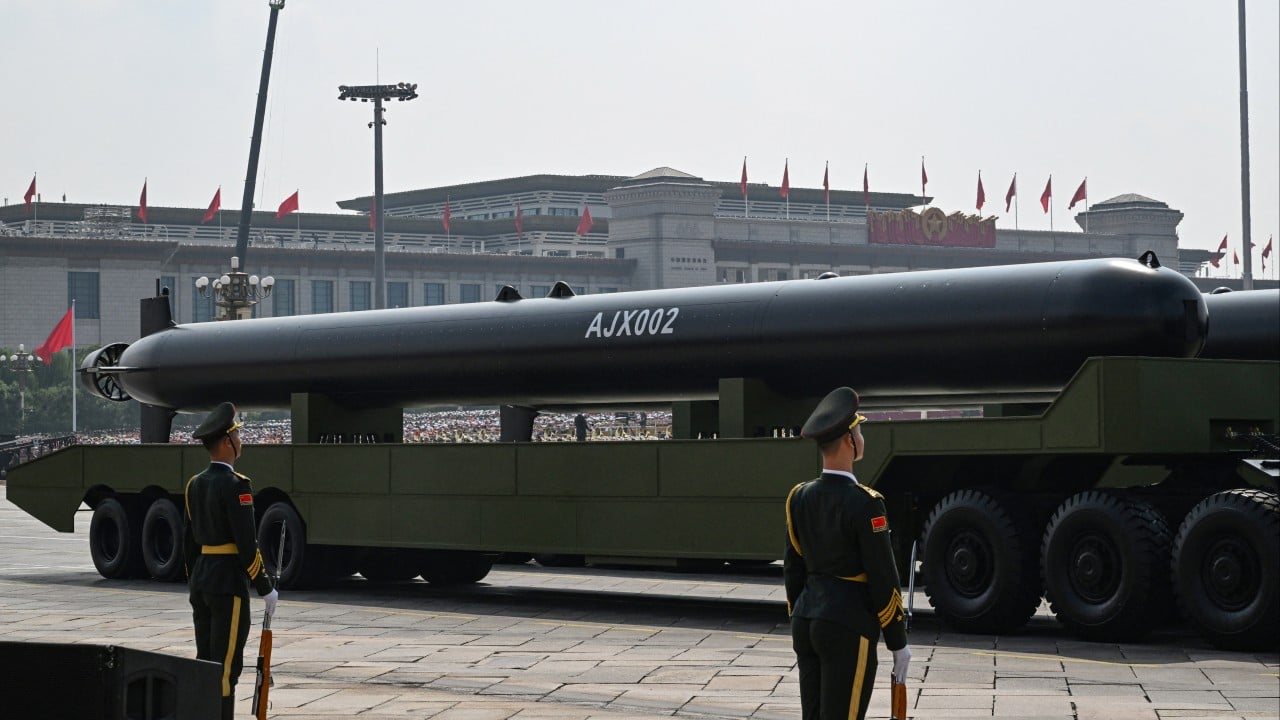
Naval architectural assessment requires moving past surface-level visual anomaly identification and into systematic evaluation of hull physics, operational constraints, and strategic payload integration. When commercial satellite imagery captures an unconventional vessel configuration at a shipyard or naval base, public discourse frequently defaults to speculative leaps regarding novel autonomous warfare platforms. The emergence of an unusual vessel design in Shanghai—widely discussed in open-source intelligence circles as a potential underwater drone mothership—demands a rigorous deconstruction of its physical architecture, hydrodynamic trade-offs, and logistics footprint rather than sensationalized capability assumptions.
Evaluating whether a specific platform functions as a dedicated deployment and recovery node for unmanned undersea vehicles requires analyzing three structural pillars: launch and recovery dynamics, internal spatial allocation efficiency, and communication-command bottlenecks in maritime environments. Without quantifiable metrics across these domains, hypotheses regarding naval capabilities remain unverified conjectures.
The Hydrodynamic and Architectural Constraints of Subsurface Motherships
Designing a surface vessel to support autonomous underwater vehicles involves resolving severe mechanical contradictions. Traditional naval vessels prioritize stability, seakeeping, and cargo capacity. A deployment platform for heavy or medium-displacement unmanned undersea vehicles, however, must incorporate large internal well decks, heavy-lift crane systems, or stern-ramp recovery mechanisms that inherently compromise hull integrity and internal volume.
A true mothership configuration requires uninterrupted internal space for three distinct operational cycles: maintenance bays, charging and data-offloading stations, and pre-launch staging areas.
- Internal Volume Allocation: Unmanned undersea vehicles possess considerable displacement. Storing multiple units requires structural reinforcement that competes with propulsion and fuel or battery bunkerage.
- Dynamic Interface Management: Recovering a subsurface vehicle in open ocean conditions creates extreme mechanical shock loads. Without dynamic positioning systems and specialized capture cages, recovery operations are restricted to calm littoral waters, severely limiting the operational radius of the deployed assets.
- Thermal and Electromagnetic Signatures: Subsurface drone operations demand high-power generation for fast-charging battery systems or servicing fuel cell power plants. This creates an elevated thermal footprint and acoustic signature, directly contradicting the low-observability doctrine typically associated with clandestine undersea warfare.
Observing an unusual hull form in a commercial or naval shipyard does not automatically validate a specialized military role. Shipyards frequently test modular barge designs, heavy-lift transport pontoons, or specialized civil engineering platforms that share visual similarities with military concepts due to convergent functional requirements.
Cost Functions and Operational Utility of Unmanned Undersea Networks
To understand why a state actor would invest in a specialized mothership, one must evaluate the economic and operational cost function governing distributed maritime surveillance and strike networks. Traditional submarine operations are constrained by human life support systems, high acquisition costs, and limited hull numbers. Deploying swarms of unmanned undersea vehicles offers a theoretical alternative to scale presence without linear personnel scaling.
However, the logistics chain required to maintain these assets introduces systemic vulnerabilities.
[Distributed UUV Fleet] --> [High-Bandwidth Line-of-Sight Data Link Bottleneck] --> [Centralized Mothership Node] --> [Strategic Command Infrastructure]
This architecture creates a single point of failure. While distributed sensors enhance area denial and surveillance persistence, a localized mothership platform coordinating them becomes a high-value, high-signature target. The cost of protecting a dedicated surface mothership in a contested environment often outweighs the asymmetric advantages gained by the unmanned assets it deploys.
Furthermore, underwater acoustic communication imposes strict bandwidth limitations. Unlike aerial drones that maintain continuous line-of-sight satellite links, undersea drones operate in an environment where electromagnetic waves attenuate rapidly. A surface mothership must bridge this gap, serving as an acoustic-to-radio frequency translation node. This requirement dictates specific antenna arrays and mast configurations that would be visible upon structural inspection.
Distinguishing Fact from Speculation in Open-Source Naval Intelligence
Analyzing open-source imagery of novel maritime platforms requires a strict adherence to evidentiary thresholds. Analysts must separate verifiable physical dimensions from functional assumptions.
- Dimensional Analysis: Measurement of length-to-beam ratios provides immediate insight into speed, stability, and theoretical payload capacity. Hull forms optimized for heavy payload transport differ fundamentally from high-speed combatants.
- Propulsion and Power Plant Indicators: Exhaust trunking, air intake sizing, and hull openings for cooling systems offer hard data regarding power generation capabilities. High electrical generation capacity points toward energy-intensive payloads, which could include directed energy systems, heavy radar arrays, or rapid-charging interfaces for autonomous vehicles.
- Deck Equipment and Handling Infrastructure: The presence of heavy crane foundations, specialized track systems, or flush deck hatches indicates material handling priorities. Absence of these features heavily diminishes the probability of active, at-sea deployment and recovery operations for large payloads.
When these analytical criteria are applied to unorthodox vessel sightings in maritime hubs like Shanghai, the conclusions are frequently more mundane than public speculation suggests. Civil engineering support, offshore oil and gas infrastructure maintenance modules, and specialized crane barges frequently display unconventional geometry designed for niche industrial applications rather than naval warfare.
Strategic Forecast for Autonomous Maritime Infrastructure
The evolution of unmanned naval systems will continue to drive experimentation in hull design and deployment mechanisms. However, the physical laws governing hydrodynamics, power generation, and mechanical interface survival in high-sea states impose rigid constraints on vessel architecture.
Rather than relying on monolithic, high-signature motherships that concentrate risk, mature doctrines are more likely to leverage modular containerized systems deployable from standard commercial or auxiliary vessels, or distributed shore-based infrastructure operating within littoral defensive perimeters. Future developments will be measured not by the appearance of singular, anomalous hulls in shipyards, but by the standardization of modular interfaces that allow existing naval surface combatants to integrate autonomous systems natively without requiring dedicated, bespoke platform classes.