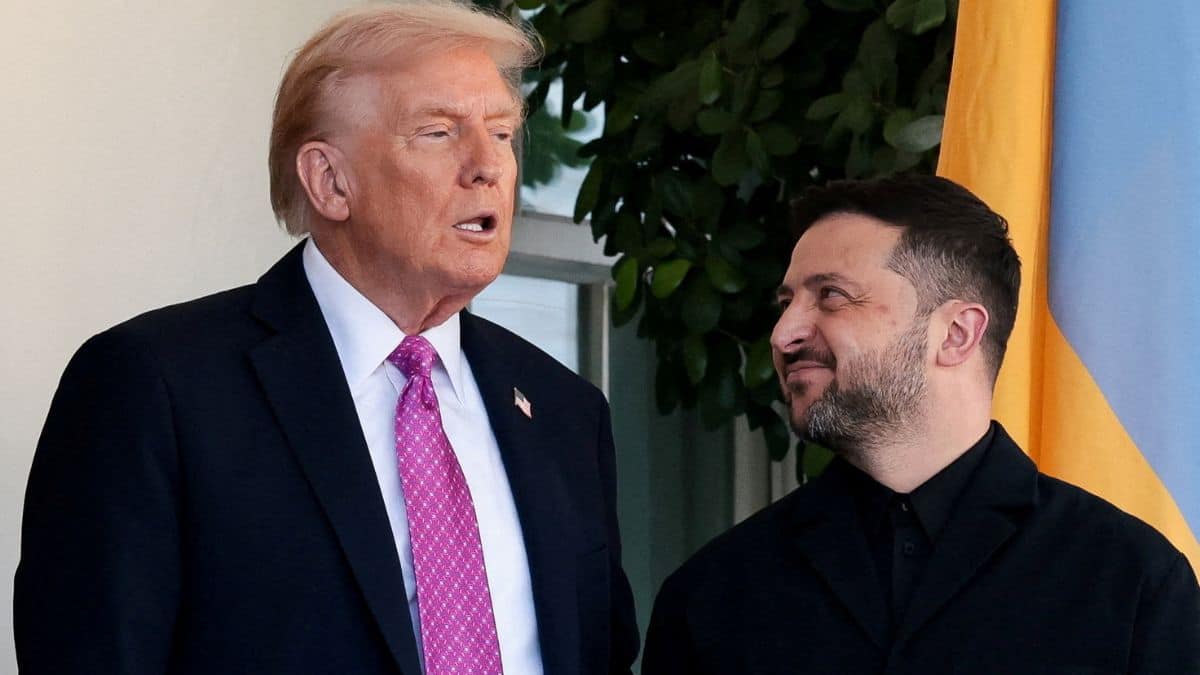
The phone call between Donald Trump and Volodymyr Zelenskyy, occurring on the threshold of the Geneva negotiations, represents a fundamental shift in the geopolitical debt-to-equity ratio of the Russia-Ukraine conflict. This interaction serves as a signaling mechanism that resets the baseline for all subsequent diplomatic leverage. To understand the implications, we must move beyond the superficial optics of "diplomatic outreach" and analyze the underlying mechanics of bilateral power dynamics and the structural constraints of the Geneva framework.
The Triad of Diplomatic Leverage
The current conflict environment functions within a three-pillar system where any change in one variable forces a recalculation in the others. The Trump-Zelenskyy call directly impacts these vectors:
- Security Guarantee Liquidity: The perceived reliability of U.S. military aid.
- Territorial Sovereignty Arbitrage: The delta between current military control and internationally recognized borders.
- Economic Reconstruction Capital: The future flow of Western investment versus Russian reparations.
By initiating contact ahead of formal Geneva talks, the Trump administration establishes an "early mover" advantage. This creates a psychological bottleneck for European allies, who must now calibrate their positions not against a fixed U.S. policy, but against a fluid, transaction-oriented strategy.
Structural Constraints of the Geneva Framework
The Geneva talks are often framed as a site of resolution, but they are more accurately described as a high-stakes auction for regional stability. The entry of a Trump-aligned policy framework introduces three specific stressors into this environment.
The Credibility Gap in Multilateralism
International organizations often rely on the assumption of long-term policy continuity. A shift toward bilateralism—evidenced by the direct call—undermines the collective bargaining power of the European Union. If Ukraine perceives that its primary security requirements can be met via a direct U.S. deal, its incentive to compromise within the broader Geneva consensus diminishes or, conversely, is bypassed entirely in favor of a "U.S.-Plus-One" arrangement.
The Logistics of a Frozen Conflict
Military experts define a "frozen conflict" not by the absence of violence, but by the stabilization of a front line that becomes a political border. The Geneva talks will likely attempt to codify the current Line of Contact (LoC). The call functions as a diagnostic tool for Trump to determine Zelenskyy’s "reserve price"—the minimum territorial and security concessions Ukraine is willing to accept to stop the kinetic phase of the war.
The Cost Function of Continued War
For the U.S., the war in Ukraine is not merely a moral or territorial issue; it is a resource allocation problem. The "Cost Function" can be expressed through the depletion of domestic munitions stockpiles, the opportunity cost of Pivot to Asia (specifically toward the Taiwan Strait), and the inflationary pressure of energy market disruptions.
- Munitions Depletion: The rate of 155mm shell consumption by Ukrainian forces often outpaces Western production capacity.
- Energy Arbitrage: The reliance on LNG exports to Europe creates a symbiotic but brittle economic link that the Trump administration may seek to renegotiate.
- Strategic Distraction: Every dollar and man-hour spent on the Donbas is one diverted from the Indo-Pacific theater.
This call signals to Kyiv that the U.S. is moving from "as long as it takes" to "as fast as it finishes." This shift in temporal priority forces Zelenskyy to reassess his long-term attrition strategy.
Technical Mechanisms of Peace Negotiation
When negotiations move from phone calls to formal tables in Geneva, the discussion focuses on technical "Off-Ramps" and "Guardrails."
Security Architectures and NATO Neutrality
A recurring friction point is Ukraine’s NATO membership path. The call likely touched upon alternative security architectures. These might include:
- The "Israel Model": High-level military aid and intelligence sharing without a formal Article 5 commitment.
- The "Neutral Buffer" Status: Formalized neutrality in exchange for massive defensive armament and economic integration with the EU, but not the military wing of the West.
Demilitarized Zones (DMZ) and Monitoring
Establishing a DMZ requires more than just a ceasefire; it requires a monitoring apparatus capable of real-time verification.
The technical difficulty of monitoring a 1,000-kilometer front line involves:
- Satellite Constellation Tasking: Using low-earth orbit (LEO) satellites for persistent surveillance.
- Ground-Based Acoustic Sensors: Detecting movement and artillery fire in real-time.
- Third-Party Peacekeeping: Determining which nations are sufficiently "neutral" to provide boots on the ground without triggering Russian or Ukrainian vetoes.
The Economic Integration Vector
The secondary layer of the Trump-Zelenskyy call is the economic post-war reality. Ukraine sits on significant deposits of lithium, titanium, and natural gas. The "Trump Doctrine" typically prioritizes economic reciprocity. Therefore, the discussion likely touched on the privatization of Ukrainian state assets and the involvement of American firms in the $400B+ reconstruction effort.
This creates a "Security for Equity" trade. Ukraine gains survival and security guarantees; U.S. interests gain preferential access to critical minerals and reconstruction contracts. This is a transactional model of foreign policy that differs fundamentally from the ideological model of the previous administration.
Counter-Signaling from the Kremlin
While the call was bilateral, its true audience included Moscow. Vladimir Putin monitors these interactions to gauge the level of Western fracture. If the U.S. signals a willingness to pressure Kyiv into territorial concessions, Russia’s bargaining position at Geneva hardens. However, if the call is used to signal a "peace through strength" ultimatum—wherein a refusal to negotiate leads to an unprecedented surge in high-tech weaponry for Ukraine—the Kremlin’s risk-reward calculation changes.
The bottleneck here is the "Red Line" paradox. Both sides have repeatedly moved their perceived red lines regarding long-range strikes and tactical nuclear rhetoric. The Trump-Zelenskyy call is an attempt to establish a new, firmer set of boundaries before the formal sessions begin.
Limitations of the Bilateral Approach
The primary risk of this strategy is the "abandonment anxiety" it triggers in European capitals. If the U.S. negotiates a framework that satisfies American domestic politics but leaves Europe vulnerable to long-term Russian pressure, the transatlantic alliance faces a structural break.
Furthermore, Zelenskyy faces internal political risks. Any concession made during a private call that appears to trade land for a fragile peace could destabilize his domestic coalition. The Ukrainian "veteran voting bloc" and nationalist factions represent a significant veto power over any agreement reached in Geneva or Mar-a-Lago.
The Strategic Path Forward
The Geneva talks will not produce a final peace treaty but will likely result in a "Memorandum of Understanding on Ceasefire Parameters." The Trump-Zelenskyy call was the opening move in a high-speed game of geopolitical chess designed to shrink the negotiation space to a manageable set of binary choices.
The immediate tactical move for the U.S. is to finalize a "Lend-Lease 2.0" framework that provides Ukraine with a massive, one-time shipment of offensive capabilities to be held in reserve. This creates a "Gun on the Table" during the Geneva talks, ensuring that Russia views a ceasefire as the more profitable option compared to an intensified conflict against a fully mobilized, Western-backed force. Simultaneously, Ukraine must be incentivized to accept a "Functional Victory"—maintaining its democratic institutions and 80% of its territory—over an "Absolute Victory" which remains militarily improbable in the current attrition cycle.
Watch the Delta in European defense spending over the next quarter. If the U.S. pivot is successful, we will see an immediate spike in independent European military procurement, signaling a realization that the security umbrella is now a shared-cost venture rather than a subsidized service.