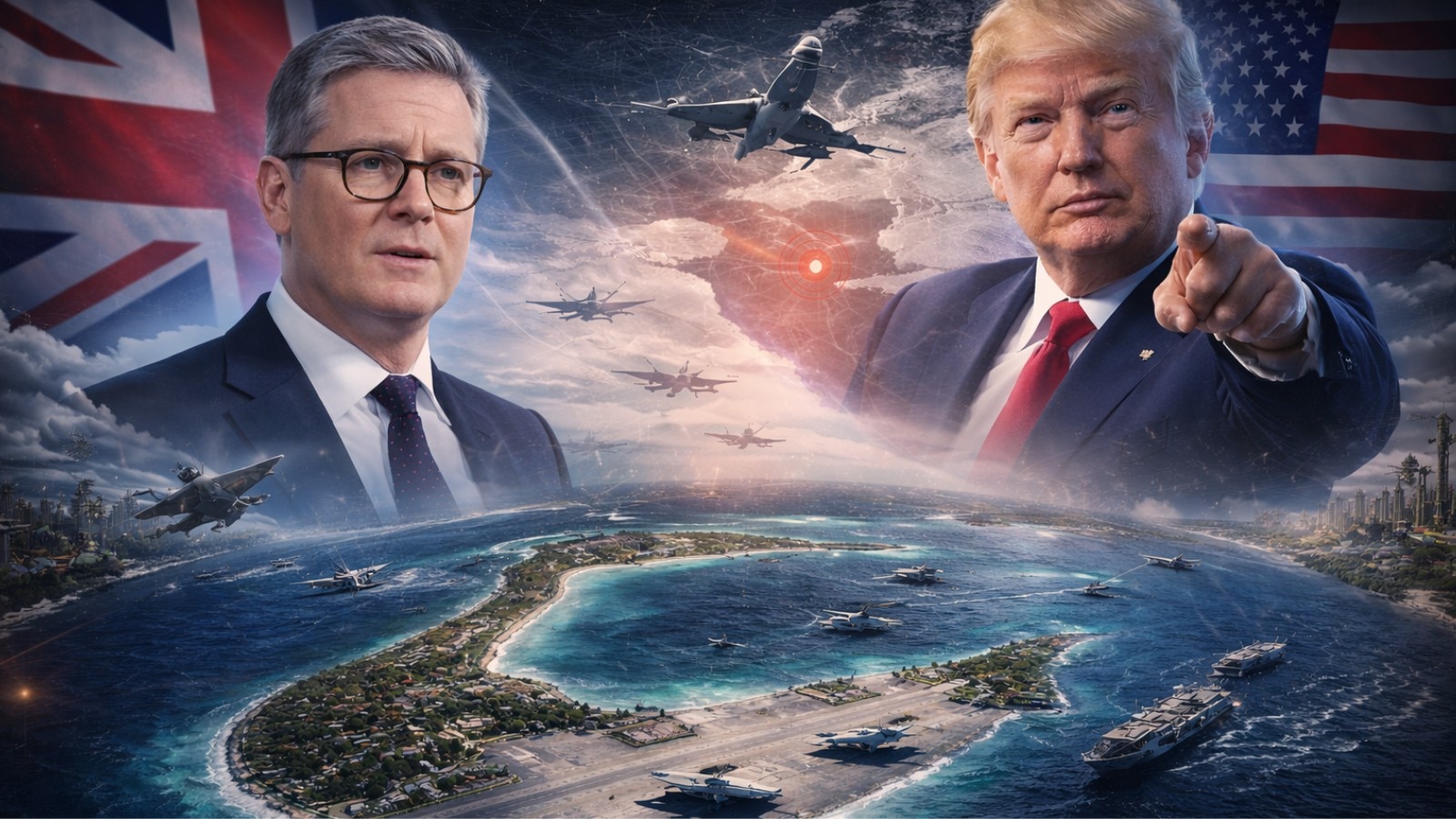
The proposed transfer of sovereignty over the Chagos Archipelago from the United Kingdom to Mauritius represents a structural shift in Indian Ocean power dynamics that transcends simple decolonization narratives. While the agreement ostensibly secures the legal status of the Camp Justice military facility on Diego Garcia for 99 years, it introduces a permanent "sovereignty gap" that complicates long-term operational certainty. The strategic value of Diego Garcia is not derived from its landmass, but from its unique status as a "polical-geographic anomaly": a platform that offers unencumbered power projection across the Middle East, South Asia, and the South China Sea without the friction of host-nation sensitivities typically found in sovereign states.
The Geopolitical Utility Function of Diego Garcia
To understand the Trump administration's opposition to this deal, one must quantify the base's utility through three specific operational vectors: Uninterrupted Sortie Generation, Subsurface Sustainment, and Signal Intelligence (SIGINT) Dominance.
- Uninterrupted Sortie Generation: Unlike bases in Qatar or Turkey, where host governments can—and have—restricted the use of facilities for specific kinetic operations (such as strikes against Iranian proxies or internal regional actors), Diego Garcia operates under British Indian Ocean Territory (BIOT) law. This provides the U.S. with a "permissive launch environment." Transferring sovereignty to Mauritius, a member of the African Union and the Non-Aligned Movement, introduces a future risk where international legal pressure or domestic Mauritian politics could lead to "mission creep" regarding base usage restrictions.
- The Nuclear-Submarine Pivot: The lagoon at Diego Garcia is one of the few locations globally capable of supporting an SSGN (guided-missile submarine) forward-deployment. This allows the U.S. Navy to swap crews and resupply without the 8,000-mile transit back to Guam or the West Coast. The deep-water pier and specialized support infrastructure are critical for maintaining a "continuous presence" in the Persian Gulf and the Malacca Strait.
- The Space and Intelligence Layer: The base houses a Ground-based Electro-Optical Deep Space Surveillance (GEODSS) site. This system tracks high-altitude satellites and space debris, providing the foundational data for space domain awareness in the Eastern Hemisphere.
The Sovereignty Gap and the China Variable
The primary analytical failure in the current UK-Mauritius agreement is the dismissal of "economic coercion" as a driver for future base access. Mauritius maintains a Deep Comprehensive Economic Partnership Agreement with China. By shifting sovereignty to Port Louis, the UK effectively moves the legal "keys" to the archipelago into a jurisdiction where Beijing holds significant financial leverage.
The mechanism of risk here is not an immediate eviction of U.S. forces, but a gradual degradation of the "security perimeter." Sovereignty grants Mauritius the right to manage the surrounding waters and the "outer islands" of the Chagos chain. If Mauritius permits Chinese-funded infrastructure projects—such as "fisheries research stations" or "civilian ports"—on nearby islands like Peros Banhos or Salomon, the SIGINT integrity of Diego Garcia is compromised.
A "dual-use" facility within 100 miles of the GEODSS site would allow for persistent electronic monitoring of U.S. B-2 and B-21 bomber signatures, frequency hopping patterns, and satellite uplink transmissions. This creates a "gray zone" vulnerability where the base remains operational but its technological advantages are neutralized.
The Cost-Benefit of the 99-Year Lease Model
Proponents of the deal argue that a 99-year lease provides "certainty." However, in international law, a lease is only as stable as the regime that guarantees it. The history of the 20th century is littered with "permanent" base agreements that were renegotiated or terminated under the threat of nationalization or civil unrest (e.g., Wheelus Air Base in Libya or Subic Bay in the Philippines).
The strategic friction arises from the Enforcement Paradox:
- If the UK retains sovereignty, the U.S. relies on a Tier-1 NATO ally with identical strategic objectives.
- If Mauritius holds sovereignty, the U.S. relies on a third-party state whose national interests may diverge during a conflict with Iran or a blockade in the South China Sea.
The U.S. Department of Defense operates on a principle of "Global Posture Excellence," which prioritizes nodes that minimize diplomatic friction. By introducing a middleman (Mauritius), the UK-US alliance adds a layer of "geopolitical rent" that must be paid in the form of ongoing aid, diplomatic concessions, and security guarantees to Port Louis.
Kinetic Implications: The Iran Strike Capability
The timing of the Trump administration’s intervention correlates with the escalating threat profile of the Iranian missile program. Diego Garcia serves as the primary "fail-safe" for long-range heavy bomber operations. If tensions in the Strait of Hormuz escalate to a kinetic state, B-52 and B-2 aircraft staged from Diego Garcia are outside the reach of almost all Iranian conventional missile systems.
Replacing this capability would require:
- Increased reliance on Al Udeid Air Base in Qatar, which is well within the range of Iranian medium-range ballistic missiles (MRBMs).
- Heavy dependence on Carrier Strike Groups (CSGs), which are increasingly vulnerable to anti-ship ballistic missiles (ASBMs).
- Extensive Aerial Refueling (AAR) chains from continental U.S. bases, which increases the "cost-per-effect" of any strike by orders of magnitude.
The loss of absolute sovereignty over the Chagos Archipelago simplifies the defensive calculus for Iran. They no longer have to account for a "black box" launch site; they can instead focus their diplomatic and asymmetrical pressure on Mauritius to deny "overflight" or "launch permission" during a regional crisis.
The Legal Logic of the "Inhabited" Argument
The International Court of Justice (ICJ) advisory opinion and the UN General Assembly resolutions have focused on the rights of the displaced Chagossian people. However, from a pure strategic consultancy perspective, the "return of inhabitants" creates a permanent security overhead.
The presence of a civilian population on the outer islands—or on Diego Garcia itself—introduces a "Human Shield" variable into military operations. It necessitates the construction of civilian infrastructure that can be used as cover for espionage, increases the difficulty of maintaining a "sterile" electromagnetic environment, and provides a platform for NGOs and adversarial states to monitor base activity in real-time.
Strategic Reclassification of the Indian Ocean
The Indian Ocean is transitioning from a "secondary theater" to the primary transit corridor for the Global Maritime Chokepoints.
- The Bab el-Mandeb
- The Strait of Hormuz
- The Malacca Strait
Diego Garcia is the only facility that sits at the center of the "Triangle of Influence" formed by these three points. The UK's decision to cede sovereignty is an admission of declining "blue-water" ambitions. For a U.S. administration focused on "Great Power Competition," this is viewed as a unilateral disarmament of a critical strategic asset.
The Path Forward: Asset Hardening and Legal Recalibration
The strategy to counter the sovereignty transfer must move beyond rhetoric and utilize the following levers:
- Veto through Financing: The U.S. provides the bulk of the operational funding for the BIOT. By making future military construction (MILCON) funding contingent on "Absolute Sovereignty Retention," the U.S. can force the UK to freeze the transfer.
- Redefinition of "Security Necessity": Under the UK-US Visiting Forces Agreement, the U.S. can argue that the "uninhibited operational control" required for the new B-21 Raider platform is incompatible with a third-party sovereign lease.
- The "Guam Model" Alternative: If sovereignty must be addressed, the U.S. should advocate for the Chagos Archipelago to become a U.S. Territory or a "Compact of Free Association" state similar to Palau or the Marshall Islands. This would bring the islands directly under the U.S. security umbrella, bypassing the volatility of Mauritian domestic politics.
The immediate move is to delay the ratification of the treaty in the UK Parliament until a formal "Security Impact Assessment" is conducted by the incoming U.S. administration. This assessment must quantify the cost of "Operational Friction" introduced by the lease and the specific electronic warfare risks posed by Mauritian-Chinese economic ties. The goal is to transform a "decolonization" issue into a "global security" imperative, where the integrity of the base is treated as a non-negotiable component of the international order.
Any attempt to move forward with the current deal must be met with a recalibration of the "Special Relationship," signaling that the UK’s withdrawal from the Indian Ocean will result in a proportional reduction in U.S. intelligence sharing and security subsidies for British interests elsewhere. The message is clinical: sovereignty is not a sentiment; it is a functional requirement for global stability.