We are watching a classic market squeeze play out in real time. On one side, geopolitical conflict in the Middle East has flared up again, sending oil prices surging toward uncomfortable levels. On the other, the long-running artificial intelligence hype machine is finally hitting a wall of cold, hard reality, dragging Asian and Wall Street tech stocks down with it.
If you have been coasting on the assumption that tech will always go up and energy markets will eventually quiet down, this week is your wake-up call. The global economy is reacting to two distinct but deeply connected shocks. If you liked this article, you should check out: this related article.
Here is what is actually happening behind the headlines, why the mainstream financial press is missing the bigger picture, and how you should position your money to survive this twin storm.
The Battle for the Strait of Hormuz and the $84 Oil Spike
Geopolitical tension is no longer just background noise for investors. It is directly dictating the price of gasoline at your local pump and the cost of shipping everything from electronics to basic foodstuffs. For another look on this story, refer to the recent coverage from The Motley Fool.
Over the weekend, the conflict between the United States and Iran escalated sharply. The main flashpoint is the Strait of Hormuz, a narrow waterway between Oman and Iran that serves as the main artery for the world's oil supply. Before the war, about 130 ships passed through this channel every single day. Today, that number has slowed to a crawl, with maritime agencies reporting a drop of over 52% in ship crossings.
The situation escalated when President Donald Trump declared that the U.S. is reinstating a blockade on Iranian ships in the strait. He even called for a 20% payment on all cargo shipped through the waterway to reimburse the U.S. military for providing protection. Iran's Revolutionary Guard fired back, asserting their absolute control over the strait and warning that they will not tolerate foreign interference.
This head-on collision sent shockwaves through energy trading desks. Brent crude, the global benchmark, immediately jumped nearly 10% on Monday to climb over $84 a barrel. U.S. benchmark crude climbed to $79.20.
While we are still below the wartime peak of $120 a barrel, the threat of a prolonged bottleneck is very real. If tankers cannot safely pass through the strait, crude oil gets stranded in the Persian Gulf. Less supply on the market means higher prices, simple as that.
Why China is Holding the Key to Oil Prices
There is an angle to this oil story that most analysts are ignoring. Why hasn't oil spiked back to $120 already given the severity of the blockade?
The answer lies in China.
Earlier this year, as oil prices climbed, Beijing made a calculated decision. They decided to stop buying massive amounts of oil from the global market to fill their strategic reserves. Instead, they tapped into their own massive domestic inventories, cutting their daily crude imports by almost 6 million barrels.
At the same time, China's rapid transition to electric vehicles has permanently wiped out about 500,000 to 600,000 barrels per day of demand for gasoline and diesel.
So, while the Middle East is on fire, China's sudden drop in demand is acting as a temporary lid on oil prices. But don't get too comfortable. If the Strait of Hormuz remains blocked for months, even China's massive reserves won't be enough to prevent a massive global energy crunch.
The Great AI Reality Check Hits Tech Stocks
While oil traders are eyeing the Middle East, tech investors are staring at a sea of red on their screens. For the past year, anything associated with artificial intelligence has been treated like free money. That era is officially ending.
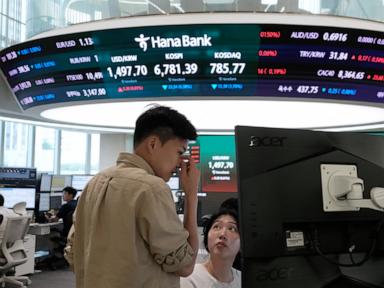
The pain started in Asia and quickly rippled across the globe. South Korea's Kospi index suffered a brutal drop, led by a massive 15.4% plunge for SK Hynix. This was the worst single-day drop for the semiconductor giant since it started trading back in 1997.
Just days before, SK Hynix had launched its U.S.-traded shares in a blockbuster $26.5 billion debut. Those shares initially popped, only to get absolutely hammered on Monday.
The selling didn't stop there.
- Tokyo's Nikkei 225 dropped 1%.
- The Shanghai Composite lost 0.8%.
- On Wall Street, the Nasdaq composite sank 1.6%.
- Micron Technology fell 4.4%, pulling back from its insane 243.1% gain earlier in the year.
- Nvidia, the undisputed king of the AI trade, dropped 3.5%.
Because Nvidia is the largest stock on Wall Street by value, its slide dragged the entire S&P 500 down by 0.8%.
The Real Problem with AI Valuations
Let's look at why this sell-off is happening. This isn't just random market volatility. It is a fundamental shift in investor sentiment.
For quarters, companies have been pouring billions of dollars into buying computer chips, memory units, and data center infrastructure. Up until now, companies like Taiwan Semiconductor Manufacturing Co. have posted incredible revenue numbers. In fact, TSMC reported that its June revenue soared nearly 68% from a year earlier.
But the stock market looks forward, not backward. Investors are starting to ask a very uncomfortable question: where are the actual profits from AI apps?
It costs a fortune to build and run these models. Tech giants are spending historic amounts of capital, but the average consumer or enterprise customer isn't paying enough for AI services to justify that spending yet. Wall Street is worried that the current demand for chips is unsustainable. If tech companies realize they aren't getting a return on their massive infrastructure investments, they will stop ordering chips from Nvidia, Micron, and SK Hynix.
When you price stocks for absolute perfection, even a tiny shadow of doubt can cause a massive sell-off. That is exactly what we are seeing right now.
The Dangerous Intersect of High Oil and Falling Tech
You might think that an oil blockade in the Middle East and a tech sell-off in Seoul have nothing to do with each other. You would be dead wrong. They are tied together by a single, critical economic factor: inflation.
When oil prices jump, everything becomes more expensive. Gas stations raise prices, airlines raise fares, and manufacturers pay more to ship parts. This pushes inflation higher.
When inflation stays high, central banks like the Federal Reserve cannot lower interest rates. In fact, if oil keeps climbing toward $100, the Fed might be forced to raise interest rates again to keep prices from spiraling out of control.
Higher interest rates are absolute poison for expensive tech stocks. When rates are high, investors can get a safe 4% or 5% yield just by holding government bonds. They don't need to take massive risks on overvalued chip companies that might not see real profits for a decade.
We can track this relationship directly in the bond market. As oil surged on Monday, the yield on the 10-year U.S. Treasury climbed to 4.61%. Before this latest round of friction with Iran, that yield was sitting comfortably at 3.97%. The bond market is signaling loud and clear that higher inflation and higher rates are locked in for the foreseeable future.
How to Position Your Money Right Now
The days of blindly throwing money at an index fund and watching it grow are hitting a pause button. If you want to protect your wealth, you need to change your approach.
Trim Your Tech Exposure
Don't wait for Nvidia or Micron to drop another 10% before you balance your portfolio. If you have massive, unrealized gains from the tech rally, take some money off the table. You don't have to sell everything, but sitting on a pile of cash or moving money into defensive sectors is a smart move when valuations are this stretched.
Watch Earnings Reports Closely
This week is critical. Wall Street's attention is shifting to second-quarter corporate earnings reports. Major institutions like Bank of America, Citigroup, JPMorgan Chase, Goldman Sachs, and Wells Fargo are all opening their books.
Analysts are expecting overall earnings growth of 23.6% for S&P 500 companies. That is an incredibly high bar. If these companies miss their targets or offer weak guidance for the rest of the year due to high energy costs, the current market pullback could turn into a full-blown correction. Watch the banks; they will tell you exactly how healthy the everyday consumer really is.
Look for Inflation Hedges
With the Strait of Hormuz effectively choked off, energy infrastructure and defensive commodities are essential. Companies that produce, refine, or transport energy are going to generate serious cash flow as long as Brent crude stays elevated. Instead of buying speculative tech, look for businesses with strong balance sheets that can pass rising costs directly onto their customers.
Stop treating the geopolitical headlines as isolated events. The blockade in the Middle East and the tech correction are two sides of the same coin. Diversify your holdings, build up your cash reserves, and protect your portfolio before the next wave of volatility hits the market.