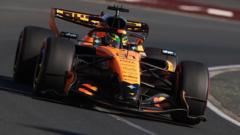
The Lap Time Lie
The collective racing media just spent twelve hours hyperventilating because Oscar Piastri sat at the top of a timesheet on day one of testing. They called it a statement of intent. They called it a McLaren masterclass. They are wrong.
If you’ve spent five minutes in a paddock during pre-season, you know that the "fastest lap" is the most expensive marketing stunt in the world. It’s a vanity metric designed to keep sponsors happy and stock prices stable. Piastri is a generational talent, but his P1 finish tells us exactly zero about who is winning the championship. It tells us plenty, however, about who is desperate for a headline.
Focusing on the top of the leaderboard on day one is like judging a marathon by who sprinted the first forty yards. It’s amateur hour.
Sandbagging and the Art of Deception
In Formula 1, the fastest car almost never shows its hand in February. This is a sport built on the concealment of truth. When a team like McLaren or Alpine sits at the top early, it’s often because they are running a "glory run."
What’s a glory run? It’s simple:
- Low fuel loads: Running $5kg$ of fuel instead of $50kg$ transforms a tractor into a rocket.
- Aggressive engine mapping: Dialing the power unit to a mode they’ll never use in a race because it would melt the pistons by lap ten.
- Softest tire compounds: Using rubber that provides a three-second advantage but disintegrates if you look at it sideways.
The heavy hitters—the Red Bulls and Ferraris of the world—are doing the opposite. They are out there with "sandbags" in the sidepods. I’ve watched engineers deliberately tell drivers to lift off the throttle in the final sector just to hide a half-second of pace. They don't want the FIA looking at their aero package too closely, and they certainly don't want their rivals copying their floor design before the first race.
If you aren't looking at long-run averages and tyre degradation curves, you aren't watching the test. You're watching a parade.
The Lindblad Hype Train is De-Railed
The headlines are also screaming about Arvid Lindblad’s "impressive" debut. Let's get real. Impressive compared to what?
The media loves a wunderkind story because it sells clicks to a British audience hungry for the next Lewis Hamilton. But putting a teenager in a car and seeing him go "fast" on a green track means nothing. Modern F1 simulators are so sophisticated that these kids have driven the track 10,000 times before their boots touch the tarmac.
The real test isn't "can he drive fast?" Every driver on that grid can drive fast. The test is "can he manage the thermal degradation of a C3 Pirelli tire while adjusting his brake migration for a 15-knot headwind?" Lindblad didn't show us that. He showed us he can hit his marks in a controlled environment.
We need to stop crowning "future champions" based on a Tuesday afternoon session where half the grid was busy testing pit-stop sensors.
Why Data Scientists Laugh at Your Power Rankings
Let's talk about the math that the "insiders" won't explain to you. In testing, we use a concept called Correction Factors. If you want to know the truth, you have to account for:
- Track Evolution: A lap at 10:00 AM is not the same as a lap at 4:00 PM. The track temperature can swing by $20^{\circ}C$, changing the grip levels entirely.
- Fuel Weight Penalty: Every $10kg$ of fuel costs roughly $0.3$ seconds per lap. Without knowing the fuel load, the time is a ghost.
- Engine Modes: If Team A is running at $90%$ and Team B is at $100%$, the gap on the screen is a lie.
I’ve seen teams finish a test P18 and go on to win the first three races. I’ve seen teams "dominate" testing only to find out their car was a "dragster"—fast in a straight line for one lap, but a tire-shredding disaster over a race distance.
The Real Metrics of Success
If you want to know who is actually fast, look at the Stint Consistency Table.
A driver who does 20 laps within a $0.2$-second window is terrifying. A driver who sets one blistering purple lap and then drops off by a second over the next five laps is irrelevant. Piastri’s P1 was a snapshot. The consistency of the Red Bull long runs was a warning.
The Danger of "Optimism Bias"
Fans and journalists suffer from optimism bias. We want the pack to be close. We want to believe McLaren has closed the gap. This leads to "narrative-driven reporting."
- Narrative: "McLaren is back at the top!"
- Reality: McLaren had a cleaner day than most, ran lower fuel, and capitalized on a rubbered-in track.
The danger here is for the teams themselves. I’ve worked with outfits that bought into their own testing hype. They stopped innovating because the timesheet told them they were fine. Then they got to the first Q3 of the year and realized they were $0.8$ seconds off the pace.
Trustworthiness in this industry comes from skepticism, not cheers.
Stop Asking "Who is Fastest?"
The question is flawed. You should be asking: "Who did the most laps without a mechanical failure?"
Reliability is the only variable that matters in February. If a team completes 150 laps a day, they are gathering the data required to win. If they are sitting in the garage changing a hydraulic pump while their driver is P1 on the screens, they are losing.
What You Should Actually Watch
- Flow-Vis Paint: Where is the neon green paint going? If it’s streaking cleanly over the rear wing, the aero map is working. If it’s swirling in eddies, they have a separation problem.
- Aero Rakes: These giant metal grids are the "truth-tellers." They measure the actual wake behind the wheels. Teams only run these when they are worried about their wind tunnel correlation.
- Driver Body Language: Watch the onboard footage. Is the driver fighting the wheel (understeer) or constantly correcting the rear (oversteer)? Piastri looked comfortable, but the car looked "snappy." That's fine for a flyer, but it's a nightmare for a 57-lap Grand Prix.
The Verdict on Day One
Oscar Piastri didn't "win" the first day of the season. He won a PR battle. Arvid Lindblad didn't "impress" the paddock; he fulfilled the baseline expectations of a modern academy driver.
The "lazy consensus" is that we have a title fight on our hands because the colors at the top of the screen changed. The reality is that the real heavyweights haven't even taken their coats off yet.
If you’re betting on the championship based on today’s times, you might as well burn your money. The stopwatch in testing is a magician’s trick—it’s designed to make you look at the wrong hand.
Ignore the times. Watch the tires. Follow the fuel. Everything else is just noise for the casuals.