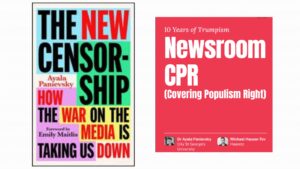
Newsrooms spend millions of dollars and thousands of editorial hours agonizing over a false choice. Should we amplify them? Should we normalize them? Should we silence them?
Every media symposium, journalism review, and editorial playbook circles these exact three verbs like vultures over a carcass. They treat populist rhetoric like a toxic chemical spill, debating whether to contain it behind a cordon sanitaire or dilute it with relentless fact-checking.
They are asking the wrong question entirely.
The debate over whether to amplify or silence populists assumes that mainstream journalism still holds a monopoly on distribution. It assumes editors are gatekeepers standing at the doors of the public square, deciding who gets a microphone. That world died over a decade ago. Today, when a legacy newsroom decides to "silence" a populist figure, that figure does not disappear. They simply broadcast directly to three million followers on an unmoderated video stream while mocking the legacy outlet for being terrified of the truth.
By obsessing over whether to cover populism, editors ignore the actual reason their coverage fails. Populism thrives not because journalists give it oxygen, nor because they starve it, but because legacy media mistakes performative neutrality for actual journalism.
The Fallacy of the Editorial Playbook
If you have spent any time inside a modern newsroom during an election cycle, you know the drill. An insurgent candidate says something incendiary. Panic ensues. The standards editor sends out a memo reminding reporters to avoid repeating the lie in the headline, to wrap every quote in a "truth sandwich," and to provide "context."
I have watched senior editors burn entire news cycles debating the precise placement of a qualifier in a twelve-word push alert, completely oblivious to the fact that the audience stopped reading push alerts for nuance years ago.
This obsession with clinical framing comes from a fundamental misunderstanding of what populism actually is. Most journalists treat populism as a synonym for demagoguery, extremism, or simple bad manners. It is none of those things.
As political scientist Cas Mudde famously defined it, populism is a "thin-centered ideology" that separates society into two homogeneous and antagonistic groups: "the pure people" versus "the corrupt elite."
Read that definition again. Notice what it says about the press.
In the populist worldview, legacy media is not a neutral referee watching the game from the sidelines. You are not the umpire. You are the captain of the opposing team. When a newsroom adopts a self-righteous "playbook" designed to quarantine, lecture, or scold populist figures, you are not fighting populism. You are proving its core thesis right in front of the audience. Every time an anchor sighs heavily, every time a headline reads "Without Evidence," and every time an editorial board announces it will no longer cover a candidate's rallies live, the populist gets to point at the screen and say, Look at the corrupt elite trying to silence you.
You cannot fact-check your way out of an epistemological war. When a voter believes the referee is rigged, showing them the rulebook only makes them angrier.
Why Silencing Backfires in a Decentralized Media Ecosystem
Let us dismantle the "silence" option first, because it remains the favorite fantasy of European public broadcasters and elite American opinion pages. The theory goes like this: if we deprive extremists of mainstream oxygen, they will wither away in the dark.
This worked in 1975. In 1975, if you did not get on the evening news or into the morning broadsheet, you did not exist.
Today, algorithmic distribution rewards friction, outrage, and authenticity. When legacy outlets enforce a blackout on a populist movement, they hand over 100 percent of the narrative framing to partisan alternative media, podcasters, and social video algorithms. Worse, they create an information vacuum. Voters who hear about a populist's policy—say, an aggressive tariff plan or a radical overhaul of immigration courts—through whispers on messaging apps will eventually search for it. If the only results come from sycophantic fan accounts because respectable outlets refused to cover it, the newsroom has actively radicalized the curious reader.
Imagine a scenario where a major populist party proposes abolishing the central bank. A legacy outlet following the "do not amplify" playbook decides the idea is too fringe to merit serious coverage, running a brief, dismissive wire story calling the proposal "dangerous and unorthodox." Meanwhile, a three-hour podcast breaks down the exact mechanics of the proposal, interviews the party's economists, and frames the legacy media's silence as a cover-up by banking elites. Who wins the persuasion battle? Not the newspaper.
The Trap of "Normalizing" and False Balance
If silencing fails, the standard playbook pivots to the opposite extreme: "covering both sides" with robotic detachment. Critics call this normalizing.
You see this every day in political reporting. A populist leader threatens to jail political opponents or dismantle judicial independence, and the headline reads: Candidates Clash Over Future of Justice System.
This is cowardice disguised as objectivity. Journalism is not stenography. Reporting that Politician A said the sky is green and Politician B said the sky is blue—and leaving it at that—is not fairness. It is an abdication of the basic duty to verify reality.
Yet the alternative proposed by media critics—abandoning objectivity altogether in favor of "moral clarity"—is equally disastrous. When reporters drop the pretense of fairness and adopt the tone of progressive activists, they surrender the only currency they have left: trust among skeptical, non-ideological voters. People do not buy newspapers or pay for subscriptions to be lectured on morality by twenty-six-year-old staff writers. They pay to understand how power works and how decisions affect their wallets and neighborhoods.
How to Actually Cover Populism Without Losing Your Mind
If silencing makes you look complicit, false balance makes you look naive, and moralizing makes you look partisan, what is left?
You stop treating populism as a rhetorical performance and start treating it as a governing reality. You shift the focus from the theater of the populist to the math of their promises.
1. Ignore the Outrage Bait and Audit the Receipts
Populists are masters of the "dead cat" strategy—throwing something shocking onto the table so everyone talks about the dead cat instead of the actual failures in the room. When a populist leader insults a minority group, attacks a celebrity, or threatens a journalist, the legacy media takes the bait every single time. They run forty-eight hours of breathless panel discussions about "norms" and "decency."
The populist loves this. Talking about norms costs them zero votes. In fact, it gains them votes, because their base hates the people enforcing the norms.
Instead of covering what the populist says to provoke you, cover what they do when they hold power. Look at their municipal budgets. Examine the contracts awarded to their donors. Track the crime rates, hospital wait times, and inflation numbers in regions they already govern. Populism relies on simple solutions to complex problems. When those simple solutions collide with reality, they leave a paper trail. Follow the paper trail.
2. Take the Grievances Seriously Without Validating the Scapegoats
Populism never emerges out of thin air. It is a fever, and a fever is a symptom of an underlying infection. You do not cure a fever by yelling at the thermometer.
When millions of working-class voters flock to a populist movement, it is usually because the institutional consensus has failed them on a massive scale—whether through deindustrialization, uncontrolled migration, housing shortages, or endless foreign wars. Legacy newsrooms routinely miss these slow-moving crises because reporters live in wealthy coastal cities, socialize with the same people, and share the exact same blind spots as the political establishment.
Good coverage separates the grievance from the scapegoat. If voters are furious because their local manufacturing base collapsed and opioid addiction hollowed out their town, report relentlessly on that collapse. Validate their reality. Then, rigorously test whether the populist's proposed scapegoat—be it immigrants, globalists, or a specific minority—actually caused the problem, and whether the populist's proposed cure will actually fix it. When you prove you understand the voter's pain, they will actually listen when you dismantle the demagogue's fake remedy.
3. Stop Fact-Checking Metaphors and Start Stress-Testing Policies
The modern fact-checking industry has largely become a pedantic exercise in missing the point. When a populist says, "Our cities are burning to the ground," and a fact-checker publishes a 1,200-word article rating the claim "False" because 99.4 percent of urban square footage is not currently on fire, the journalist looks like an idiot.
Voters understand hyperbole. They know it is a metaphor for disorder, rising crime, and visible decay. By literalizing a metaphor, the journalist signals that they care more about scoring a technical point than addressing the underlying fear.
Save your forensic rigor for concrete policy mechanics. If a populist promises to deport ten million people in twelve months, do not write an op-ed calling it cruel. Do the logistical math. How many buses does that require? How many detention beds exist? What does it cost per taxpayer? Which industries lose their labor force overnight, and what happens to the price of groceries the following Tuesday? Hard math is kryptonite to populist fantasy.
4. Interview the Voters, Not Just the Strongman
Most political journalism is terribly lazy. It is much easier to sit in a studio and dissect a politician's latest speech than it is to spend three weeks in a post-industrial town talking to people who switched their votes.
When reporters do venture out into "populist country," they often treat the locals like exotic zoo animals, looking for the most extreme, toothless caricature to put on camera so the urban audience can feel superior.
Flip the script. Find the articulate, thoughtful small-business owner, nurse, or union mechanic who voted for the populist candidate. Ask them what trade-offs they are willing to accept. Ask them what they think the populist will actually deliver. When you treat populist voters as rational actors making calculated bets rather than brainwashed victims, your journalism immediately becomes smarter, sharper, and infinitely harder to dismiss.
The Uncomfortable Truth About This Approach
There is a catch to doing journalism this way, and it is the reason most newsrooms refuse to adopt it.
It requires tremendous discipline, deep subject-matter expertise, and the willingness to anger your own subscribers.
If you stop running daily outrage-bait headlines, your programmatic ad clicks will drop in the short term. If you investigate the real policy failures of the establishment that gave rise to populism, your progressive readers will cancel their subscriptions and accuse you of "both-sidesism." If you ruthlessly audit the populist's economic math, their supporters will call you a globalist shill.
You will have no friends in the comment section. You will not get invited to the best cocktail parties in Washington, London, or Brussels.
Media consultant Jay Rosen once noted that the press needs to focus on "not the odds, but the stakes." That is half right. You need to cover the stakes, the math, and the failures of the status quo with equal ruthlessness.
Throw the playbook in the trash. Stop worrying about whether you are amplifying, normalizing, or silencing anyone. Just do the reporting.