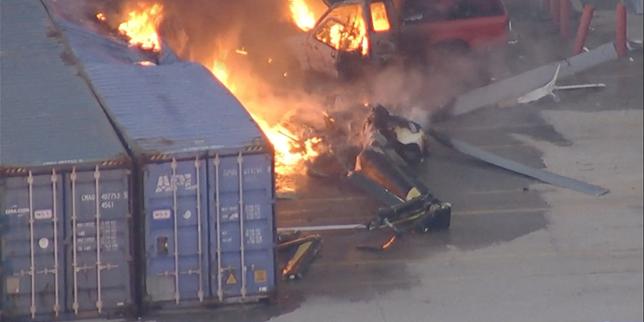
Another helicopter goes down in Western Los Angeles. Three dead. The media ritual begins within minutes. Tragic headlines flash across screens, anchors clutch their pearls, and the chorus of armchair safety experts demands an immediate ban on rotorcraft over urban areas. It is the same tired script played out after every aviation incident. Everyone points their fingers at the pilots, the machinery, or the sheer density of the Los Angeles basin, demanding stricter regulations and sweeping crackdowns.
They are focusing on the entirely wrong tragedy.
Every time a news outlet reports on a commuter or private helicopter crash, they treat it as an isolated freak accident born of pilot error or mechanical failure. They miss the systemic, structural cancer eating away at modern metropolitan transit. The real outrage is not that private aircraft occasionally fall out of the sky over Brentwood or Westwood; the outrage is that our ground infrastructure is so utterly broken, congested, and hostile that people with the means are forced into the air in the first place.
I have spent over a decade analyzing urban mobility frameworks, infrastructure budgets, and municipal zoning laws across major North American metros. I have watched city planners blow hundreds of millions of dollars on vanity rail projects that move a fraction of projected commuters while completely ignoring the fundamental physics of point-to-point transit. When ground travel becomes a multi-hour exercise in stationary frustration, the sky becomes an economic necessity. Blaming the helicopter for crashing is like blaming the parachute for failing when you are forced to jump out of a burning building.
The Fallacy of Urban Air Bans
The lazy consensus among civic activists right now is straightforward: ground all non-essential rotorcraft over residential neighborhoods. Politicians nod along, drafting superficial zoning ordinances that sound compassionate on the evening news but collapse under basic scrutiny.
Let us look at the data. Commercial and private helicopter operations in the United States log millions of flight hours annually. Statistically, per mile traveled, aviation remains exponentially safer than driving a passenger vehicle down the San Diego Freeway during rush hour. Yet when a car accident claims three lives on Interstate 405, it gets a ten-second traffic update. When a helicopter goes down, it becomes a front-page moral panic.
The anti-helicopter lobby loves to paint these machines as toys for the ultra-wealthy, buzzing over suburban backyards just to save a few minutes getting to a Hollywood meeting. That caricature ignores the vital work rotorcraft perform every single day. We are talking about organ transport, emergency medical services, structural fire monitoring, utility grid inspections, and rapid law enforcement response. More importantly, we are talking about a nascent micro-mobility sector trying desperately to bypass the concrete arteries that our incompetent municipal governments refuse to fix.
When you ban or heavily restrict aviation because of a rare, catastrophic failure, you do not create a safer city. You create a more congested one. You push more people back onto asphalt that is already buckling under capacity constraints.
The Real Culprit Is Municipal Gaslighting
Why do people take to the skies in Los Angeles? Because the ground is a disaster zone.
For decades, city officials have played a shell game with urban planning. They promise high-speed rail, light rail expansions, and smart-corridors. They hire expensive consultants, commission endless environmental impact reports, and burn through billions of taxpayer dollars. The result? Snail-paced construction projects that take decades to complete, stations plagued by safety issues, and routes that do not actually connect where people live to where people work.
Los Angeles is built around sprawl. That is not a moral failing; it is a geographic and historical reality. You cannot force a decentralized metropolis of nearly ten million people into a nineteenth-century European transit model just because urban studies professors think it looks nice on paper.
When ground transit fails to scale with population growth, the market finds a workaround. For some, that workaround is lane-splitting on a motorcycle. For others, it is private aviation. Treating the symptoms while ignoring the disease is standard operating procedure for city hall, but we should not pretend it is safety policy. It is deflection.
What Real Urban Reform Looks Like
If we actually care about human life and reducing the frequency of aviation incidents in crowded skies, we have to stop treating helicopters as the enemy and start treating gridlock as the crisis.
First, we need to overhaul air traffic management for low-altitude urban corridors. Modernize the tracking, mandate advanced collision-avoidance avionics across the entire commercial fleet, and establish strict, automated highway-in-the-sky routing that keeps aircraft away from dense residential pockets whenever possible. Technology exists today to manage dense urban air traffic safely and efficiently. The Federal Aviation Administration and local authorities just refuse to fund and implement it with the urgency it demands.
Second, we need to unleash private competition in ground and low-altitude transit. Stop protecting archaic municipal monopolies on transportation. If private companies want to build vertiports, invest in electric vertical takeoff and landing aircraft, or create alternative commuter networks, get out of their way. Let innovation drive safety down through competition, rather than freezing the status quo in amber through red tape.
The downside to this approach? It requires political courage. It means admitting that municipal planning has failed for fifty years. It means telling homeowners that they cannot control every square inch of airspace above their property while demanding zero solutions for the traffic roaring past their front doors.
The three souls lost in the Western Los Angeles crash deserve better than a performative moment of silence followed by recycled political rhetoric. They deserve an infrastructure system that does not force people into the clouds just to get across town.
Stop blaming the sky for the failures on the ground.