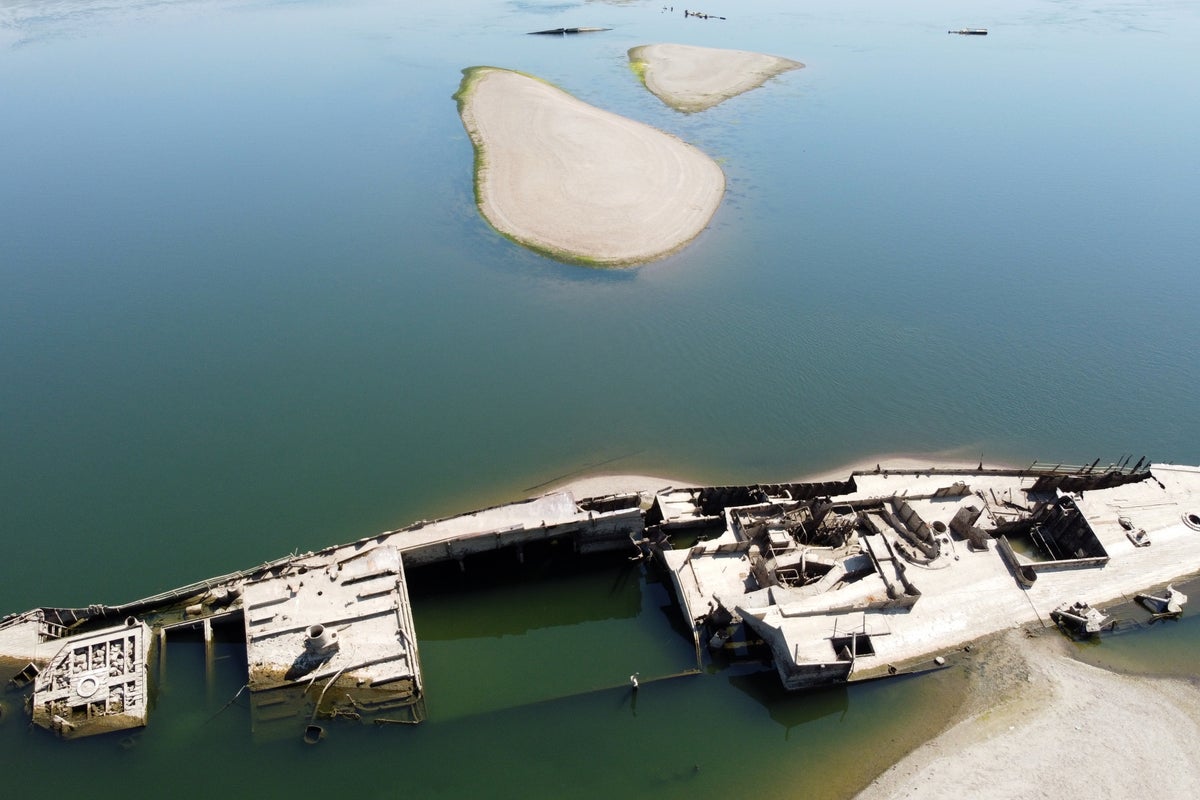
Every time a European river drops a few inches below its historical average, the internet loses its collective mind. Headlines scream about ghost ships, sunken armadas, and World War Two relics breaching the surface like cinematic villains crawling out of a tomb. Tourists flock to muddy riverbanks with smartphones held high, hunting for rusted metal as if nature just unearthed a lost blockbuster set.
It is historic panic porn at its finest.
Media outlets love framing these low-water events as apocalyptic anomalies. They treat the emergence of German naval hulks from Operation Barbarossa as eerie omens of climate collapse. They want you to gasp at the spooky aesthetics of history dragging itself back into the light.
They are missing the entire point.
Those sunken vessels are not supernatural warnings. They are heavy, cumbersome pieces of municipal trash that engineering arrogance parked in the middle of a major European shipping lane eighty years ago. The real story isn't that the Danube is revealing ghosts. The real story is that we spent decades pretending we could ignore basic hydrology just because we poured concrete and dredged channels.
Here is what actually happens when a river dries up.
The Myth of the Unprecedented Drought
Go back through Central European history records. The drying of the Danube is not a glitch in the simulation. It is a documented recurring feature of the basin's geography. Long before industrial carbon emissions became a global talking point, chronic low-water phases forced local populations to adapt.
During the summer of 1944, the retreating German Black Sea fleet realized their destroyers, escort ships, and landing craft were trapped. Rather than surrender the hardware to advancing Soviet forces, commanders scuttled dozens of their own vessels right in the navigable channels near Prahovo, Serbia. They didn't sink them by accident. They sank them to intentionally choke the waterway and block Allied shipping.
When water levels drop today, those hulks appear because they were designed to sit on the bottom of the riverbed in the first place. They are heavy scrap iron resting precisely where they were dropped. Calling their rediscovery a profound environmental revelation is like calling an old sofa in a drained swimming pool an archaeological treasure.
The panic relies on historical illiteracy. Tourists look at rusted steel ribs poking through the silt and assume the riverbed is shrinking for the first time since the Pleistocene era. In reality, the Danube has always been a dynamic, volatile system characterized by massive seasonal swings in discharge volume.
Why Scuttled Hulls Are a Logistics Nightmare, Not a Tourist Attraction
Governments treat these exposed wrecks as quirky roadside attractions. Local tour operators run boat trips out to view the rusty skeletons. People snap selfies against a backdrop of environmental degradation and military debris.
This is backward.
Those ships loaded with unexploded ordnance and toxic materials are actively choking modern European trade. When cargo barges running between Rotterdam and the Black Sea slam into unmarked steel plates hidden just beneath the surface, supply chains fracture. Grain exports stall. Energy shipments via barge slow to a crawl because captains cannot risk tearing open their hulls on Nazi-era shrapnel.
The European Union has spent decades dragging its feet on clearing the Prahovo bottleneck. Why? Because dredging out sunken warships encased in decades of river silt is expensive, politically boring, and offers zero viral social media traction compared to publishing photos of spooky ghosts of the past.
We romanticize the wreckage while ignoring the economic tax it levies on everyday commerce.
The Engineering Hubris of Taming Natural Flows
The deeper issue tied to the Danube's fluctuating levels stems from an addiction to hard infrastructure. For over a century, civil engineers tried to squeeze the river into a rigid, predictable highway. They built dykes, cut off natural floodplains, and channelized the current to maximize cargo capacity.
Rivers hate straight lines. When you constrain a dynamic watershed, you remove its ability to absorb stress.
When a dry summer hits, a natural, unconstrained river responds by drawing on its broader floodplain network, maintaining a healthier baseline ecology. A channelized, concrete-straightened river like the modern Danube drops off a cliff the moment upstream precipitation dips. The water level plummets because there is nowhere else for the system to buffer the loss.
The emergence of the 1944 fleet is a symptom of a broader design flaw. We built an economy dependent on a permanent water depth that nature never guaranteed. Instead of redesigning our logistics around seasonal variability, we cross our fingers every July and pray for rain, acting surprised when the riverbed exposes our garbage.
How to Fix Our Broken Relationship with Inland Waterways
If Europe wants to maintain viable inland navigation without panicking every time a heatwave hits, the strategy has to change completely.
First, stop treating river restoration as a landscaping project. Restoring wetlands and reconnecting side-channels along the upper and middle Danube creates natural water retention zones. This buffers low-water periods and prevents the extreme drops that expose navigation hazards.
Second, fund the heavy industry of wreck removal. Serbia and neighboring transit nations need dedicated clearance budgets backed by Brussels to lift every single scuttled warship out of the silt permanently. Leave nothing for tourists to gawk at. Turn the scrap into rebar and let the commercial traffic flow smoothly at two meters of depth instead of forcing ships to carry half-loads.
Third, transition industrial freight to dynamic loading models. Shippers must accept that modern climate volatility means draft depths will fluctuate. Build modular, shallower-draft vessels instead of doubling down on massive, heavy barges designed for artificial high-water conditions that no longer exist reliably.
Stop treating the river like a museum exhibit. Clear the channel, dismantle the debris, and respect the water for what it actually is.