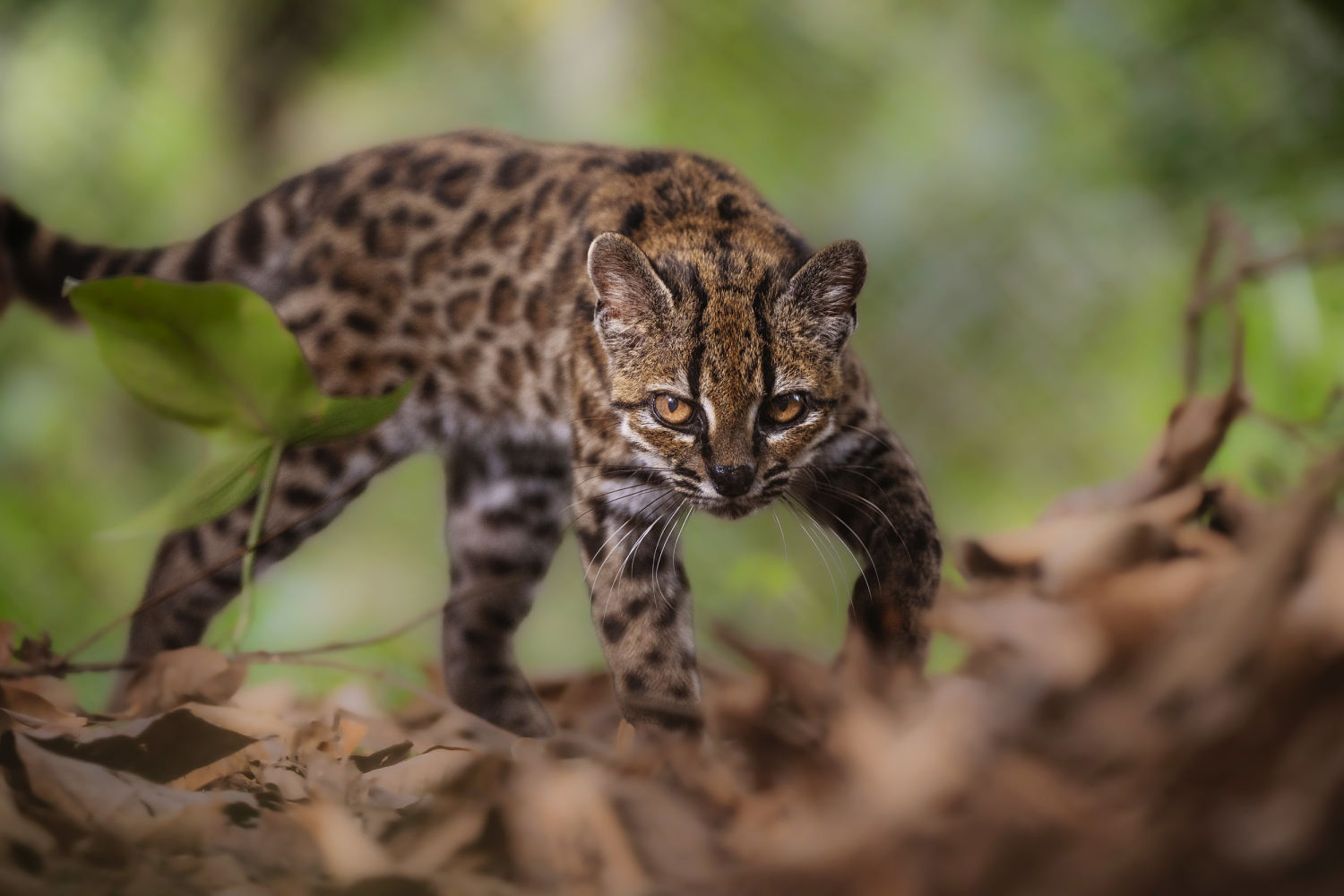
Every time a headline declares a brand-new wild cat species unearthed after a century of hiding, conservation Twitter loses its mind. People share the grainy camera-trap photo with tear-drop emojis, politicians pledge vague funding, and armchair biologists congratulate themselves for caring about biodiversity.
It is a comforting narrative. It implies nature is resilient, science is winning, and somewhere out there, hidden jungles are still keeping secrets safe from industrial expansion.
It is also an ecological distraction.
While the public celebrates a taxonomic split—where geneticists take an existing, struggling population of felines, re-analyze a few base pairs of mitochondrial DNA, and declare it a distinct species—actual ecosystems are collapsing. We are spending millions of dollars and decades of academic bandwidth arguing over species boundaries while the habitat supporting those animals shrinks to the size of a postage stamp.
Taxonomy is important, but taxonomy without immediate habitat protection is just bookkeeping on a sinking ship.
The Taxonomy Trap
To understand why these announcements are often a systemic failure disguised as a breakthrough, you have to look at how modern species are manufactured. For decades, the biological species concept defined a species by reproductive isolation: if they cannot or do not interbreed in the wild, they are distinct.
Modern molecular phylogenetics changed the rules. Today, researchers rely heavily on the phylogenetic species concept, which looks at the smallest diagnosable cluster of individual organisms sharing a parental pattern of ancestry. Translation? If you sequence enough DNA from isolated populations separated by a mountain range or a deforested valley, you can almost always find enough genetic divergence to draw a new box around them.
The media loves a new species because it sounds like a literal miracle. A resurrection. Proof that nature can still surprise us.
Conservation biologists love it because rebranding an animal as a "new species" is the only reliable way to pry open government coffers and donor checkbooks. When a tiger or a leopard is just a leopard, donors yawn. When it is suddenly the rarest, most newly minted cat on Earth, grants materialize.
Yet, naming a cat does not feed it. Giving a fragmented, inbred population of fifty individuals a brand-new Latin binomial does not protect them from poachers, snare lines, or palm oil plantations chewing through their canopy. In fact, it often achieves the opposite: it fractures large, cohesive conservation strategies into micro-battles over administrative definitions.
The Myth Of Pristine Discovery
Another persistent fiction is that these cats are hiding in untouched wilderness, quietly evading science until a heroic team of intrepid explorers stumbles upon them.
That is rarely how it works. Local indigenous communities and rural hunters usually know the animals exist. They have hunted them, feared them, or cursed them for taking livestock for generations. When scientists finally publish a paper claiming a discovery, they are usually just slapping Western scientific validation onto an animal that local people have lived alongside for centuries.
More importantly, these "hidden" populations are almost never living in pristine, untouched paradises. They are trapped in ecological islands.
When a wild cat population is identified as a new species, it frequently turns out to be a relict population—a small, isolated remnant of a once-widespread group that got cut off from its kin by human infrastructure, agriculture, or geographic shifts. They are not thriving in secret harmony with the wild. They are clinging to survival in a heavily degraded ecosystem, trapped by roads and clear-cuts, marching steadily toward genetic bottlenecking and inbreeding depression.
Celebrating the discovery of a relict population without addressing the highway slicing through its migratory corridor is like marveling at a patient's rare blood disorder while ignoring the fact that they are actively bleeding out on the floor.
The Math Of Extinction Versus Speciation
Let us look at the ledger. Over the last century, humanity has driven entire apex predators and distinct subspecies into extinction. We wiped out the Tasmanian tiger, the Barbary lion, the Caspian tiger, and the Zanzibar leopard. We have compressed wild cat habitats across Africa, Asia, and the Americas into fractured patches surrounded by human-dominated landscapes.
Against this backdrop of staggering biotic loss, discovering a new species through genetic splitting feels like rearranging deck chairs on the Titanic.
If we divide an existing endangered cat lineage into two distinct species, the total number of individuals on the planet does not change by a single hair. But suddenly, both groups are classified as rarer and more endangered than before because their population sizes have been cut in half on paper. Conservation groups panic, governments scramble to rewrite red lists, and resources are diverted into emergency captive breeding programs and endless genetic assays.
Meanwhile, generalist threats—habitat fragmentation, prey depletion, illegal wildlife trade, and climate disruption—continue to grind down every single wild cat on the planet, regardless of what taxonomy is printed in a journal.
What Real Conservation Looks Like
If we want to save wild cats, we have to stop treating taxonomy as a rescue strategy.
Real conservation is unglamorous. It is about buying back land to reconnect corridors so gene flow can happen naturally. It is about compensating local farmers so they do not poison predators that kill livestock. It is about dismantling illegal snare lines in the dark, rainy hours of the night when no cameras are rolling. It is about fighting powerful agricultural lobbies and corrupt officials who want to pave over national parks for short-term profit.
None of those actions require a new species announcement to be urgent. A common leopard facing localized extinction deserves just as much protection, funding, and aggressive defense as a newly minted feline superstar with a fresh genetic classification.
The next time a headline announces a miraculous cat discovery, do not ask how many genes make it distinct. Ask how many square kilometers of safe, connected habitat it has left to roam. If the answer is zero, the name on the paper is just an obituary.