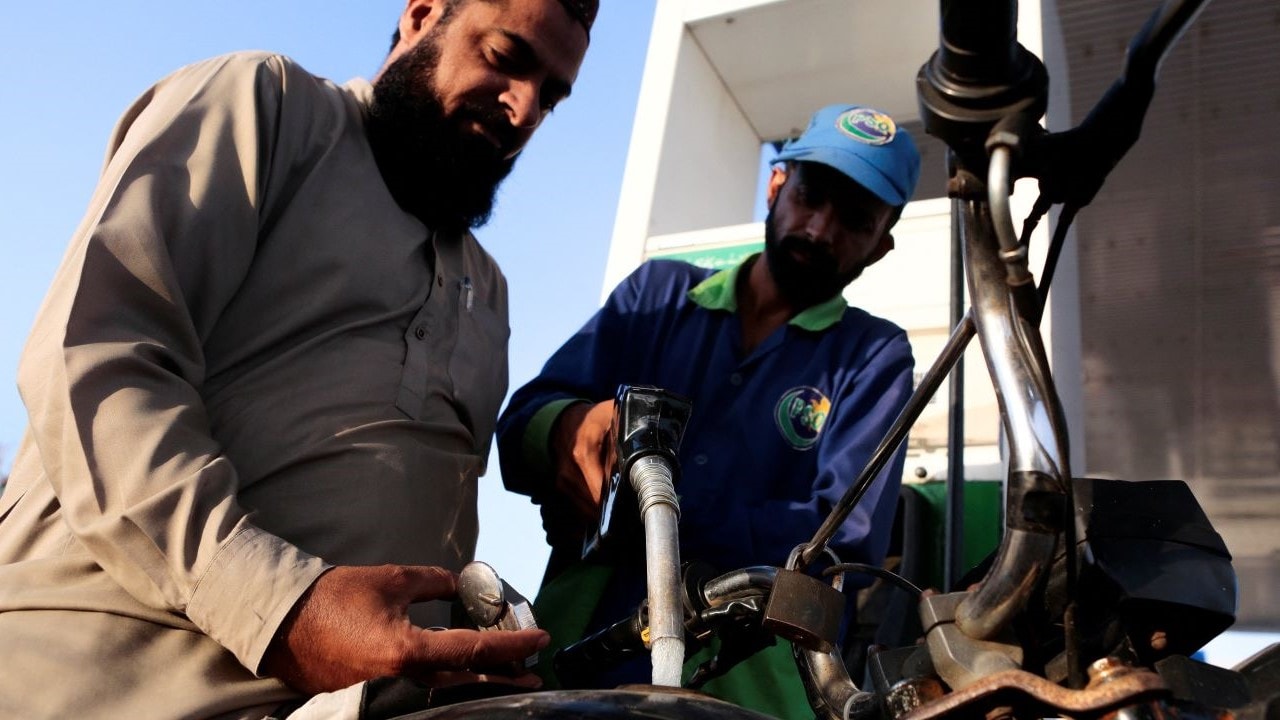
The Pakistani media is currently awash with collective euphoria because Prime Minister Shehbaz Sharif just slashed petrol and diesel prices by 22 rupees per litre. This is the third consecutive reduction in recent weeks, driving petrol down to roughly 381 rupees per litre and high-speed diesel to around 380 rupees. The Prime Minister’s Office is proudly parading this move as a hard-won victory for the common man. They are calling it a "gift." Transport alliances are eagerly cutting freight charges by 6%, and the public is breathing a sigh of relief.
It is a complete farce.
Cheering for cheap fuel in a structurally broken, import-dependent economy like Pakistan is equivalent to celebrating a high room temperature while the house is on fire. What the public sees as immediate relief is actually an economic ticking time bomb. The lazy consensus among local analysts is that lower domestic fuel rates will miraculously tame inflation and jumpstart growth. The reality is that these artificial reductions are undermining the country's long-term financial survival.
The Mirage of Public Relief
I have watched South Asian administrations play this exact populist game for decades, and it always ends in fiscal ruin. The narrative being sold is simple: international oil prices dipped due to a pause in regional conflicts, so the state is generously passing those savings directly to the citizens.
But look at the mechanics under the hood. Pakistan does not possess the sovereign wealth or the domestic production capacity to treat energy as a cheap commodity. Every single drop of refined petroleum product flowing into a local vehicle's tank requires foreign exchange reserves. When the state forces domestic retail prices down to chase a temporary dip in global benchmarks, it stimulates artificial demand.
Basic economic theory dictates that when you lower the price of a highly coveted, essential good, consumption spikes. In a self-sustaining economy, higher consumption is excellent. In Pakistan, higher fuel consumption means a wider current account deficit. The country must immediately export more US dollars to buy more oil to satisfy the newly induced demand of motorists who feel richer because of a 22-rupee discount.
Dismantling the IMF Premise
Let us tackle the core question that every local talk show host is asking the wrong way: "Why shouldn't the government give relief when global oil prices fall?"
The premise itself is fundamentally flawed. The question assumes that Pakistan's baseline economy is stable enough to afford a policy of pure pass-through pricing. It is not.
The International Monetary Fund (IMF) has repeatedly made one structural demand crystal clear to Islamabad: expand the tax base and maximize domestic resource mobilization. The petroleum levy is one of the very few highly efficient, non-evadable revenue collection mechanisms the federal government possesses. In a country where direct income tax compliance is notoriously low, the fuel pump functions as a critical revenue collector for the treasury.
When the state slashes prices by 22 rupees per litre instead of maintaining the price and pocketing the difference as an emergency fiscal cushion, it strips away its own revenue. Consider this thought experiment: Imagine a household that is drowning in millions of rupees of debt, unable to pay its electricity bills or fund its children's education without borrowing from neighbours. Suddenly, the father finds a 500-rupee note on the street. Instead of paying off a fraction of the debt, he buys ice cream for the neighborhood to show how generous he is. That is precisely what the state is doing with these fuel cuts.
By sacrificing the petroleum levy to secure short-term political popularity, the government ensures that it will have to beg for the next IMF tranche on even harsher terms later. The state is trading its future macroeconomic stability for a few weeks of positive headlines.
The Hidden Cost of the Subsidy Culture
The Prime Minister's Office boasted that during the height of the recent energy crisis, the government absorbed massive losses and provided over 130 rupees per litre in subsidies to prevent internal unrest. This is treated as a badge of honor. It should be treated as an admission of fiscal recklessness.
Subsidizing fossil fuels is the most regressive economic policy imaginable. Who benefits the most from cheap petrol? It is not the laborer walking to a factory or the family cramming onto a local bus. The primary beneficiaries are the affluent upper-middle class and wealthy elites who drive gas-guzzling sport utility vehicles and run high-capacity diesel generators to power their air conditioners.
| Consumer Segment | Primary Vehicle/Equipment | Real Benefit from Price Cuts |
|---|---|---|
| Elite / Upper-Middle Class | SUVs, Luxury Sedans, Large Generators | High (Massive volume consumption) |
| Commercial Transport | Heavy Trucks, Inter-city Buses | Medium (Offset by operational overheads) |
| Lower-Middle Class | 70cc Motorcycles, Auto-Rickshaws | Low (Minimal fuel tank capacity) |
| Vulnerable Segments | Public Transit, Walking | Negligible (Indirectly dependent on trickle-down) |
When you suppress the price of diesel and petrol across the board, you are using scarce public funds to bankroll the lifestyle of the rich. The counter-intuitive truth is that high fuel prices are exactly what Pakistan needs to force structural efficiency. High prices compel the market to conserve energy, reduce unnecessary consumption, and transition toward alternative solutions. By artificially depressing the price, the government removes any incentive for the country to break its crippling addiction to imported oil.
The Transportation Fallacy
The immediate defense of these price cuts is that they lower transport costs, which will subsequently bring down the price of food and essential goods. The Pakistan Goods Transport Alliance already announced a 6% reduction in freight charges. It sounds logical on paper, but the real-world market mechanics do not work that way.
Prices in a highly inflationary, unregulated market are notoriously sticky downward. When fuel prices skyrocket, traders, wholesalers, and retailers immediately hike the prices of milk, vegetables, and meat, citing increased transport overheads. However, when fuel prices drop by a marginal percentage, those same market actors rarely lower their retail prices. They pocket the difference as an expanded profit margin.
The consumer ends up paying the exact same price for groceries at the retail stall, while the state loses billions in potential tax revenue at the pump. The promised trickle-down relief to the average citizen is a structural myth.
Embracing the Pain
The alternative strategy is politically painful, which is why no administration in Islamabad wants to touch it.
The government should have held the line. When international oil prices dropped, the domestic price should have remained completely unchanged. The 22 rupees per litre should have been retained by the national treasury as an emergency debt-retirement fund or redirected exclusively into rebuilding the collapsing national electricity grid.
Yes, keeping fuel prices high while global rates fall would spark furious public protests. It would draw immense criticism from opposition parties. But leadership is not about handing out sweetmeats during a fiscal meltdown. True economic management requires structural discipline. If Pakistan ever wants to escape the exhausting cycle of boom-and-bust crises and continuous foreign bailouts, it must stop treating energy as a political tool. Cheap petrol is a luxury the country simply cannot afford.