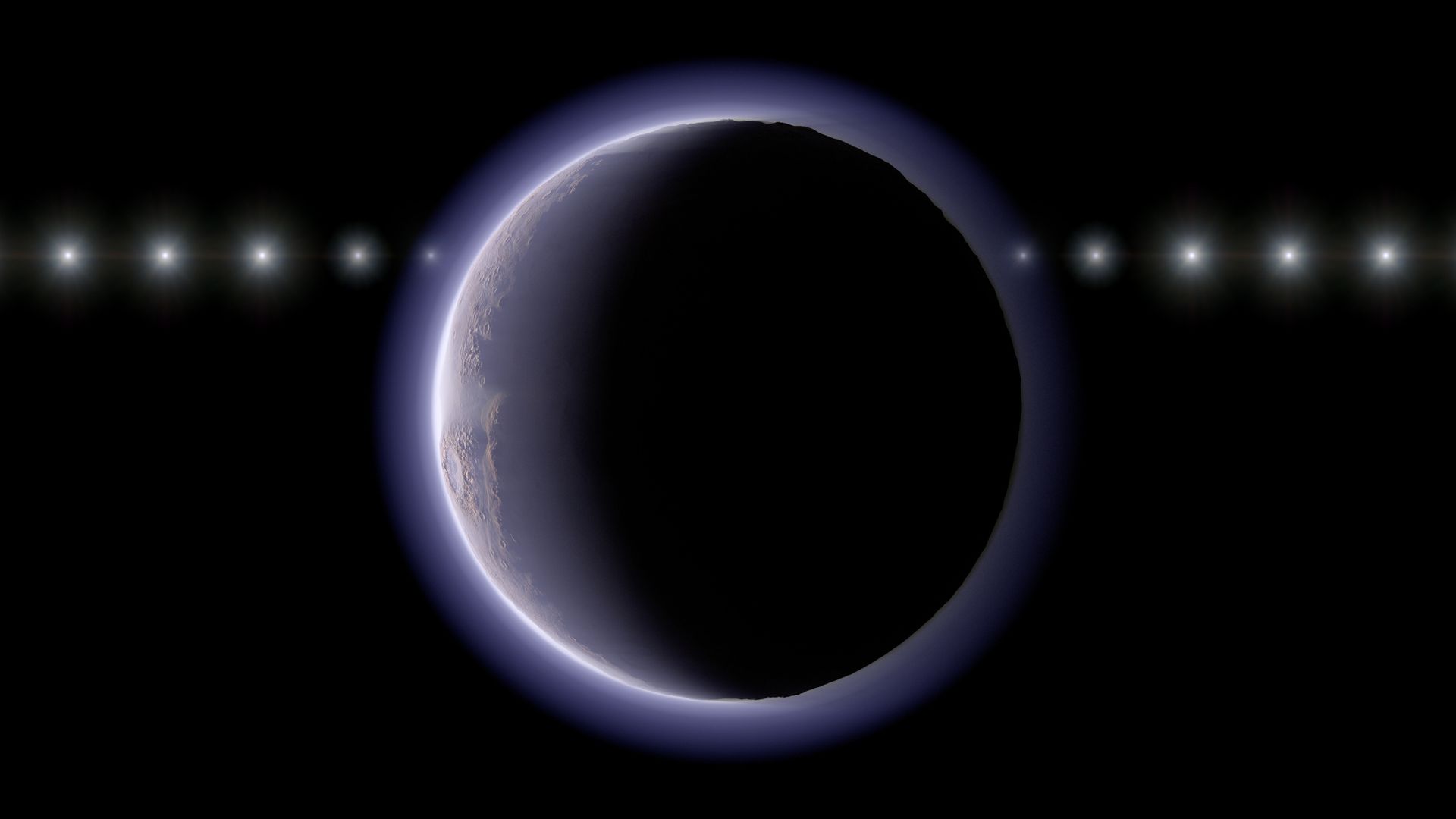
The headlines are screaming about a "Mini-Pluto" discovery beyond Neptune like it’s a theological breakthrough. It isn’t. We are currently witnessing a desperate attempt by legacy astronomy to keep the public engaged using a branding strategy that is scientifically bankrupt. Every time a survey telescope catches a glint of sunlight off a dirty ice ball in the Kuiper Belt, the media machine cranks out the same tired narrative: a "new world" with an "atmosphere" that "challenges everything we know."
It’s time to stop the charade. This isn't a Mini-Pluto. It’s a Trans-Neptunian Object (TNO) behaving exactly as the laws of orbital mechanics and thermodynamics dictate. If we want to actually understand the outer solar system, we have to stop treating these objects like misplaced planets and start seeing them as the debris field they actually are.
The Atmosphere Myth and the Pressure Trap
The clickbait articles love to lead with the "atmosphere" hook. It sounds breathable. It sounds like Earth. In reality, what they are calling an atmosphere is a transient, pathetic haze of sublimated nitrogen and methane that only exists because the object is currently at its perihelion—the closest point in its orbit to the Sun.
Imagine a block of dry ice in a vacuum. If you shine a flashlight on it, a few molecules will jitter off. That isn't an "atmosphere" in any functional sense; it’s a temporary leak. These objects have such low surface gravity that they cannot hold onto a permanent gas envelope.
The physics here is governed by the Jeans escape mechanism. For a body to maintain a gas layer, the thermal velocity of the gas molecules must be significantly lower than the body's escape velocity ($v_e$).
$$v_e = \sqrt{\frac{2GM}{R}}$$
Where:
- $G$ is the gravitational constant
- $M$ is the mass of the object
- $R$ is the radius
On these so-called "Mini-Plutos," $M$ is negligible. The "atmosphere" is literally bleeding into space in real-time. To report this as a feature of the planet is like reporting the steam rising off a hot cup of coffee as a "localized weather system." It’s technically true and intellectually dishonest.
The Kuiper Belt is Not a Trophy Case
I have spent years watching funding committees prioritize "planet-like" discoveries over raw data analysis of the Kuiper Belt’s structure. We are obsessed with finding individuals when we should be studying the swarm.
The "lazy consensus" is that the outer solar system is a dark, empty void punctuated by the occasional rare gem. The reality is far more crowded and far more chaotic. We aren't looking at a few "Mini-Plutos"; we are looking at the leftover scraps of a failed construction project. When the giant planets—Jupiter, Saturn, Uranus, and Neptune—migrated billions of years ago, they kicked these icy rocks into the cheap seats of the solar system.
By hyper-focusing on one "new" discovery, we miss the resonance patterns. We ignore the way Neptune’s gravity sculptures the entire region. The "Mini-Pluto" in the news is likely in a 2:3 or 3:5 orbital resonance with Neptune. That’s the real story. The math is the story. The ice ball is just the medium.
Why the Pluto Comparison is Insulting to Pluto
Pluto is a complex, geologically active world with cryovolcanoes and a massive liquid water ocean hiding beneath its crust (as suggested by the New Horizons data from 2015). Calling a 400-kilometer-wide rock a "Mini-Pluto" because it has some nitrogen frost on it is like calling a puddle a "Mini-Pacific Ocean."
It creates a false equivalence that diminishes the actual complexity of dwarf planets. To be a "Pluto-class" object, you need enough mass to reach hydrostatic equilibrium—meaning your gravity is strong enough to pull you into a sphere. Many of these new discoveries are barely spherical; they are lumpy, elongated potatoes that just happened to get a good photographer.
The Funding Industrial Complex
Why does this happen? Follow the money.
NASA and the European Space Agency need public "wins" to justify the billions spent on survey telescopes like the Vera C. Rubin Observatory. "We found another TNO with a predictable albedo" doesn't get a segment on the evening news. "Mini-Pluto Found" does.
I’ve seen researchers massage their findings to emphasize "planetary characteristics" specifically because it increases the chances of their paper being picked up by major outlets, which in turn leads to higher citation counts and easier grant renewals. It’s a feedback loop of hyperbole.
The downside to this contrarian view? It’s boring. It doesn't sell t-shirts. But it’s the truth. We are populating our mental maps of the solar system with ghosts and exaggerations.
The Albedo Deception
One of the biggest tricks in these "discovery" articles is how they calculate size. Because these objects are so far away, we can't see their diameter directly. We see a point of light. We estimate the size based on how much light it reflects—its albedo.
If an object is covered in fresh nitrogen ice, it’s highly reflective. It looks "big." If it’s covered in dark, organic tholins (basically space soot), it looks "small."
We have "discovered" objects that turned out to be much smaller than initially reported once we got a better look at their heat signature. The "Mini-Pluto" of today could easily be the "Medium-Sized Comet" of tomorrow once the surface ice sublimates and we see the dark rock underneath.
Stop Asking if it’s a Planet
The most common question from the public is: "Is this the tenth planet?"
That is the wrong question. It’s a legacy question from a time when we thought the solar system had nine things in it and a lot of empty space. We now know there are likely hundreds of thousands of objects larger than 100 kilometers in the Kuiper Belt and the Scattered Disc.
If we called every one of them a "Mini-Pluto," the term would become meaningless within a decade. We are dealing with a population, not a pantheon.
The Cold Hard Physics of the Outskirts
The real value in these discoveries isn't the object itself, but what its orbit tells us about the "Missing Mass" of the solar system. There is a persistent discrepancy in the orbits of these distant objects—a clustering that some suggest points to a "Planet Nine."
But every time we find a "Mini-Pluto" that doesn't fit the clustering, the Planet Nine hunters get quiet. The industry wants a "Planet Nine" because it’s a narrative masterpiece. It’s a mystery to be solved. But what if the "clustering" is just an observational bias? We look where our telescopes are pointed. We find what we expect to find.
If we want to be serious about space exploration, we have to kill the "Planet" fetish. We need to start categorizing the solar system by its dynamic zones:
- The Inner Churn: Mercury to Mars.
- The Gas Giants: The lords of mass.
- The Kuiper Debris: The frozen record of the early system.
The "Mini-Pluto" in the news belongs to the third category. It’s a fossil. It’s a piece of debris. It’s an icy scrap of history that tells us how the big players moved 4 billion years ago.
Stop looking for another Pluto. Pluto was the fluke that we happened to find early because its orbit brings it relatively close. The rest of the belt is a graveyard of "almost-planets" that never had a chance.
Treating these discoveries as anything else isn't science—it's PR. And we've had enough of that. If you want to find a new world, go build a warp drive. If you want to understand this solar system, stop naming the rocks and start doing the math.