Most product reviews are written by people who copy spec sheets. They look at a slick plastic cylinder, see a high price tag, and assume it works miracles. It does not.
Every year, affiliate marketing sites churn out the same tired listicles. They rank tower fans, bladeless loops, and smart circulators based on aesthetics and bogus marketing metrics. They tell you to spend $300 to stay cool. They are lying to you, or they simply do not understand basic physics.
I have spent over a decade analyzing home climate systems, airflow dynamics, and consumer hardware. I have watched manufacturing brands slap a digital screen and a Wi-Fi chip onto a basic electric motor, mark up the price by 600%, and watch desperate, sweating consumers hand over their credit cards.
It is a scam.
If you want to stop burning money, you need to understand that most premium cooling fans are engineered for showroom floors, not actual thermodynamics.
The Fundamental Flaw of the Cooling Fan
Let us start with a brutal truth that the appliance industry tries to bury.
Fans do not cool rooms. They cool people.
Unless a fan is connected to a refrigeration cycle or an evaporative media intake, it cannot lower the ambient temperature of a sealed space by even a fraction of a degree. In fact, due to the laws of thermodynamics, the electric motor of a running fan actually introduces a small amount of heat into the room.
A fan keeps you cool through a single biological mechanism: accelerating the evaporation of sweat from your skin. This process, known as forced convection, strips the thin, insulating boundary layer of warm, humid air away from your body.
When a company charges you $400 for a "premium cooling experience," they are charging you for a luxury delivery system of the exact same air that a $20 box fan moves. The air molecules do not care if they were pushed by a hand-carved wooden blade, a hidden impeller, or a cheap piece of injection-molded plastic.
The industry wants you to believe that advanced engineering creates "better" cold air. It is marketing fiction. Air movement is a solved science.
The CFM Deception
Go to any major retail site and you will see buyers obsessing over CFM, or Cubic Feet per Minute. Manufacturers love to flash high CFM numbers to prove their product is a powerhouse.
Here is what they do not tell you: there is no universally enforced, standardized testing protocol for measuring residential fan CFM.
One manufacturer might measure CFM directly at the discharge grille using an anemometer, capturing the peak velocity at the dead center of the blade path. Another might place the fan in a specialized test chamber, measuring total volumetric flow over time. A third might simply calculate a theoretical maximum based on motor RPM and blade pitch, completely ignoring real-world aerodynamic drag and shroud losses.
More importantly, raw CFM is an incomplete metric. It completely ignores static pressure and velocity profile.
Imagine a fire hose and a backyard misting system. Both might push the same volume of water over an hour, but their delivery is entirely different. A high-CFM fan with zero static pressure cannot push air across a large room. The air stream destabilizes, hitting a wall of stagnant air and dispersing within three feet of the grille.
When you buy a fan based solely on a high CFM number printed on the box, you are buying a metric that has been optimized in a lab to trick you at the cash register.
The Tower Fan Trap
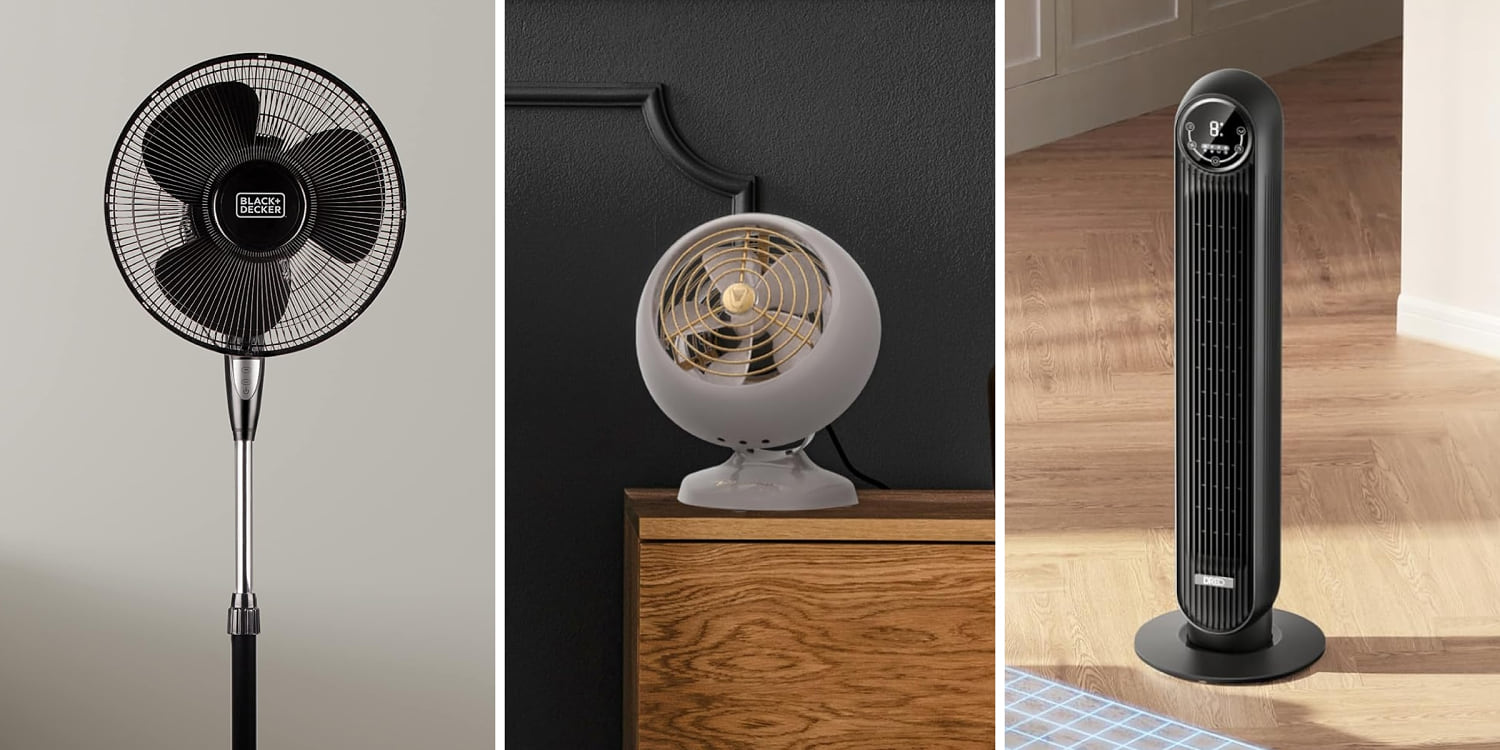
The modern obsession with the tower fan is a triumph of form over function. They are sleek. They take up a small footprint. They fit perfectly into the corner of a minimalist living room.
They are also aerodynamic disasters.
Standard pedestal and box fans use axial blades. These blades slice through the air, pushing it forward parallel to the motor shaft. It is an efficient, direct method of air displacement that has been refined since the industrial revolution.
Tower fans do not use axial blades. They rely on centrifugal impellers, also known as squirrel-cage blowers. These long, cylindrical drums draw air in and force it out at a 90-degree angle through a narrow vertical slot.
This design introduces massive internal resistance. The air must turn a sharp corner inside a cramped plastic housing before it ever reaches your face. To overcome this resistance and move a meaningful volume of air, the internal impeller must spin at incredibly high RPMs.
High RPMs mean two things: high-pitched, annoying acoustic signatures and rapid mechanical wear.
Because the exit aperture of a tower fan is a narrow, restrictive slit, the air exits at a high velocity but with virtually no mass behind it. The stream shears against the still air of the room, creating turbulence that destroys the velocity of the air current within a few feet.
You are left with a noisy, fragile device that requires you to sit directly in front of its narrow exit column to feel any relief. But it looks nice, so reviewers keep giving it five stars.
The Bladeless Illusion
No discussion of overpriced fans is complete without addressing the bladeless phenomenon. These devices look like pieces of modern art. They promise smooth, uninterrupted airflow without the buffeting of traditional blades.
They are an engineering marvel, but they are an economic failure for the consumer.
A "bladeless" fan is not bladeless. The blades are simply hidden in the base. A small, high-speed brushless motor drives a mixed-flow impeller, forcing air up into a hollow ring. The air exits through a microscopic slit running around the inside of the loop, passing over an airfoil-shaped ramp.
This utilizes the Coandă effect. As the high-velocity air hugs the ramp, it creates a localized low-pressure zone. This vacuum draws surrounding air through the center of the ring, a process called entrainment. The manufacturer will claim this amplifies the initial airflow by fifteen times.
Technically, it does. But look at the efficiency trade-off.
To force air through that tiny internal slit, the motor in the base must work under immense static pressure. It screams like a miniature vacuum cleaner. To dampen this noise, manufacturers have to pack the base with acoustic baffles and sound-dampening foam, driving the size and cost up.
Furthermore, the velocity profile of a Coandă-effect fan is incredibly hollow. The air velocity is highest at the edges of the projected stream and drops off significantly in the center. If you are sitting ten feet away, the air stream has expanded and lost almost all its momentum.
You have paid a massive premium for a device that is louder at high speeds, less energy-efficient per cubic foot of moved air, and incredibly expensive to repair when the complex brushless motor controller inevitably fails.
The Industrial Air Mover Alternative
If the goal is purely to stay cool without spending a fortune, the solution does not live in the appliance aisle. It lives in the janitorial and industrial supply catalogs.
Enter the utility blower, also known as a carpet dryer or centrifugal air mover.
+---------------------------------------------------------------+
|                      FAN TYPE COMPARISON                      |
+------------------------+-------------------+------------------+
| Fan Type               | Real-World Throw  | Durability       |
+------------------------+-------------------+------------------+
| Premium Bladeless      | 6 - 8 feet        | Low (Complex)    |
| Standard Tower Fan     | 4 - 6 feet        | Low (Plastic)    |
| Industrial Air Mover   | 20 - 30 feet      | High (Commercial)|
+------------------------+-------------------+------------------+
These units are designed for one purpose: to move massive amounts of air under high static pressure across large surface areas. They use heavy-duty, oversized squirrel-cage impellers housed in rugged, aerodynamic scrolls.
Unlike a consumer tower fan, which chokes its own airflow through a tiny decorative slit, an industrial air mover features a wide, unrestrictive snout that projects a wide, dense beam of air along the floor or up a wall.
Because these units are engineered to run continuously for weeks at a time on commercial jobsites, they use heavy-gauge copper windings and ball-bearing motors. A mid-tier utility blower costing around $60 will easily outperform a $300 designer fan in terms of air velocity, column stability, and total room circulation.
The downside? They look like industrial equipment. They are usually bright yellow or construction orange. They do not blend into a mid-century modern aesthetic. They do not have Bluetooth.
But if your priority is survival during a summer heatwave rather than interior design coordination, the choice is clear.
The Fluid Dynamics of Home Cooling
Buying the right hardware is only half the battle. Most people place their fans entirely wrong, nullifying whatever efficiency the device possessed.
The standard move is to place a fan in the corner of a hot room and aim it directly at your face. This provides immediate, localized relief via the boundary-layer stripping we discussed earlier, but it does nothing to address the structural heat load of the environment.
To maximize a fan, you must understand fluid dynamics and the principle of cross-ventilation.
Air behaves like a fluid. It follows the path of least resistance, and it responds directly to pressure differentials. If you want to cool a space down using outdoor air during a cool evening, do not stick a fan in the window blowing inward.
Instead, place the fan about three to five feet away from an open window, facing outward toward the exterior of the house.
This sounds completely counter-intuitive to the average consumer. Why blow air out when you want cool air in?
The answer lies in Bernoulli's principle. As the high-velocity stream of air leaves the fan and heads toward the window, it drags the surrounding indoor air along with it through viscous shear. This creates a low-pressure zone inside the room.
If you open a second window on the opposite side of the house, cooler outdoor air will rush in to fill that pressure deficit. By blowing air out, you create a powerful, whole-house directional wind tunnel that clears out stagnant thermal mass far faster than a standard window fan pushing air inward.
Structural Hardcore Realism
Let us be completely transparent about the trade-offs of this contrarian approach.
If you abandon the sleek, high-priced consumer options for industrial utility blowers or high-velocity axial air circulators, you are making compromises.
- Acoustics: Industrial air movers do not have a "whisper mode." They emit a low, mechanical hum. It is a consistent white noise, but it will interfere with low-volume television viewing or delicate audio recording.
- Aesthetics: Your living room will look less like a tech influencer's haven and more like a commercial restoration site.
- Controls: You will generally lose the luxury of remote controls, sleep timers, and smart-home integrations. You get a heavy-duty rotary switch with three distinct speed positions.
If those trade-offs are unacceptable, then by all means, pay the aesthetic tax. Hand over several hundred dollars to a premium lifestyle brand. Just do so with the full awareness that you are paying for plastic styling and a logo, not thermal performance.
Stop looking at buying guides that treat cooling fans like fashion accessories. Look at the motor wattage, look at the housing aerodynamics, and stop letting slick marketing campaigns dictate how you manage the fluid dynamics of your home.