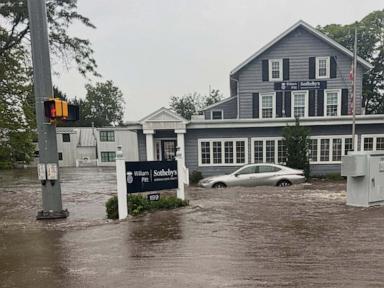
Every time a few inches of water pooling across coastal Connecticut, New York, and New Jersey make the evening news, the script writes itself. Reporters stand ankle-deep in suburban runoff, blaming angry skies, climate volatility, and historical storms. Meteorologists wave their arms at atmospheric rivers and saturated soils. The public nods along, shaking their heads at the sheer wrath of nature.
It is a convenient fiction.
Nature does not flood suburbs. Municipal zoning boards, decades of tax-hungry real estate development, and asphalt-obsessed civil engineering do. When we pave over every square inch of natural watershed, strip away the wetlands that act as ancient sponges, and build million-dollar subdivisions on top of historical floodplains, a heavy downpour is not a natural disaster. It is an invoice. And payment is due.
Let us dismantle the lazy consensus that Mother Nature is waging a rogue war against the tri-state area.
The Infrastructure Gaslighting
For years, local governments have hid behind the phrase once-in-a-century storm. This is statistical malpractice. When storms that supposedly happen every hundred years occur three times in a decade, your baseline is broken. Yet planners keep using legacy hydrology data from the mid-twentieth century to permit developments built for twenty-first-century density.
I have watched developers spend millions on cosmetic drainage systems while ignoring the macro-hydrology of the basin. You cannot pour concrete over every acre of permeable soil from Fairfield County down through the Meadowlands and act surprised when the water refuses to vanish into thin air. Water goes where gravity takes it. If you pave its path, it finds your basement.
Insurance companies are complicit in this theater. By treating flood zones as moving targets and federalizing the risk through subsidized programs, they insulate developers from the true cost of bad geography. If every coastal municipality had to internalize the full financial cost of rebuilding in a basin that wants to be a marsh, shovels would stop hitting dirt tomorrow.
The Myth of the Quick Fix
Whenever property values dip after a washout, politicians trot out proposals for multi-million-dollar sea walls, bigger retention basins, and emergency pumping stations. These are placebo projects. They treat the symptom while subsidizing the disease.
Engineering your way out of poor land use is like trying to bail out the Titanic with a thimble while someone keeps drilling new holes in the hull. Every seawall alters currents elsewhere. Every channelized river accelerates downstream velocity, turning a manageable surge into a kinetic battering ram for the next town downstream.
We do not need better pumps. We need urban shrinkage. We need the courage to admit that certain parcels of land should never have been zoned for human habitation, let alone high-density housing or commercial strip malls.
What You Should Do Instead
Stop looking at weather forecasts as acts of God and start looking at municipal master plans as acts of fiction. If you are buying property in the tri-state corridor, do not trust FEMA flood maps that rely on outdated topography. Look at historical maps from a century ago. Find out where the creeks used to run before someone put a pipe over them and named a cul-de-sac after the displaced wildlife.
If your basement floods every time the sky opens up, stop blaming the rain. Blame the system that prioritized short-term property tax revenue over basic physics.
The water is merely reclaiming its property. It is time we let it.