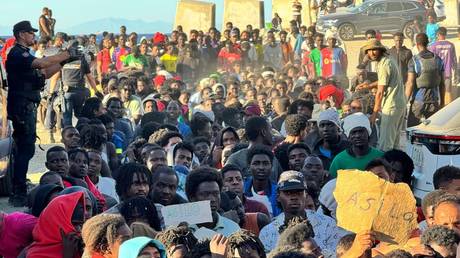
Every time a few hundred people sprint across a border fence in North Africa, the geopolitical commentariat loses its collective mind. Pedro Sánchez takes the punches in Madrid, Brussels convenes another emergency panel of bureaucrats who specialize in sounding deeply concerned while achieving precisely nothing, and the mainstream press recycles the exact same tired script about migration management failures.
It is a lazy, superficial narrative. It completely misses how modern sovereign leverage actually works.
If you think the pressure points at the Spanish enclaves of Ceuta and Melilla are merely humanitarian anomalies or administrative slip-ups by the Moncloa Palace, you are looking at a shadow on the wall and mistaking it for reality. The border crossings are not bugs in the diplomatic operating system. They are features. They are calculated, pressure-tested instruments of transactional statecraft used by external actors to extract concessions, test European resolve, and expose the hollow core of the bloc's southern defense strategy.
Blaming Madrid is safe. It lets the rest of the European Union pretend that borders are simple lines on a map rather than complex economic and diplomatic pressure valves. Let us tear down that consensus.
The Geography of Leverage
To understand why the standard criticism of Sánchez falls flat, look at the actual mechanics of the border. Ceuta and Melilla are geographic paradoxes. They are patches of Europe physically grafted onto the African continent, entirely dependent on Moroccan cooperation for daily supplies, municipal stability, and basic security management.
When migration spikes happen at these gates, the mainstream analysis always frames it as a failure of Spanish policing or European Frontex deployment. That is an amateur's diagnosis.
I have watched diplomats negotiate in smoke-free rooms across Geneva and Brussels for years, and the fundamental rule of cross-border migration is rarely discussed out loud: migration is a controlled asset class for transit states. When Rabat wants to signal displeasure over Western Sahara diplomacy, trade agreements, or agricultural quotas, the tap gets turned. When Rabat wants European development funds or counter-terrorism intelligence sharing, the tap gets closed.
Sánchez does not control the tap. He simply inherits the flood.
Criticizing the Spanish Prime Minister for failing to stop human desperation with concrete and razor wire is like blaming a ship captain for a hurricane. The structural reality is that Spain acts as Europe's political shock absorber. Madrid absorbs the domestic political blowback so that Paris, Berlin, and Brussels can maintain their clean, detached veneer of human rights advocacy while relying on third-party states to do their dirty work.
Dismantling the Brussels Bureaucracy Myth
When the European Union convenes emergency summits over Mediterranean crossings, the script is always identical. Expressions of solidarity are traded like diplomatic currency. Promises of border reinforcement funds are announced with great fanfare.
Yet, these funds rarely solve the underlying vulnerability. Why? Because Europe prefers deniable outsourcing to actual strategic integration.
Imagine a scenario where the European Union fully internalizes Ceuta and Melilla not as Spanish border towns, but as core external flashpoints of the entire Schengen zone, backed by the collective economic and military weight of twenty-seven nations rather than just a strained Madrid budget.
If Brussels treated an incident in Ceuta with the same collective defense urgency as an incident in the Baltic states, the calculus in Rabat would shift overnight. But Brussels will never do that. Why? Because compartmentalizing the crisis allows Northern European capitals to lecture Southern Europe on border management while conveniently keeping the physical and moral burden thousands of miles away from their own voters.
This is the hypocrisy at the heart of the European project. Spain is expected to be a fortress and a diplomat simultaneously, holding the line against demographic and economic pressures while adhering to human rights standards that the architects of the EU migration pact would never dream of enforcing on their own external frontiers.
The Economic Realities Nobody Mentions
Let us talk about the data that the pundits ignore. Migration flows are directly correlated with economic shocks, climate volatility, and the deliberate weaponization of geopolitical friction.
When commentators demand stricter enforcement, they are usually talking about symptoms, not causes. You cannot police your way out of a demographic gradient. When the economic disparity between a neighboring state and the EU internal market is astronomical, no wall is high enough and no police force is brutal enough to permanently suppress human movement.
The real failure of the Spanish government—and the wider EU—is not a lack of physical security infrastructure. It is the absence of a coherent, long-term economic partnership model that replaces transactional blackmail with genuine integration. For decades, European foreign policy in North Africa has relied on a paternalistic aid-and-containment framework. You give us border control; we give you development aid packets that disappear into bureaucratic black holes.
It is a failed model. It incentivizes transit countries to maintain a perpetual state of controlled crisis to ensure the aid checks keep clearing.
Sánchez is caught in this trap. If he pushes too hard for structural changes, he risks breaking fragile bilateral diplomatic ties. If he yields too easily, he hands ammunition to domestic political opponents who weaponize every crossing to paint him as weak on national sovereignty.
The Uncomfortable Truth About Sovereignty
The core misconception is that sovereignty in the twenty-first century is territorial. It is not. Sovereignty is functional.
Spain's sovereignty over Ceuta is absolute in legal theory, but completely porous in practical execution. The moment a neighboring government decides that its strategic interests are better served by looking the other way, Madrid's territorial control becomes secondary to Rabat's geopolitical willpower.
Pretending otherwise is a comforting delusion for voters who want simple answers to complex global shifts. It allows opposition politicians to score cheap points about weak borders, and it allows European commissioners to issue solemn press releases that change nothing on the ground.
Until Brussels and Madrid stop treating migration as a localized policing problem and start treating it as a systemic failure of foreign economic policy, the cycle will repeat. Every few months, the fences will be tested. Every few months, the cameras will roll. Every few months, the politicians will posture.
Stop looking at the fence. Look at the balance of power that built it.