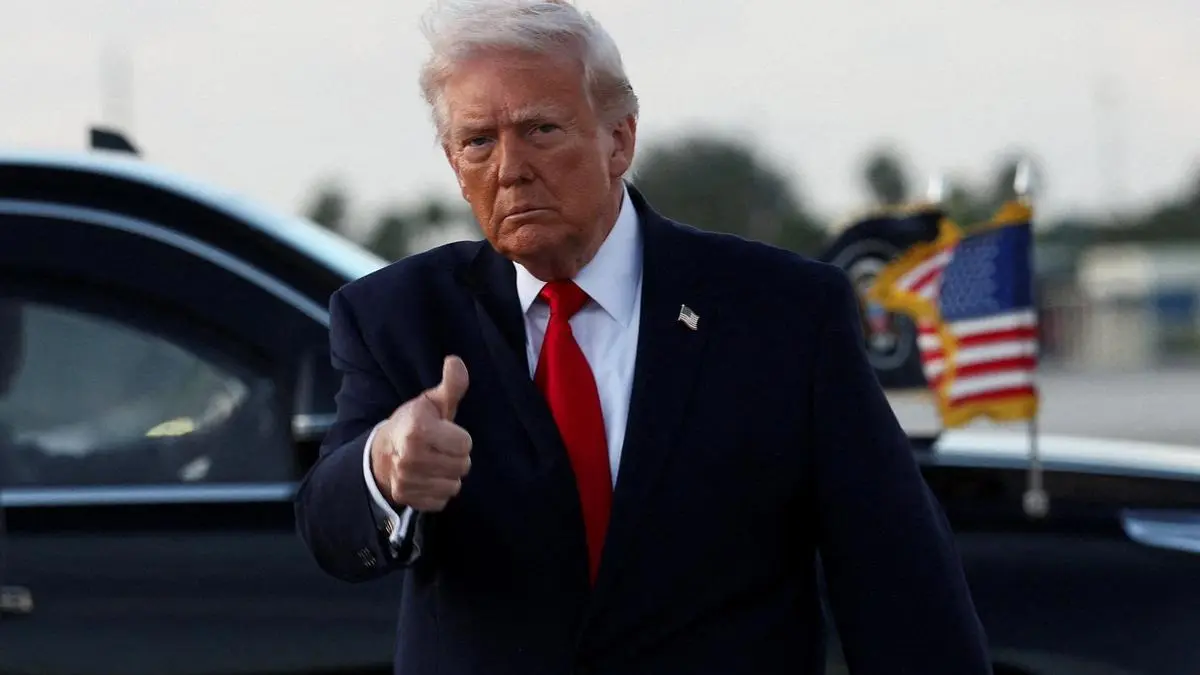
The sea does not care about politics, but it is where politics goes to become physical. On a map, the Persian Gulf looks like a narrow throat. On the water, it feels like a pressure cooker. When Donald Trump shares an article suggesting a naval blockade of Iran, he isn't just talking about ships and steel. He is talking about a total reconfiguration of how the world breathes.
Think about a container ship captain. Let's call him Elias. He is responsible for three hundred million dollars’ worth of cargo and the lives of twenty-two crew members. Every time he nears the Strait of Hormuz, he feels a tightening in his chest that no amount of sea-time can erase. To Elias, a blockade isn't a policy paper or a campaign promise. It is the sight of a gray hull on the horizon. It is the sudden silence on the radio. It is the realization that the path home has been erased by an order from a desk seven thousand miles away. You might also find this similar story insightful: Why the Catholic Church is finally forced to talk about polygamy.
The mechanics of a blockade are deceptively simple and terrifyingly absolute. You stop the flow. You check the papers. You turn the ships around. But the ripples of that action move faster than the vessels themselves.
The Cost of a Closed Door
Money is cowed by uncertainty. The moment a blockade becomes a serious proposal rather than a fringe theory, the insurance markets in London begin to twitch. Risk premiums on tankers don't just rise; they spike. We see this in the grocery aisles and at the gas pumps before a single shot is ever fired. As highlighted in recent reports by USA Today, the results are worth noting.
The proposal shared by the former president suggests a return to "maximum pressure" with a physical edge. It posits that the only way to truly decapitate a regime’s influence is to sever its primary artery: oil. Iran’s economy is a house built on black gold. If you take away the ability to move that product through the Gulf, the house doesn't just shake. It collapses.
But a blockade is a heavy instrument. It is not a scalpel; it is a sledgehammer. History shows us that when you corner a nation at sea, the response is rarely a quiet surrender. It is a desperate lashing out. Small, fast attack boats. Mines that drift like ghosts beneath the surface. The "Tanker War" of the 1980s proved that once the cycle of escalation begins, the ocean becomes a graveyard for commerce.
Elias knows this. He knows that his massive, slow-moving vessel is a target the size of a city block. In a world of high-tech missiles and low-tech drones, the "security" provided by a blockade can feel a lot like being caught in a crossfire.
The Invisible Stakes of Sovereignty
There is a legal fiction that the high seas belong to everyone. In reality, they belong to whoever has the biggest engine and the longest reach. By floating the idea of a naval blockade, the conversation shifts from diplomatic maneuvering to a direct challenge of international maritime law.
A blockade is an act of war. Traditionally, you don't do it unless you are prepared for the full consequences of that definition. The proposal suggests a shift in the American appetite for risk. It asks the American public—and the world—a pointed question: Is the containment of Iran worth the potential of a global energy shock?
Consider the butterfly effect of a shuttered strait. A factory in South Korea slows its production because the energy costs have doubled. A family in Ohio pays an extra forty dollars a week for fuel, money that was supposed to go toward a child’s braces. The geopolitical becomes the personal with brutal efficiency.
We often treat these headlines as abstract chess moves. We talk about "projecting power" and "leveraging assets." But power is only projected when someone is willing to stand on a vibrating deck in the middle of a heatwave, staring through binoculars at a ship that refuses to stop.
The Friction of Reality
The logistics of a blockade are a nightmare of scale. The Strait of Hormuz is only 21 miles wide at its narrowest point. That sounds small, but it is a vast, churning highway of water. To "enforce" a blockade means constant surveillance, boarding parties, and the ever-present threat of a mistake.
One nervous sailor. One misinterpreted radio transmission. One mechanical failure on a drone. That is all it takes for a blockade to turn into a conflagration.
The article shared by Trump points toward a philosophy of dominance. It argues that the current approach has failed to produce results and that a physical barrier is the only language the Iranian leadership understands. This is a return to the "Big Stick" policy, updated for an era of satellite tracking and hypersonic threats.
But what happens when the "Big Stick" hits something that won't break?
The Iranian strategy has always been one of asymmetric resistance. They don't need a navy that can match the United States ship for ship. They only need to make the cost of presence too high to bear. They use the geography of the Gulf—the tiny islands, the hidden coves, the shallow waters—as a force multiplier.
The Human Core of the Conflict
Behind every statistic about "barrels per day" are the people who actually move the world. The sailors, the port workers, the families living along the coast of the Gulf who watch the horizon for signs of trouble.
For them, the rhetoric of a blockade isn't a debate topic. It is an existential threat. They live in the shadow of the world's most vital chokepoint. If the door slams shut, they are the ones caught in the doorframe.
We tend to look at these issues through the lens of our own borders. We ask what it means for our interests, our security, our economy. But the sea connects everything. A blockade in the Persian Gulf is a tremor felt in the ports of Rotterdam, the refineries of Singapore, and the boardrooms of New York.
It is a gamble. The proposal suggests that the pressure will force a breakthrough. The critics argue it will only force a breakdown.
The ocean remains indifferent. It carries the ships that are allowed to pass and hides the ones that are not. As the political winds shift and the talk of blockades grows louder, the men like Elias keep their eyes on the horizon. They know that in the end, it isn't the words of politicians that define the sea. It is the weight of the steel and the cold reality of the water.
The sun sets over the Gulf, turning the water into a sheet of hammered copper. For now, the tankers continue their slow, rhythmic crawl through the strait. They move with a deceptive peace, a fragile normalcy that depends entirely on the restraint of those who hold the keys to the gate. The steel ring remains a theory, a set of words shared on a screen, but the shadow it casts is already long, stretching across the waves and into the lives of everyone who depends on the flow of the world.