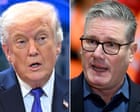
The phone sits on a mahogany desk in Downing Street, a heavy, silent weight in a room built for history. Outside, the London rain streaks the windows of Number 10, turning the familiar gray of the city into a blurred watercolor. Inside, the air is thick with the specific, metallic tension of a diplomatic crisis. Keir Starmer reaches for the receiver. This isn’t a casual check-in. It is a repair job.
Across the Atlantic, the air is different. It is charged, electric, and notoriously unpredictable. Donald Trump does not do diplomatic "gray areas." He prefers the stark contrast of loyalty and abandonment, of strength and perceived weakness. When he picked up his end of the line, the grievance was already aired, public, and pointed: the UK had stayed home while American jets were in the air over Iran.
To understand the weight of this silence, you have to understand the geography of an alliance. For decades, the "Special Relationship" has been described in the lofty language of shared values and democratic bastions. In reality, it is more like a high-wire act performed by two people who haven’t practiced together in years. One is a cautious former prosecutor who values process, law, and the steady hum of institutional stability. The other is a disruptor who views institutions as obstacles.
When the US launched strikes against Iranian targets, the expectation from the Oval Office was a chorus of support—or better yet, a wingman. London’s decision to hang back wasn't just a military calculation; it was a statement of sovereignty that hit a very specific American nerve.
The Anatomy of a Cold Shoulder
Imagine you are a diplomat in a windowless room, staring at a secure monitor. You see the coordinates. You see the potential fallout. In the British strategic mind, every missile launched is a pebble thrown into a very volatile pond. They worry about the ripples—the shipping lanes in the Red Sea, the fragile peace in the Levant, the domestic blowback in a country already weary of "forever wars."
But to the Trump administration, this caution looks like a flickering flame. It looks like a partner who wants the protection of the umbrella but refuses to help hold the handle when the storm breaks. Trump’s public criticism wasn't just about military strategy. It was about brand. If you aren't with him, you are an "other." And being an "other" in the eyes of the world’s largest superpower is a cold, lonely place to be.
The phone call was Starmer’s attempt to pull the UK back into the warmth. It was a twenty-minute exercise in linguistic gymnastics. How do you defend your right to say "no" while desperately needing the other person to keep saying "yes" to trade deals, intelligence sharing, and NATO?
The Ghosts in the Room
Every British Prime Minister since Churchill has been haunted by the ghost of the 1956 Suez Crisis—the moment the United States flexed its muscles and reminded the UK that its days as a global hegemon were over. Conversely, they are haunted by the ghost of Tony Blair, whose "shoulder to shoulder" stance with George W. Bush led the country into the quagmire of Iraq, a ghost that still wanders the halls of Westminster, rattling its chains every time a Middle Eastern conflict flares up.
Starmer is walking between these two spirits.
He is trying to build a version of Britain that is "useful but not subservient." It is a difficult sell. Especially when the person on the other end of the line views the world through the lens of a balance sheet. To Trump, an alliance is a transaction. If the UK doesn't provide the "product" (military support), why should the US provide the "service" (security and favorable trade)?
During the call, the reports suggest a tone of "constructive dialogue." In the language of the Foreign Office, that usually means no one hung up, but no one is happy. Starmer likely spoke of the "long-term strategic interests" and the "shared goal of a stable Middle East." Trump likely spoke of "fairness" and "winning."
They are speaking two different languages using the same words.
The Invisible Stakes at the Kitchen Table
It is easy to dismiss this as high-level theater, a spat between two men in suits thousands of miles away. But the static on that phone line vibrates all the way down to the person filling up their car at a petrol station in Manchester or a small business owner in Ohio.
If the UK is sidelined by Washington, it loses its leverage in Europe. If the US feels abandoned by its oldest ally, it retreats further into isolationism, leaving a vacuum that less predictable powers are more than happy to fill. When the giants argue over Iran, the price of oil flinches. When the giants stop speaking, the world gets darker.
We often think of geopolitics as a game of chess, cold and calculated. It isn't. It’s a game of poker played by people who are tired, stressed, and deeply aware of their own legacies. Starmer knows that a single wrong word could pivot the UK into a decade of diplomatic irrelevance. Trump knows that his base thrives on the image of him "putting America first" and calling out "freeloaders."
The Art of the Repair
There is a specific kind of bravery in making that call. It is the bravery of the person who knows they are disliked in the moment but knows they cannot afford to be ignored. Starmer wasn't just talking to a President; he was talking to a reality. The reality is that Britain, for all its history, is a medium-sized island that needs a friend with a very big stick.
The conversation reportedly touched on the "enduring strength" of the bond. That is the diplomatic equivalent of saying "we’re still married for the sake of the kids." It doesn’t mean the passion is there. It doesn’t mean the trust is restored. It means the paperwork is still valid.
As the call ended and the line went dead, the silence in Downing Street likely felt different. Perhaps a little less heavy, but no less uncertain. The "lack of support" hasn't been forgotten; it has merely been filed away. In the high-stakes world of international relations, memories are long and ledgers are never truly balanced.
The rain continues to fall on the Thames. The lights stay on late in the Cabinet Office. Somewhere in the West Wing, a staffer briefs the President on the next move. The world spins on, held together not by grand treaties or soaring speeches, but by the fragile, often desperate attempts of two people to find a signal through the noise.
Starmer laid his hand on the table. Trump looked at the cards. The game continues, but the stakes have never been higher, and the room has never been quieter.