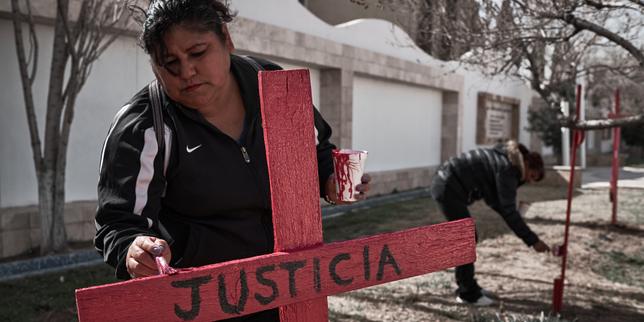
The room in Montreuil is cold, but the air is heavy with sweat and collective anxiety. A woman stands in the center of the makeshift stage. Her voice vibrates with a vulnerability that forces everyone in the room to look at their own shoes. She is acting, but she isn't lying. Across the ocean, in a sun-bleached square in Mexico, another woman is screaming the exact same words.
They are separated by thousands of miles, a massive expanse of dark ocean, and vastly different cultures. Yet, they are trapped in the exact same script.
Statistics have a formatting problem. They turn flesh, bone, and stolen futures into clean, sterile digits that we can look at, sigh over, and promptly forget. We read that a woman is killed by a partner or ex-partner every three days in France. We scroll past reports detailing the staggering reality in Mexico, where an average of ten women are murdered every single day. The mind numbs. The numbers act as armor, protecting us from the jagged reality of what those digits actually mean.
That is where interactive theater steps in. It smashes the armor. It takes the cold, clinical data of a global crisis and forces us to breathe the same air as the casualties.
The Script We All Know by Heart
Imagine a fictional composite of this reality, a young woman we will call Elena. Elena lives in the suburbs of Paris, or perhaps in the heart of Ciudad Juárez. The geography matters less than the anatomy of her isolation.
It never begins with a fist. It begins with a comment about a dress. A heavy silence after a text message rings. A slow, systematic erosion of her confidence until her world shrinks to the size of her partner’s shifting moods.
When traditional media covers Elena’s story, it usually happens at the end. The police tape is already up. The neighbors are offering shocked soundbites to a reporter holding a furry microphone. The narrative is treated as a sudden, unpredictable lightning strike.
But it isn't lightning. It is a slow, predictable, agonizingly logical progression.
Interactive theater—specifically the Forum Theater model pioneered by visionary practitioners like Augusto Boal—refuses to start at the end. It rewrites the relationship between the storyteller and the witness. In a traditional theater setting, you sit in the dark. You watch the tragedy unfold. You feel a pang of pity, perhaps a flash of anger, and then you check your phone and catch the metro home. You are a consumer of someone else’s misery.
In the community centers of Montreuil and the grassroots spaces of Mexico, that passive safety is revoked.
Dismantling the Wall Between Stage and Street
The performance begins like any other play. The actors portray a scene of domestic control, gaslighting, or escalating street harassment. The tension builds. The audience feels the familiar, suffocating knot of helplessness tightening in their stomachs.
Then, right at the moment of crisis, the director calls a halt.
The director turns to the audience and asks a deceptively simple question: "What could have been done differently?"
This is not a rhetorical exercise. The actors do not simply take notes and try again. Instead, a member of the audience—a baker from down the street, a high school student, a grandmother who has kept her own secrets for forty years—is invited to step out of the shadows. They walk onto the stage. They literally take the place of the protagonist or an onlooker.
They have to try to change the outcome.
The first time you see this happen, the awkwardness in the room is palpable. People fidget. We are conditioned to mind our own business, to look away when a couple is arguing too loudly on the bus, to treat domestic violence as a private tragedy rather than a public emergency. Stepping onto that stage requires a terrifying leap of faith.
When a spectator takes the stage, they immediately realize how heavy the air is. They try to speak calmly to the aggressor. The actor playing the aggressor pushes back, using the exact psychological manipulation verified by domestic abuse counselors worldwide. The spectator stumbles. They realize that their neat, theoretical solutions do not work when the adrenaline is pumping and the threat of violence is real.
This failure is not a defeat. It is the entire point of the exercise.
The Shared Geography of Terror
The connection between Montreuil, a commune in the eastern suburbs of Paris, and Mexico might seem tenuous at first glance. One is an urban space grappling with gentrification, multicultural integration, and European systemic pressures. The other is a vast country dealing with deep-seated institutional corruption, drug cartel violence, and a historic culture of machismo that treats women's bodies as territory to be conquered.
But the activists coordinating these cross-border theatrical initiatives recognized something profound: the psychological architecture of misogyny does not care about passports.
In Mexico, groups use theater to reclaim public spaces that have been poisoned by fear. When a performance takes place in a public plaza, it interrupts the daily routine of commerce and commuting. It forces the community to acknowledge the ghosts walking among them. It transforms a site of potential danger into a laboratory for collective defense.
When those techniques are brought back to the French suburbs, they carry that raw, survival-driven urgency with them. The French performances strip away the polite, intellectual distance that often sanitizes European discussions about human rights.
Consider the mechanics of an intervention. A spectator steps into a scene where a character is being systematically isolated from her friends. The spectator tries to intervene as a friend. They face the wall of denial. They learn, through trial and error, that calling out the abuser directly can sometimes escalate the danger for the victim. They practice subtle redirection. They learn how to offer a lifeline without triggering an immediate explosion.
They are training their muscle memory for real life.
The Invisible Weight of the Spectator
We often comfort ourselves with the myth of the monster. We want to believe that perpetrators of femicide are recognizable beasts, easily spotted and easily avoided.
The reality is far more terrifying. They are ordinary. They are our colleagues, our brothers, our neighbors. The systems that protect them are equally mundane: a police officer who refuses to take a report seriously, a family member who tells a woman to stick it out for the sake of the children, a culture that treats controlling behavior as a sign of passionate love.
Through interactive theater, the audience learns to see these supporting characters in the machinery of violence.
The true focus of a Forum Theater session is rarely the victim or the abuser. It is the bystander. It is the person who overhears the screaming through the apartment wall and decides not to call the authorities because they do not want to make a fuss. It is the coworker who notices the bruises but accepts the clumsy explanation about tripping over a rug.
By stepping onto the stage, the bystander is forced to confront their own complicity. They experience the terrifying friction of breaking the social contract of silence.
It is agonizingly difficult to watch. A young man from a local youth club steps up to intervene in a scene of street harassment. He stammers. His friends in the audience chuckle nervously. He tries again, changing his posture, using his physical presence to shield the actress playing the victim. The laughter dies down. The room shifts. Something fundamental has altered in the social dynamic of that neighborhood group. They have just watched one of their own define what bravery looks like in their own vocabulary.
Beyond the Final Curtain
This is not entertainment. It is a dress rehearsal for survival.
The critics of this approach argue that theater cannot fix broken judicial systems. They point out that a performance in Montreuil cannot reform a corrupt police force in Guerrero or fund more women’s shelters in Seine-Saint-Denis.
They are missing the forest for the trees.
Laws only work when the culture demands their enforcement. Governments only allocate resources when the public conscience finds the alternative intolerable. Interactive theater operates at the absolute root of the problem: the human heart and the local community. It builds an invisible network of people who have looked at violence without blinking, who have practiced the exact words needed to disrupt an escalation, and who refuse to look away when the script of tragedy begins to play out in their own apartment buildings.
The performance in Montreuil eventually ends. The house lights come up, casting a raw, unforgiving light on the scuffed linoleum floor. There is no polite, rhythmic applause. There is only a deep, collective exhale from a roomful of people who suddenly realize that the stage they have been watching is the very world they are about to walk back out into.