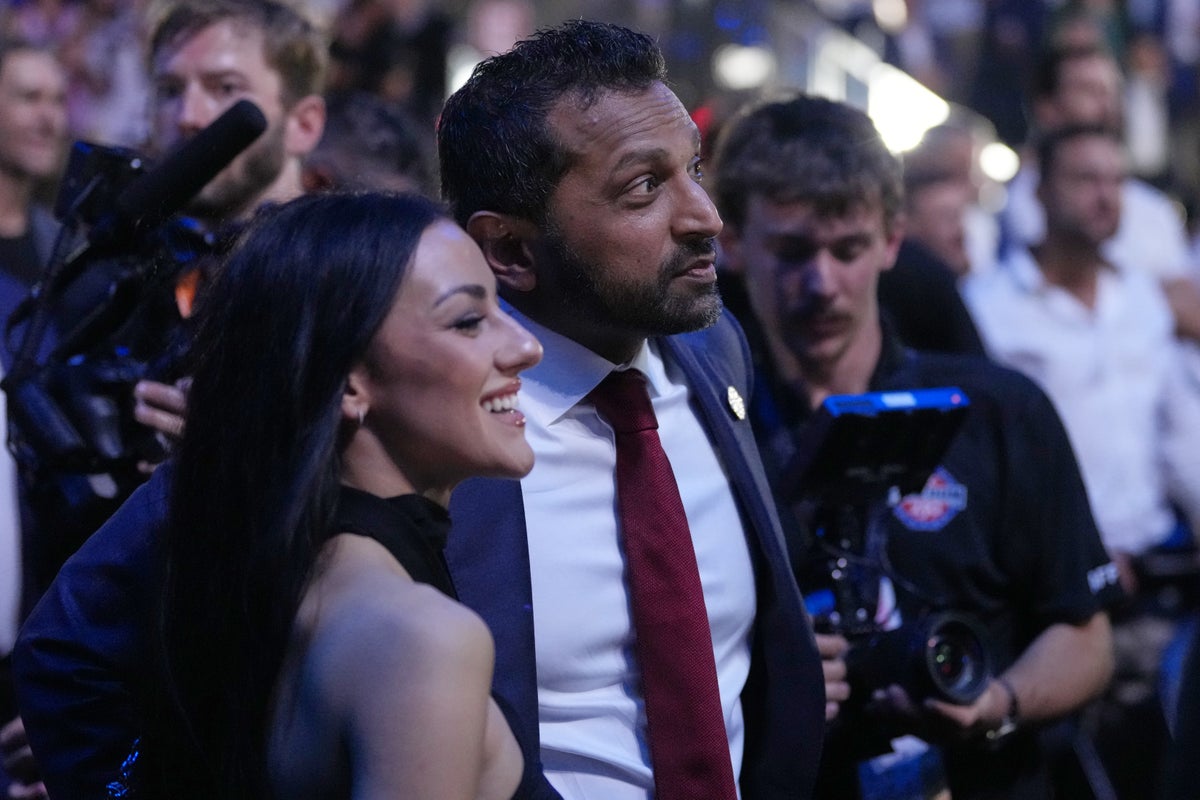
The lights inside an arena do not just illuminate a ring. They create a boundary. On one side of the velvet rope, twenty thousand people scream until their lungs raw, drowning in the scent of stale beer, expensive cologne, and sweat. They are there to watch two human beings attempt to dismantle each other for sport. It is loud. It is chaotic. It is entirely predictable.
On the other side of that same rope stand men and women who do not look at the fight. They stand with their backs to the action, earpieces molded to the contours of their ear canals, scanning faces. For them, the arena is not a theater of sports entertainment. It is a massive, multi-tiered security perimeter with thousands of variables, any one of which could turn a Saturday night into a national tragedy.
To pull off an event of this scale under the shadow of a credible threat requires an invisible, seamless machinery. Two entirely different federal agencies must bleed into one another. The Federal Bureau of Investigation tracks the shadows—the digital whispers, the overseas wire transfers, the radicalized lone wolves plotting in encrypted chat rooms. The Secret Service manages the physical reality—the metal detectors, the high-ground countersnipers, the evacuation routes that must remain clear even if panic erupts.
It is a relationship built on a fragile currency. Trust.
When that currency is devalued for a headline, the machinery breaks. And when the machinery breaks, the people on the floor are left exposed.
The Calculus of Silence
Imagine a field agent sitting in a parked sedan outside a suburban apartment complex, watching a window. Let us call him Miller. Miller has been awake for twenty-six hours. He is eating lukewarm gas station food, and his eyes burn from the blue light of a laptop screen tracking an active cell phone ping. He belongs to a Joint Terrorism Task Force. He knows that three days from now, a massive UFC event will draw international dignitaries, high-profile targets, and thousands of ordinary citizens into a single concrete bowl.
Miller also knows that a group of individuals has spent the last three weeks acquiring components that do not belong together. Fertilizer. Detonators. Maps of the arena’s loading docks.
In the world of counterterrorism, timing is everything. If you move too early, you scare the rats back into the woodwork. You arrest a man for possessing household chemicals, and a clever defense attorney gets him off on a misdemeanor. The network stays intact. The threat simply relocates. If you move too late, the bomb goes off.
The sweet spot exists in the razor-thin margin between preparation and execution. To hit that mark, the FBI and the Secret Service must operate like a single organism. The FBI gathers the wiretaps; the Secret Service adjusts the perimeter. If a suspect mentions an entry point, that entry point gets fortified by a dozen extra bodies in tactical gear before the sun rises.
But this coordination relies on a fundamental rule of the trade. You do not talk about the monster until it is safely in the cage.
When FBI Director Kash Patel stepped up to a microphone and prematurely announced that federal authorities had disrupted a major terrorist plot targeting a high-profile UFC event, that rule was shattered. To the public, it looked like a victory speech. A declaration of competence. A reassurance that the bad guys had been stopped.
To the Secret Service agents tasked with protecting the human beings inside that arena, it felt like an act of betrayal.
The Anatomy of an Outrage
The anger within the Secret Service following Patel’s announcement was not born out of professional jealousy. It was not a bureaucratic turf war over who gets credit for a successful bust. It was a matter of operational survival.
Consider what happens the moment a high-ranking official announces a disrupted plot while the investigation is still breathing.
First, the network scatters. A terrorist cell is rarely composed of just the three people holding the blueprints. There are financiers, suppliers, safe-house operators, and ideologues. When the director of the FBI tells the world that a plot has been foiled, every secondary player on the periphery of that plot burns their burner phones, flushes their hard drives, and vanishes. A chance to dismantle an entire network is traded for a single news cycle.
Second, the defensive posture must completely reset. The Secret Service builds its security plans based on specific intelligence. If they know the enemy is looking at Gate 4, they stack Gate 4. The moment the enemy realizes the government knows about Gate 4, the enemy changes the plan. The intelligence goes cold. Suddenly, the entire arena becomes a question mark again.
The men and women in dark suits are forced to scramble, re-evaluating every square inch of concrete under an immense cloud of uncertainty. They must look at the crowd and wonder if the partner of the man arrested yesterday is currently standing in line at the concession stand, carrying out a backup plan.
The friction between the agencies is old, rooted in a clash of cultures. The FBI is an investigative body. They look backward from a crime to find the perpetrators, or they look forward through a lens to prevent a future event by building a legal case. The Secret Service is a protective body. They do not care about the legal case. They care about the kinetic reality of a bullet or a blast. Their metric of success is a day where nothing happens.
When politics interfaces with intelligence, the protective mission is almost always the casualty. The Secret Service viewed Patel’s public revelation not as a strategic communication, but as an ego-driven leak that compromised ongoing surveillance and increased the risk to everyone inside the venue. It was an announcement that served the podium, not the perimeter.
The Cost of the Spotlight
We have grown accustomed to the theater of security. We take off our shoes at airports, walk through magnetometers at stadiums, and glance casually at the armed guards patrolling the entrances of political rallies. It provides a sense of comfort. A collective illusion that the world is ordered and protected.
But the real protection happens in the dark. It happens through quiet agreements between agencies that despise each other’s culture but respect each other’s capability. It happens when an FBI analyst shares a raw, unverified tip with a Secret Service detail leader at three o'clock in the morning, knowing it won't be leaked to the press or used to score points in a congressional hearing.
When leadership prioritizes the narrative over the operation, that willingness to share evaporates. Agents on the ground become defensive. They silo information. They protect their own data because they can no longer trust that their superiors won't weaponize it for a press conference.
The next time an analyst sees a red flag on a spreadsheet, they might hesitate. They might double-check the bureaucratic protocols before passing it up the chain. They might try to confirm it independently rather than risking a premature disclosure that ruins a month of fieldwork.
In the world of security, hesitation is measured in seconds. And seconds are measured in lives.
The lights eventually went down in the arena. The fighters walked out to their music, surrounded by the roar of a crowd that had no idea how close they had come to a different kind of history. The event passed without incident, a testament to the sheer grit of the personnel on the floor who managed to hold the line despite the noise coming from Washington.
But the damage to the infrastructure of federal law enforcement is not easily repaired with a clean safety record. Trust takes decades to build across agency lines. It requires thousands of shared cups of coffee, hundreds of midnight briefings, and a mutual understanding that the mission outlives the administration.
It can be undone by a single man, standing before a room of flashing cameras, eager to tell a story before the ending has actually been written.
The crowd went home happy that night, singing along to the arena speakers as they filed out into the cool night air, entirely unaware of the invisible fractures widening beneath their feet.