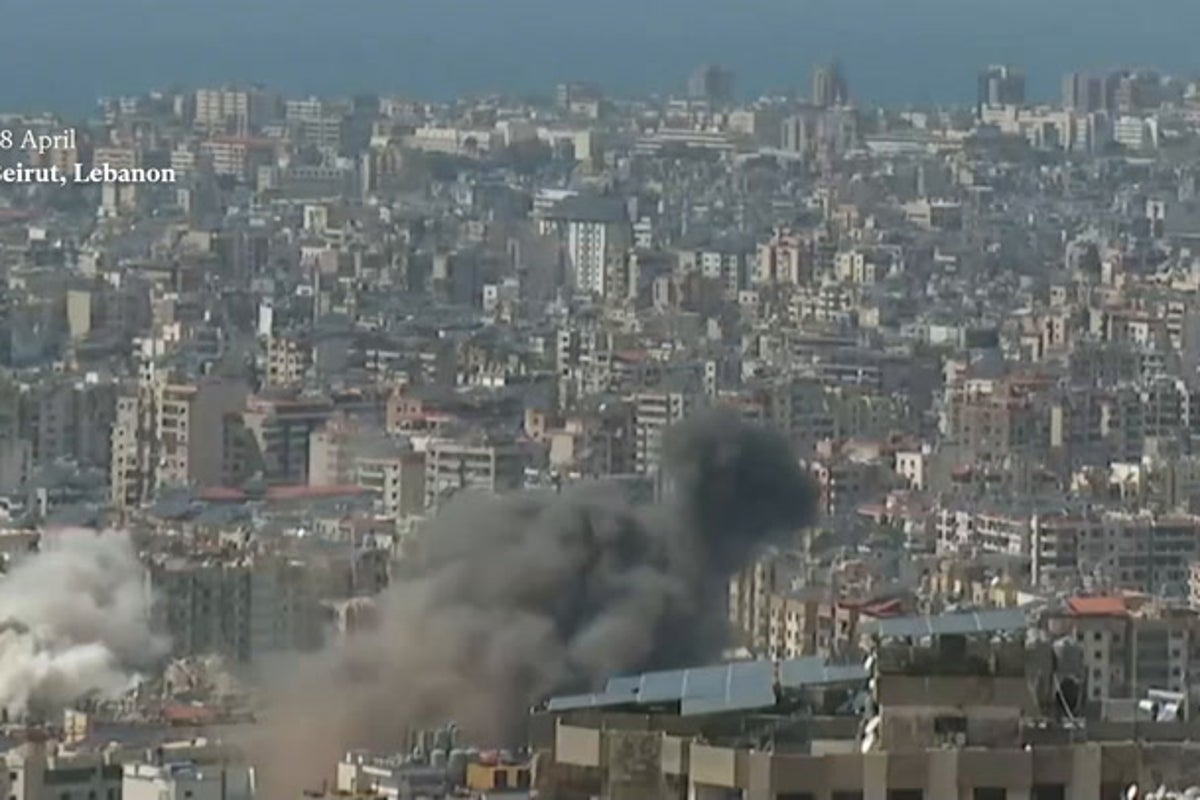
The camera sits on a tripod, staring across the border at the Lebanese skyline. Suddenly, the horizon erupts. Orange plumes of fire mushroom into the night sky, followed seconds later by the bone-shaking thump of high explosives hitting their marks. Social media feeds explode instantly. Headlines scream about "massive waves" of strikes. The world watches the livestream, convinced they are seeing the war in real-time.
They aren't. They are watching a curated feed of kinetic outcomes while missing the entire architecture of modern warfare.
We have become addicted to the "Livestream War" aesthetic. It creates a dangerous illusion of transparency. When you watch a missile hit a building on a 4K feed, you feel like an informed witness. In reality, you are a consumer of a specific brand of military theater. The "massive wave" isn't just a tactical maneuver; it is a data-rich environment where the most important events happen in the electromagnetic spectrum, miles away from the pretty explosions.
The Kinetic Fallacy
Mainstream reporting treats airstrikes like a scoreboard. More strikes equals more "winning" or more "escalation." This is the kinetic fallacy. It assumes that the visible destruction of physical infrastructure is the primary metric of success.
In the 2024–2026 conflict cycle, the physical explosion is often the least interesting part of the operation. By the time that livestream picks up the flash, the real battle—the suppression of enemy air defenses (SEAD) and the electronic warfare (EW) surge—has already concluded.
I have spent years analyzing how military hardware interacts with digital perception. If you are looking at a building collapsing, you are looking at the past. The future was decided ten minutes earlier when an EW suite fried a localized sensor node or a cyber-insertion spoofed a command-and-control relay. The livestream is merely the receipt.
Why the "Wave" Narrative is Lazy Journalism
News outlets love the word "wave." It implies a mindless, overwhelming force of nature. It fits the narrative of a region spiraling out of control. But modern air campaigns are not waves; they are surgical extractions performed with a scalpel made of silicon and tungsten.
When Israel hits Southern Lebanon with "massive" strikes, the media focuses on the volume. They should be focusing on the silence.
- The Signal Noise: For every bomb dropped, there are thousands of packets of data intercepted.
- The Feedback Loop: Militaries use these "massive" strikes to force an opponent to turn on their radar or pick up a radio. The goal isn't just to blow up a depot; it's to map the entire reactive nervous system of the enemy.
- The Algorithmic Targeting: We are seeing the first major conflicts where target acquisition is accelerated by AI-driven pattern recognition. The "wave" is actually a series of rapid-fire calculations executed at a speed no human general could manage.
The competitor articles ignore this. They treat the strikes as a blunt instrument. They fail to explain that in the current era, a miss can sometimes be more informative for a military than a hit. If you miss a target but force the enemy to reveal a previously hidden mobile launcher to defend it, you’ve won the exchange.
The Myth of the "Unprecedented" Escalation
Every time a livestream captures a significant bombardment, the "unprecedented" tag gets pulled out of the drawer. It’s a clickbait staple. But looking at the historical data of the IAF (Israeli Air Force) operations in 1982, 2006, and the various operations in Gaza, the current volume is often well within established operational doctrines.
What is unprecedented is the density of sensors.
In 2006, we waited for grainy satellite shots or delayed combat camera footage. Today, every teenager in Tyre has a high-definition camera and a global platform. This doesn't make us better informed; it makes us more prone to emotional manipulation. We are drowning in "ground truth" that lacks any strategic context.
Imagine a scenario where a military intentionally strikes a low-value target specifically because they know it is in the field of view of a popular livestream. They aren't hitting a target; they are sending a message to a domestic audience or a foreign backer. The livestream isn't reporting the war; it is the battlefield.
The High Cost of Visual Confirmation
We demand to see the fire. Because we demand it, combatants feel pressured to provide it. This creates a feedback loop where military decisions are influenced by the "optics" of the strike.
If a commander can neutralize a threat via a cyber-attack that turns off the power to a facility, it’s a clean win. But it doesn't look like anything on a livestream. It doesn't "deter" the public in the same way. So, they drop a 2,000-pound JDAM instead. We are effectively incentivizing more violent, visible warfare because we refuse to value the invisible victories.
Addressing the "People Also Ask" Delusions
People want to know: "Is this the start of World War III?"
The answer is brutally simple: No. World War III would not be televised via a static camera in a border town. It would begin with the simultaneous blinding of global positioning satellites and the collapse of the undersea fiber optic cables. If you can still see a livestream of a strike, the world is still functioning exactly as intended.
People ask: "Why can't they stop the missiles?"
They ask this because they see a few interceptions and assume technology is magic. They don't understand the "Saturation Point." Every defense system has a finite number of tracks it can follow. If I fire 100 drones that cost $20,000 each, and you have to use $2 million interceptors to stop them, I am winning the economic war even if every single one of my drones is destroyed. The livestream shows the explosion in the air; it doesn't show the bank account of the nation being defended bleeding out.
The Professional’s Perspective: Stop Watching the Sky
If you want to understand what is happening in Lebanon or Israel, stop looking at the horizon.
- Monitor Flight Tracking: Watch the tankers. When the aerial refueling tracks move to specific orbits, the "wave" is coming.
- Watch the NOTAMs: Notices to Airmen tell you more about the geography of the next 24 hours than any "breaking news" alert.
- Follow the Currency: Look at the Shekel and the Lebanese Pound. Markets react to the reality of logistics long before the cameras catch the fire.
The livestream is a sedative. It gives you the feeling of being "in the know" while keeping you trapped in the spectators' gallery. It turns the horror of war into a 24/7 reality show where the stakes are reduced to "likes" and "shares."
The massive wave of airstrikes isn't just hitting buildings. It’s hitting your ability to think critically about how modern power is projected. We are watching a high-definition broadcast of a 20th-century concept of war, while the 21st-century version happens in the silence between the frames.
Stop being a spectator. Start looking at the wires.