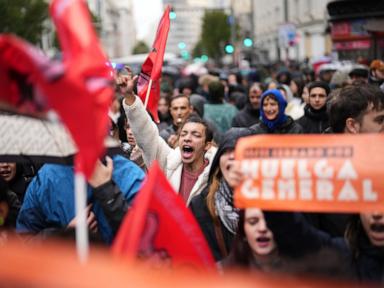
Mainstream commentary surrounding Spain’s first general strike in 14 years treats the walkout as an ideological collision between workers and the state. That framing is convenient. It is also superficial.
When observers characterize a national strike as "clashing social and political desires," they flatten a complex economic dispute into a dramatic tug-of-war. In reality, a modern European general strike rarely functions as a revolutionary rupture. More often, it operates as an institutionalized negotiation mechanism—one that reveals deep structural tensions in Spain’s labor market, fiscal trajectory, and union governance.
To understand what is actually happening on the streets of Madrid, Barcelona, and Valencia, you have to look past the picket lines and examine the mechanics of collective bargaining, inflation-adjusted purchasing power, and political capital.
The Myth of the Spontaneous Uprising
Coverage of major industrial action frequently portrays strikes as organic explosions of public frustration. That narrative ignores how general strikes in Spain are organized, financed, and legally executed.
Under Spanish labor law—specifically the Royal Decree-Law 17/1977 on labor relations—calling a general strike is not an impromptu street movement. It is a heavily regulated legal procedure requiring formal notice, minimum service agreements (servicios mínimos) negotiated with regional and national ministries, and logistical coordination by major trade union confederations such as Comisiones Obreras (CCOO) and the Unión General de Trabajadores (UGT), or regional and sectoral syndicates.
When commentators frame a 14-year gap between general strikes as evidence of sudden, unprecedented social breakdown, they miss the more revealing question: why did unions abstain from calling one during periods of acute economic stress over the preceding decade?
Consider the timeline:
- During the sovereign debt crisis and austerity measures of the early 2010s, general strikes occurred in 2010 and 2012.
- Throughout the COVID-19 pandemic and the immediate post-pandemic inflation shock, major unions largely favored tripartite social dialogue (diálogo social) with the government and employer associations like the CEOE (Confederación Española de Organizaciones Empresariales).
- Labor reforms negotiated in 2021 under Labor Minister Yolanda Díaz focused on curbing temporary contracts and restoring collective bargaining primacy, temporarily aligning union leadership with government policy.
The return of a general strike after 14 years does not mean Spanish workers suddenly discovered grievance. It signals that institutional consensus—the quiet room where union leaders, business lobbies, and government ministers trade concessions—has temporarily lost its ability to absorb economic friction.
What the "Clashing Desires" Narrative Conceals
Describing the strike as a clash of "social and political desires" treats all demands as equally abstract preferences. In practice, the competing pressures are concrete, measurable, and rooted in structural arithmetic.
On one side sits the macroeconomic constraint facing any Spanish administration operating inside the Eurozone fiscal framework. With public debt hovering above 100 percent of GDP—a figure consistently tracked by the Banco de España and Eurostat—Madrid faces strict scrutiny from Brussels whenever permanent public expenditure increases. Wage indexation in the public sector, pension revaluation tied to the Consumer Price Index (CPI), and subsidized transport or energy measures all carry compounding fiscal costs.
On the other side sits the lived reality of household balance sheets. Even when headline inflation moderates, cumulative price increases in housing, groceries, and utilities permanently reset the baseline cost of living. In major Spanish urban centers, housing affordability has deteriorated sharply, driven by supply constraints, tourism-oriented short-term rentals, and wage growth that lags behind property valuations.
Calling this a clash of "desires" obscures the core conflict: who absorbs the cost of structural adjustment?
- Labor groups argue that corporate profit margins expanded faster than real wages during the inflationary cycle, citing data from the Banco de España’s Central Balance Sheet Data Office showing margin recovery across several non-financial sectors.
- Employer associations counter that rising non-wage labor costs—including social security contributions and minimum wage (Salario Mínimo Interprofesional) hikes—squeeze small and medium-sized enterprises (SMEs), which represent over 99 percent of Spanish businesses and generate the majority of private-sector employment.
- Government policymakers walk a narrow corridor between maintaining coalition support on the political left and preserving fiscal credibility with European institutions and bond markets.
None of these positions are mere "desires." They are competing claims on finite economic output.
Why Analysts Misread Strike Participation Numbers
Whenever a general strike takes place in Spain, the immediate aftermath devolves into a predictable statistical ritual. Unions announce participation rates of 70 or 80 percent; government ministries and employer groups publish figures closer to 15 or 20 percent.
Both numbers are technically defensible, and both are misleading if taken at face value.
The discrepancy stems from methodology:
- Minimum Services Baseline: In essential sectors—healthcare, public transit, energy, and emergency services—legally mandated minimum services often require 50 to 80 percent of staff to work. Government tallies frequently treat mandated workers as non-strikers, depressing the official participation rate.
- Sectoral Concentration: Industrial manufacturing, logistics, and public administration exhibit high union density and visible walkouts. By contrast, Spain’s vast hospitality, retail, and micro-enterprise sectors have low union representation and high rates of precarious employment, where striking carries immediate financial or informal retaliatory risks.
- Self-Employed Workers (Autónomos): Over three million workers in Spain are registered as self-employed. They do not participate in traditional collective bargaining strikes, yet their economic stagnation is often a primary driver of broader social discontent.
Focusing on headline turnout percentages misses the real metric of a strike’s impact: disruption to supply chains, municipal logistics, and political messaging. A targeted shutdown of ports, rail corridors, or industrial parks in Catalonia, the Basque Country, or Madrid exerts far more leverage than a broad, diffuse walkout across fragmented service businesses.
The Structural Fault Lines Behind the Walkout
To understand why Spain’s labor environment has reached an inflection point, look at three underlying pressures that commentary often treats in isolation.
1. The Productivity Trap
Spain’s economy has generated strong headline GDP and employment growth compared to several northern Eurozone peers, buoyed by tourism, services, and immigration-driven labor force expansion. Yet total factor productivity growth remains sluggish. When an economy grows primarily by adding labor hours in lower-value-added sectors rather than increasing output per worker, real wages face a hard ceiling. Unions can demand higher nominal pay, and governments can raise the statutory minimum wage, but without productivity gains, businesses either pass costs onto consumers or compress hiring.
2. The Intergenerational Transfer Squeeze
Spain’s demographic profile is aging rapidly. Revaluing state pensions in line with inflation protects retirees' purchasing power, a politically untouchable pillar for any major party. However, financing those commitments relies heavily on social security contributions levied on current workers and employers. Younger workers—already facing high youth unemployment rates relative to the EU average and steep barriers to homeownership—experience a widening gap between gross labor costs and net disposable income. A general strike often channels broader generational frustration over housing and mobility into traditional labor demands, even when trade unions themselves are disproportionately weighted toward older, permanent-contract employees.
3. Fragmented Political Representation
A general strike in Spain is never purely economic; it is inherently political. Minority coalition governments rely on fragile parliamentary alliances involving regional nationalist parties from Catalonia and the Basque Country alongside left-wing platforms. In that environment, street mobilization serves dual purposes:
- For opposition parties, a strike is framed as proof of government mismanagement and economic failure.
- For left-wing coalition partners and unions, mobilization can be used to pressure the executive branch from the flank—pushing for faster action on workweek reductions (such as the debate over cutting the statutory 40-hour week to 37.5 hours) or stricter housing market intervention.
What People Actually Get Wrong About General Strikes
When readers search for context on a Spanish general strike, they usually ask a variation of three questions. The standard answers rarely hold up under scrutiny.
"Does a general strike actually change government policy?"
Directly? Almost never on the day after. No modern Spanish government revokes a budget or rewrites labor statutes simply because trains ran on a reduced schedule for 24 hours. Indirectly, however, a strike alters the political cost of inaction. It forces stalled legislative priorities—such as working-time regulations, collective bargaining protections, or public service funding—back to the top of the parliamentary agenda. The real negotiation happens weeks later behind closed doors, using the strike’s turnout as a bargaining chip.
"Are unions too powerful in Spain?"
This is one of the most persistent misconceptions in European business commentary. Compared to Nordic countries where union membership routinely exceeds 50 to 60 percent, Spain’s actual union density is relatively low—typically hovering around 12 to 15 percent of salaried workers, according to OECD data. Spanish unions derive their influence not from massive dues-paying memberships, but from institutional representation: the legal framework grants "most representative" unions the authority to negotiate sector-wide collective agreements (convenios colectivos) that automatically apply to all workers in that sector, unionized or not. That distinction explains why unions can mobilize institutional pressure even when grassroots membership rates appear modest.
"Is this a sign that Spain’s economy is collapsing?"
No. Industrial unrest frequently peaks not at the bottom of a recession, but during uneven recoveries. In deep downturns, workers prioritize job preservation over wage demands. Strikes emerge when macroeconomic indicators—GDP growth, corporate earnings, tourism records—look strong on paper while household living standards feel stagnant. Prosperity that feels unevenly distributed generates far more political friction than shared austerity.
The Trade-Offs Nobody Wants to Admit
Any serious assessment of labor action requires acknowledging the downsides on both sides of the ledger—something partisan commentary routinely avoids.
For unions and strikers, a general strike carries diminishing returns if overused. Forfeiting a day’s wages imposes an immediate financial hit on low-income households—the very demographic unions aim to defend. Furthermore, disrupting public transit and municipal services can alienate urban commuters and small business owners if the demands appear disconnected from private-sector realities.
For employers and fiscal hawks, dismissing labor mobilization as mere political theater ignores genuine structural risks. Persistent wage stagnation relative to housing and living costs depresses domestic consumption, fuels brain drain among skilled technical workers, and entrenches a two-tier labor market where permanent insiders are protected while younger cohorts cycle through precarious roles.
How Businesses and Policymakers Actually Navigate Labor Friction
If you operate a business in Spain—or analyze European sovereign and corporate risk—treating a general strike as an isolated headline event is a strategic mistake.
- Track collective bargaining calendars, not just street protests. The real financial impact on operating margins comes from multi-year sectoral convenios colectivos and statutory minimum wage adjustments, not 24-hour work stoppages.
- Watch the gap between core inflation and housing costs. Headline CPI can look benign while urban rent inflation triggers intense political pressure for regulatory intervention, wage mandates, or commercial tax surcharges.
- Separate institutional signaling from operational disruption. Evaluate supply chain exposure specifically around transport hubs, ports, and public-sector dependencies rather than assuming uniform national shutdowns.
Spain’s first general strike in 14 years is neither the dawn of a socialist upheaval nor a meaningless tantrum by entrenched syndicates. It is the predictable friction of an economy trying to reconcile European fiscal discipline, low productivity growth, and rising living costs without breaking its political coalition.
The picket lines last 24 hours; the structural math behind them will dictate Spanish policy for the next decade.