Thousands of people are currently descending on the Florida coastline, clogging the arteries of Brevard County for a glimpse of the Artemis moon launch. While mainstream reports focus on the "excitement" and "anticipation" of the crowds, they miss the logistical nightmare and the staggering economic friction required to move the needle on deep-space exploration. The reality is a volatile mix of infrastructure strain, price gouging, and a high-stakes gamble on a launch window that could evaporate in seconds due to a single faulty sensor or a stray cloud.
The Infrastructure Breaking Point
Brevard County was not built for this. When NASA prepares for a major lunar milestone, the local population effectively doubles overnight. This isn't just a matter of crowded beaches; it is a systemic stress test for a region that has struggled to modernize its transit since the Shuttle era.
State Road 528 and A1A become literal parking lots. Local law enforcement agencies shift to twelve-hour rotations, not to catch criminals, but to manage the sheer physics of hundreds of thousands of vehicles trying to occupy the same narrow strips of asphalt. The cost to the taxpayer for this surge in security and traffic management is rarely calculated in the glowing PR pieces distributed by space agencies.
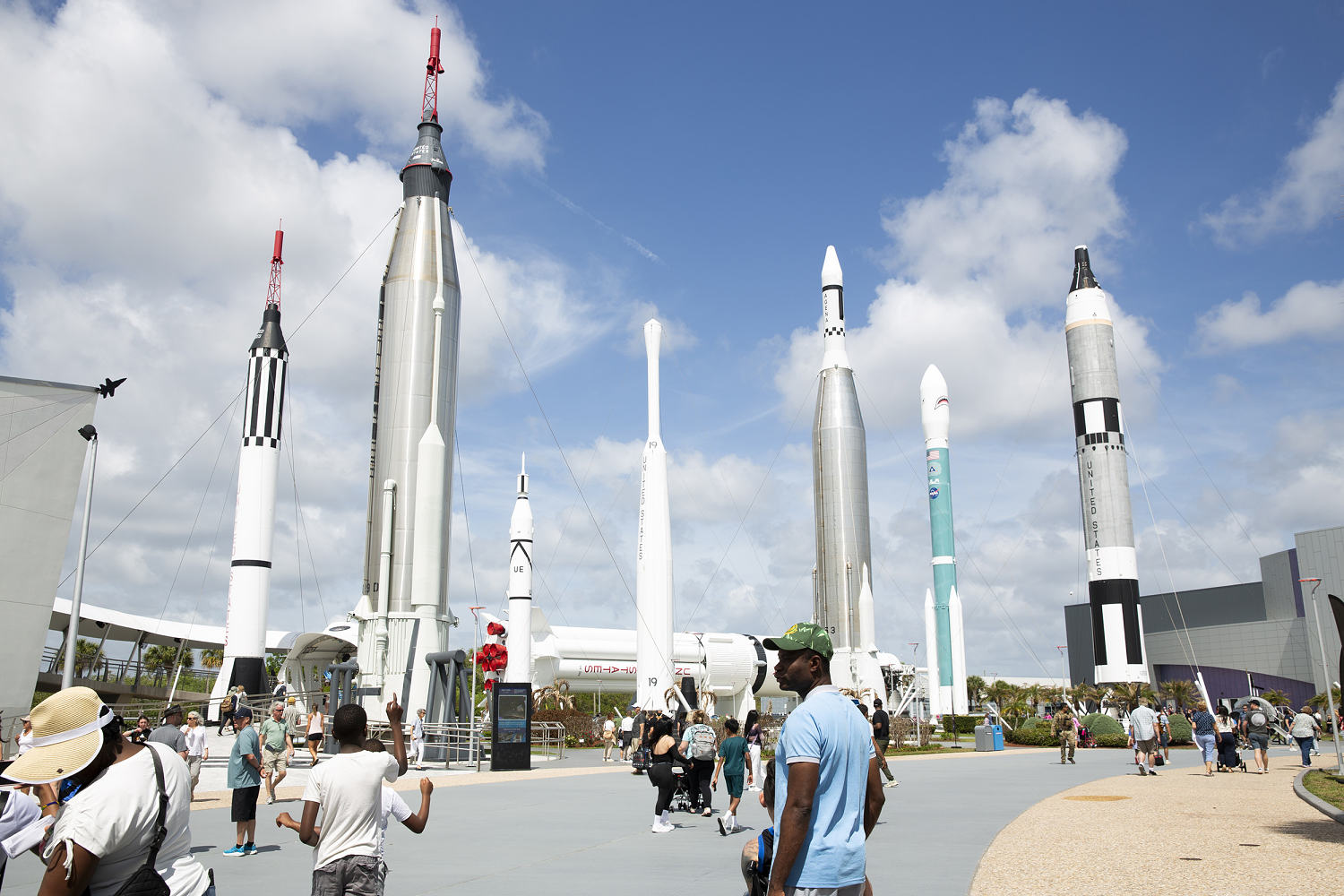
The physical footprint of the crowd is immense. From the Max Brewer Bridge in Titusville down to the Jetty Park pier, every square inch of public land is contested. For the dedicated space enthusiast, this means arriving forty-eight hours early, sleeping in SUVs, and navigating a lack of basic sanitation. It is a grueling endurance test that transforms a scientific achievement into a survivalist exercise.
The Economics of a Launch Window
While the spectators wait, a predatory micro-economy thrives. Hotel rates in Cocoa Beach and Merritt Island don't just increase; they explode. It is common to see modest two-star motels charging upwards of $600 a night with a three-night minimum stay. This is the "Launch Tax," a localized inflation spike that hits the pockets of families who just want their children to see history.
Rental car agencies often run dry weeks in advance. Even the local grocery stores feel the pinch as supplies of water, ice, and portable snacks vanish from the shelves. For the local business owner, it’s a windfall. For the average traveler, it’s a lesson in the brutal math of supply and demand.
The irony is that this entire economy is built on a "scrub" culture. If the countdown stops at T-minus ten minutes due to a hydrogen leak or a sudden shift in wind shear, the crowd doesn't get a refund on their hotel or their gas. They are left with a choice: go home empty-handed or pay for another three nights in the hope that the next window holds.
The Technological Mirage
The public sees a rocket as a singular object of power. In reality, it is a fragile collection of millions of parts, many of which are decades-old designs retrofitted for a new era. The Space Launch System (SLS) is a massive, complex machine that relies on liquid hydrogen—a substance so volatile and difficult to contain that it has been the primary cause of most recent launch delays.
Hydrogen molecules are small enough to escape through the tiniest imperfections in seals and joints. When the cryogenics begin, the metal shrinks, the seals shift, and the "leak" becomes the protagonist of the day. The crowd on the beach, looking through binoculars, cannot see the frantic engineers in the firing room monitoring the $p \Delta V$ calculations or the thermal gradients across the fuel tanks.
$$F = \dot{m} V_e + (P_e - P_a) A_e$$
The physics of thrust, represented by the equation above, is what everyone comes to see. But the engineering reality is the $P_a$ (ambient pressure) and the $T$ (temperature) variables that often dictate a "No Go" decision. The disconnect between the public's desire for a show and the cold, hard requirements of orbital mechanics creates a unique tension. NASA is under immense pressure to perform, but the physics of the moon don't care about a tourist's vacation schedule.
The Hidden Environmental Cost
We rarely discuss the debris and the acoustic impact. A launch of this magnitude generates sound waves capable of vibrating the internal organs of spectators miles away. While that "thump" in the chest is a selling point for many, the ecological impact on the Banana River lagoon and the surrounding wildlife refuge is significant.
The plume from solid rocket boosters contains hydrochloric acid and aluminum oxide. While NASA conducts extensive environmental assessments, the sheer frequency of planned launches in the coming years raises questions about the long-term saturation of these chemicals in the local marshlands. The very environment people are flocking to enjoy is being subjected to repeated, high-intensity chemical and acoustic shocks.
The Geopolitical Stakes Behind the Spectacle
This isn't just about "exploration" or "the human spirit." This is a race. The urgency felt at Cape Canaveral is driven by the fact that other nations are eyeing the lunar south pole for its water ice. The moon is no longer a destination for footprints and flags; it is the next high ground for resource extraction and orbital dominance.
When the rocket clears the tower, it isn't just carrying a capsule. It is carrying the credibility of the American aerospace industry. A failure in front of half a million witnesses would be a catastrophic blow to the Artemis program's funding and the nation's standing in the new space race. This pressure trickles down to every technician on the pad and every officer directing traffic on the causeway.
The Reality of the "Prime View"
If you are standing on the beach at Playalinda, you are seeing the result of billions of dollars in government contracts and years of political maneuvering. The "prime view" isn't actually on the sand. The best view is in the data centers and the assembly buildings where the real work happens long before the engines ignite.
The crowd sees the fire. They hear the roar. But they are largely disconnected from the agonizingly slow bureaucracy and the procurement hurdles that delayed this moment by years. The SLS was famously over budget and behind schedule, a victim of the "cost-plus" contracting model that prioritizes job creation in specific congressional districts over lean, efficient engineering.
The Logic of the Crowd
Why do they do it? Why drive twenty hours and sleep in a parking lot for a three-minute event that might not even happen?
It is the search for a collective "we" in a fragmented culture. For a few seconds, the political divisions and economic anxieties of the modern era are drowned out by the sheer volume of 8.8 million pounds of thrust. It is a rare moment of objective reality. You cannot argue with a rocket. It either goes up or it doesn't.
However, as the Artemis program moves from these early test flights to regular "bus routes" to the moon, the novelty will fade. The Space Coast will have to decide if it can sustain this level of chaos as a permanent feature of its existence. The current infrastructure is a relic of the mid-twentieth century trying to support a twenty-first-century cadence.
The next time you see a photo of a family cheering on a Florida pier, look past the smiles. Look at the gridlock behind them, the price tags on their hotel doors, and the precarious nature of the liquid hydrogen sensors that hold their entire trip in the balance. The moon is a harsh mistress, but the logistics of getting to her might be even harsher.
Check the local Brevard County traffic maps and NASA’s official scrub notification system before you even think about putting the keys in the ignition.