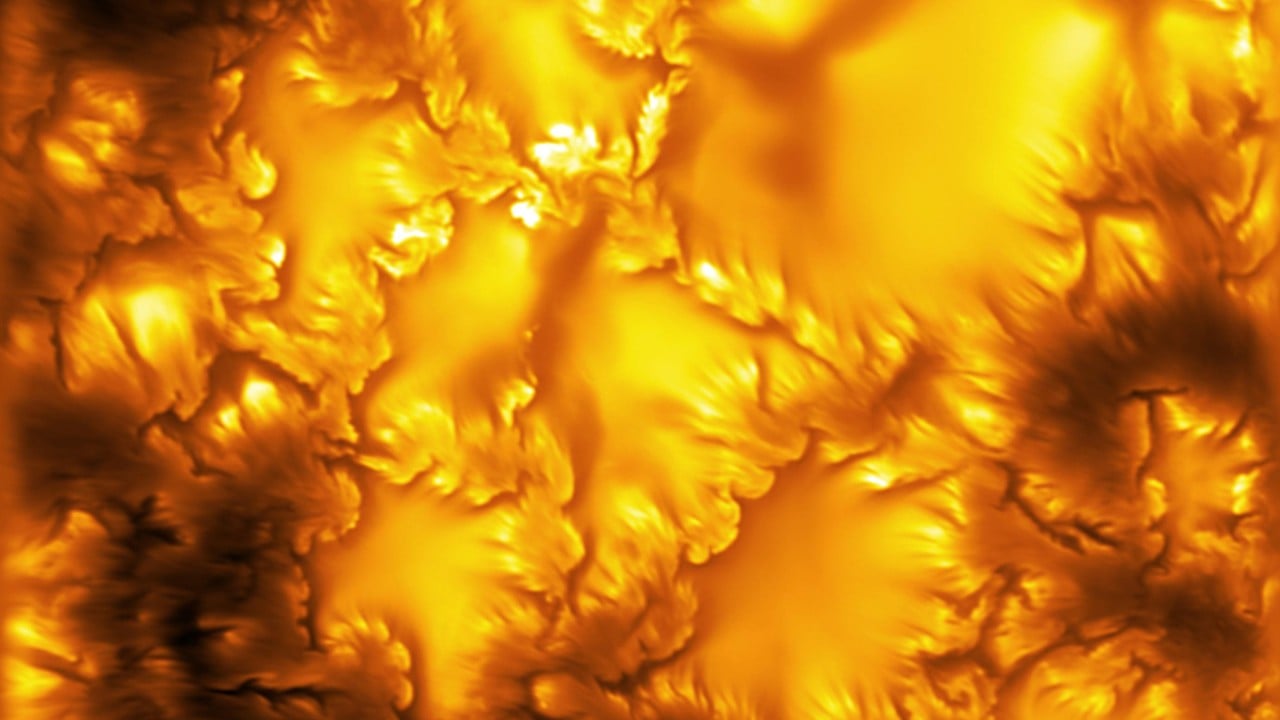
High-resolution imaging campaigns targeting the solar atmosphere consistently reveal localized, transient perturbations propagating across the sun. While mass media framing routinely characterizes these patterns as mysterious or exotic anomalies, astrophysical observation confirms they are predictable manifestations of magnetohydrodynamic coupling between the deep convection zone and the lower solar atmosphere. Understanding these surface dynamics requires moving past speculative commentary and breaking down the precise physical mechanisms governing solar plasma movement, magnetic field amplification, and acoustic wave propagation.
The Thermodynamic Drivers of Photospheric Convective Cells
The visible surface of the sun, known as the photosphere, is not a solid boundary but a thermal transition zone roughly five hundred kilometers thick where opaque plasma transitions to transparent space. Energy generated by nuclear fusion in the core propagates outward primarily via radiation through the radiative zone before shifting to convective transport in the outer thirty percent of the solar radius.
Convective columns, measuring anywhere from one thousand to two thousand kilometers across in the case of granular cells, continuously surge upward, cool at the boundary via radiative emission, and plunge back downward along narrow intergranular lanes. These upwelling thermal plumes create a granular mosaic that dominates optical observations.
The rippling patterns observed in advanced solar imagery typically represent acoustic oscillations or magneto-acoustic waves channeled through this turbulent medium. Plasma density, temperature gradients, and localized sound speeds dictate how these pressure waves travel across the surface. When a high-velocity convective upwelling collides with the stable stratification of the photosphere, it triggers compressive waves that ripple outward much like stone drops in a liquid medium, though operating under the strict physics of ionized compressible fluids.
Magnetic Field Topography and Wave Trapping
A primary driver for complex, localized surface patterns involves the interaction between convective plasma motion and embedded magnetic flux tubes. The sun possesses a dynamic, self-regenerating magnetic field driven by the solar dynamo operating near the tachocline. Magnetic field lines are continually twisted, stretched, and buoyantly forced to the surface by convective currents.
When magnetic flux concentrates into intense bundles, the local plasma pressure changes dramatically compared to non-magnetic regions. These magnetized patches alter the acoustic impedance of the solar atmosphere, acting as wave guides or reflecting mirrors for sub-surface oscillations.
- Acoustic Cutoff Frequency: The solar atmosphere acts as an acoustic cavity. Waves below a specific frequency threshold are trapped beneath the transition region, bouncing between the dense interior and the upper layers.
- Magnetic Blocking: Strong magnetic fields inhibit local convection, creating cooler, darker regions where wave propagation paths are physically distorted by Lorentz forces.
- Mode Conversion: As pressure waves encounter steep horizontal and vertical gradients in magnetic field strength, acoustic waves convert into magnetohydrodynamic waves, specifically slow and fast magneto-acoustic modes, altering the visual appearance of surface ripples.
These interactions explain why surface ripples frequently correlate with emerging active regions or precursor signatures of solar flare activity. The observed patterns are direct readouts of sub-surface stress redistribution.
Observational Constraints and Instrument Resolution Limits
Interpreting solar surface imagery requires rigorous accounting for spatial and temporal resolution limits imposed by both ground-based and space-borne observatories. Ground telescopes, such as the Daniel K. Inouye Solar Telescope, utilize adaptive optics to correct for atmospheric distortion in real time, achieving spatial resolutions down to twenty kilometers on the sun. Space-based platforms like the Solar Dynamics Observatory and the Solar Orbiter provide continuous, uninterrupted multispectral views free of atmospheric interference.
Despite these technological leaps, several observational bottlenecks persist. Line-of-sight integration effects mean that any optical or ultraviolet filter captures photons emitted across a finite depth range of the solar atmosphere, blending lower photospheric structures with upper chromospheric phenomena. This integration can blur sharp boundaries, making distinct wave fronts appear as diffuse ripples. Furthermore, Doppler shifts caused by high-velocity plasma flows must be mathematically decoupled from intensity variations to accurately isolate true density waves from simple bulk mass movements.
Diagnostic Value for Space Weather Prediction
Monitoring these photospheric ripples provides critical utility for space weather forecasting. Coronal mass ejections and solar flares pose severe risks to terrestrial satellite infrastructure, power grids, and high-frequency communication networks. By analyzing the velocity vectors and frequency spectra of waves rippling across the photosphere, researchers can infer the sub-surface architecture of magnetic loops long before those structures breach the visible surface.
The transition from descriptive astronomy to predictive modeling relies on tracking these surface anomalies as leading indicators of magnetic energy storage limits. When the kinetic energy of convective turbulence surpasses the magnetic tension holding a flux rope in place, the system destabilizes. Quantitative tracking of surface ripples offers a direct operational metric for assessing magnetic instability, transforming raw imaging data into actionable lead time for infrastructure operators facing geomagnetic storm threats.