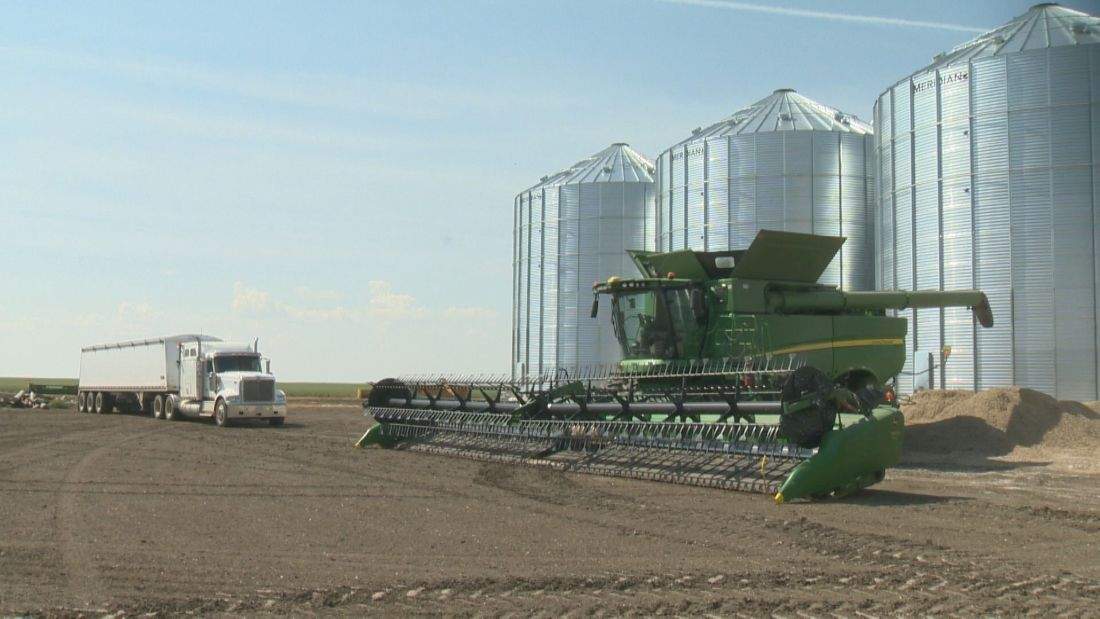
The wind in southeastern Saskatchewan does not just blow. It carves. On a dry Tuesday afternoon, if you stand at the edge of a dirt road near Indian Head, the dust will sting your eyes and leave the faint, metallic taste of copper on your tongue. It is the taste of a topsoil that has been fought over, cried over, and studied for more than a century.
To the untrained eye, a research farm looks like regular farmland. There are tractors, long stretches of green and amber stalks, and weather-beaten sheds. But look closer. The plots are unnaturally square, divided into meticulous, tiny grids like a living checkerboard. Each square holds a different secret. One might contain a strain of wheat engineered to survive on three fewer inches of rain a year. Another might hold a multi-decade experiment on how carbon moves through clay.
When the rumors started circulating that the gates to these living laboratories might lock permanently, a quiet panic rippled through the farming communities. It was not the kind of panic that makes the nightly television broadcasts in Toronto or Vancouver. It was the heavy, silent kind that settles into the kitchen tables of people who watch the sky for a living.
Then came the document. A Memorandum of Understanding. It is a dry, bureaucratic phrase born in the air-conditioned boardrooms of Ottawa and Regina. Yet, that single piece of paper managed to stop a decades-old clock from ticking down to zero. The federal government and the province of Saskatchewan signed a pact, agreeing to co-manage and co-fund two vital research facilities that were staring down the barrel of obsolescence.
To understand why this matters, you have to understand what happens when a research station dies.
The Ghost Plots of the Prairies
Consider a hypothetical researcher named Dr. Sarah Finch. She does not exist, but pieces of her live in every agronomist currently working for Agriculture and Agri-Food Canada. Sarah has spent fourteen years tracking a specific fungal pathogen in canola. This is not work that can be accelerated by a faster computer chip or a larger grant. It requires the slow, agonizing passage of the seasons. It requires waiting for the frost, waiting for the thaw, and praying the hail does not destroy the control group before August.
If her station closes, those fourteen years do not go into a filing cabinet to be retrieved later. They evaporate. The specialized soil profiles, cultivated over decades to maintain precise nutrient balances, are plowed under or sold off. The data continuity breaks. In science, a broken chain of data is often as useless as no data at all.
When Ottawa hinted at scaling back its footprint in provincial agricultural research, the stakes were invisible to the average supermarket shopper. People buy a loaf of bread without thinking about the rust-resistant genes that kept the wheat alive during a damp July. They buy canola oil without realizing that the seeds were perfected by a handful of civil servants wearing muddy boots.
The friction between the federal government and the western provinces is older than the highways that connect them. For years, the narrative has been one of tug-of-war. Ottawa holds the purse strings and often pushes for sweeping, national environmental mandates. Regina protects the immediate, raw economic realities of the producers who drive the provincial economy. It is a classic Canadian standoff.
But the dirt does not care about jurisdiction.
When the provincial government stepped up to negotiate the new agreement, it was a rare admission that some things are too foundational to be used as political footballs. The province recognized that losing federal expertise would paralyze local adaptation strategies. Ottawa recognized that trying to run prairie research from an office building near the Rideau Canal is an exercise in futility.
The Long Memory of the Mud
We often treat innovation as something that happens overnight in a cleanroom in Silicon Valley. A young coder types a few lines, a server blinks, and the world changes.
True agricultural innovation is the exact opposite. It is glacial.
The Indian Head Research Farm was established in 1887. Let that year sink in for a moment. It was created before Saskatchewan was even a province. It was built because the early settlers were breaking the sod and realizing, with a sense of creeping dread, that the farming methods they brought from Europe were utterly useless in the brutal, unpredictable climate of the Canadian West. They needed answers. How deep do you plant? How do you keep the moisture in the ground when the summer heat turns the soil to powder?
For nearly a century and a half, that plot of land has kept a record of human survival.
The second facility saved by the new agreement, located further north, addresses a completely different set of challenges. The soil there is heavier, the growing season shorter, the forest closer. A seed that thrives in the south will rot in the north. This geographical diversity is why a centralized approach to farming science always fails. You cannot simulate the microclimate of Melfort or Scott from a greenhouse in Ontario.
The decision to keep these two stations open under a joint model is not just a victory for the current generation of farmers. It is an insurance policy for a future we cannot quite see yet.
Climate patterns are shifting. The bugs that used to stay south of the forty-ninth parallel are moving north. The rain is coming in violent, erratic bursts rather than the steady drizzles of the past. If a producer wants to know how to manage a crop in the year 2040, the work to find that answer has to begin this morning.
What Happens at the Kitchen Table
Step away from the science for a moment and look at the economics.
Farming is one of the few businesses where you buy all your inputs at retail, sell your output at wholesale, and pay the freight both ways. The margins are razor-thin. A bad investment in the wrong seed variety can ruin a family enterprise that took three generations to build.
When a farmer sits down in January to plan their crop rotation, they do not look at marketing brochures from multinational seed conglomerates with blind faith. They look at the independent variety trials conducted by public research farms. They look for the data that has no commercial bias.
They ask simple questions. Did it lodge during the high winds? Did it tolerate the late spring frost?
Without these public stations, the only information available would come from entities trying to sell a product. The public research farm acts as a referee in a game where the cost of entry is astronomical. By securing the future of these two farms through the new agreement, the province and the federal government have preserved that independent referee.
It is easy to get lost in the dry language of public policy announcements. The phrases are designed to neutralize emotion. They talk of shifting frameworks, optimized resource allocation, and intergovernmental cooperation.
But if you look past the ink, you can see the real story. It is a story about a group of people who refused to let a century of localized knowledge be erased by a budget cut. It is about the acknowledgment that even in an era of satellite imagery and artificial intelligence, there is no substitute for a human being walking out into a field, kneeling down, and pulling a handful of earth apart with their fingers to see if the roots are healthy.
The trucks will keep rolling down the grid roads. The combines will still run into the twilight hours of October. And down the road, behind a modest sign denoting a government research plot, the slow, quiet work of saving the world's food supply will continue, one square yard at a time.