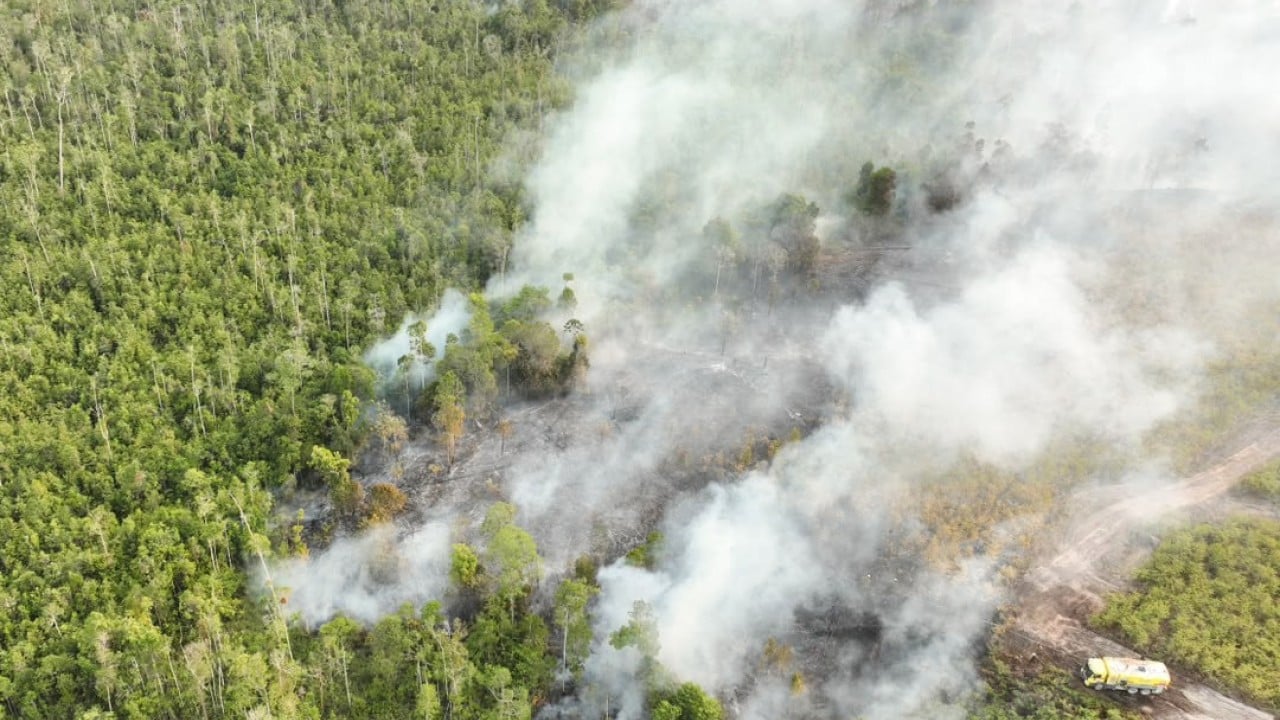
The air tastes like copper and wet ash long before the sun actually clears the horizon. If you have ever stood on the peat-rich earth of Sumatra or Central Kalimantan when the dry season hardens into a drought, you know that breathing becomes an act of quiet negotiation. Every inhalation scratches the back of your throat. Every exhale carries the weight of a slow-moving emergency.
For months, the sky wears a bruised, yellow-gray shroud. Schools close. Flights stall on tarmac runways because pilots cannot see past the thick, greasy fog. Children cough into damp rags pressed against their faces. People call it the haze, as if it were a weather pattern drifting down from the clouds like a sudden autumn mist.
It is not the weather. It is a choice.
Behind closed doors in air-conditioned Jakarta offices and deep within the rustling corridors of rural villages, a different kind of calculation takes place. To understand why seventy-two human beings were recently led away in handcuffs by the Indonesian police, suspected of waking the sleeping fire demons beneath the brush, you have to look past the cold statistics of charred hectares. You have to look at the geometry of profit, the desperation of smallholders, and the ancient, catastrophic habit of clearing land with a single flick of a Bic lighter.
Smoke does not rise by accident.
The Anatomy of a Match
Let us be entirely clear about what happens when a forest burns in Southeast Asia. This is not the dry-lightning theater of California or the sprawling pine timberlands of the Canadian shield. This is tropical deforestation meeting ancient, carbon-dense peatlands—swampy underworlds of decayed vegetation that have spent thousands of years sucking carbon out of the atmosphere and locking it safely beneath the mud.
When you set fire to peat, you do not just burn trees. You open a vault.
Imagine a kitchen sponge the size of a football field, soaked in ancient oil and carbon, baked until it is bone dry by months of El Nino heat. Now imagine throwing a match onto it. Surface fires are easy to spot from satellites. They crackle. They throw orange plumes into the evening sky. But peat fires burn downward, silently, creeping through subterranean veins of organic matter for weeks, eating away at the foundations of the earth long after the surface flames have supposedly been beaten back with wet branches and backpack pumps.
The seventy-two suspects detained across various provinces are not all masterminds in corporate boardrooms. That is the tragedy of the smoke.
On one side of the ledger, you have the industrial syndicates—the shadowy shell companies tied to palm oil and pulpwood expansions that view the forest as an inconvenient obstacle between them and a quarterly dividend. For them, fire remains the cheapest clearing tool on earth. Why pay heavy machinery operators and fuel costs for bulldozers when a gallon of diesel and a matchbook can level a hundred hectares of biodiversity for pennies?
On the other side, you are looking at the smallholders. Consider a hypothetical farmer named Joko, living on the ragged edge of a forest concession in Riau. Joko has three acres of scrubland and a family to feed before the next monsoon breaks. He has heard the government warnings on the radio about zero-burning laws. He knows the penalties. But he also knows that buying commercial clearing equipment costs more money than he will see in five years. When his neighbor clears land with fire and gets away with it, Joko reaches into his pocket. He strikes the match because survival has a way of narrowing human ethics down to the immediate horizon.
And so the smoke thickens.
The Cost of Looking Away
For years, the international community wagged a collective finger at Indonesia whenever the satellite maps turned the color of dried blood. Air pollution index readings soared past dangerous thresholds in neighboring Singapore and Malaysia, turning diplomatic channels sour. The pressure worked, up to a point. Stricter laws were drafted. Specialized task forces were mobilized. Satellite monitoring stations began tracking thermal anomalies with the precision of a sniper rifle.
Yet the fires kept returning. Why? Because laws written in air-conditioned capitals mean very little when the enforcement officers on the ground are outmatched, out-resourced, and sometimes out-bribed.
When the Indonesian National Police announced the arrest of these seventy-two individuals, it was framed as a crackdown. It was a show of force. The authorities want the world to know that impunity is ending, that the days of shrugging off deliberate arson as an unfortunate seasonal quirk are over.
Yet arresting seventy-two people is like trying to catch a waterfall in a teacup.
Consider what happens next in the judicial pipeline. Will the low-level laborers who struck the physical matches take the full weight of the penal code, while the corporate financiers sitting in high-rise suites hundreds of miles away maintain plausible deniability? History suggests an uncomfortable answer. Wealth buys exceptional legal counsel. Desperation buys handcuffs.
This is the part of the story where we have to admit our collective complicity. Every time we buy a box of cookies, a tube of toothpaste, or a bottle of shampoo containing uncertified palm oil, we are casting a silent vote in favor of cheap clearing methods. The global supply chain runs on convenience, and convenience is subsidized by the lungs of people living three thousand miles away.
The Quiet Aftermath
Walk through a village in Jambi after the smoke finally clears and the rains arrive. The ash turns into a slick, black mud that clings to the soles of your boots like heavy guilt. The oil palms stand in neat, military rows where ancient rainforests once hummed with the calls of gibbons and hornbills.
The silence is the loudest thing in the room.
The seventy-two suspects are sitting in holding cells, waiting for trials that will make local headlines for a day before vanishing into the bureaucratic machinery of the courts. The charred earth will be planted over with monoculture crops. The corporations will file their sustainability reports, polishing their corporate social responsibility metrics until they gleam under fluorescent office lights.
Meanwhile, the peat waits.
It takes thousands of years to build a single foot of peatland soil, and only a single afternoon of dry wind and human carelessness to turn it into a ghost. The fire is out for now, suppressed by the seasonal downpours, washed down the rivers into a murky, suffocating sea. But the ground is still warm underneath. The match is already back in the pocket, waiting for the next dry spell, waiting for the next desperate season, waiting for the world to look away again.