The canopy of the Amazon rainforest does not look like a boardroom. Underneath the dense layer of green, the air is thick, humid, and smells of wet earth and decaying leaves. If you stand still enough in the northern stretches of Mato Grosso, you can hear the chainsaw. It is a distant, mechanical buzz, like an angry hornet.
For years, that sound meant one thing: another patch of the world’s lungs was being shaved away.
Now, shift the scene thousands of miles north. In Washington, D.C., the air is air-conditioned, crisp, and smells of expensive coffee and old paper. Here, the Amazon is not a place of jaguars and towering mahogany. It is a line item. It is a political leverage point. It is the justification for a sweeping set of trade tariffs aimed directly at Brazil’s economy.
Two entirely different worlds, connected by a thread of environmental data and global politics.
Recently, the Brazilian government released numbers that sent a shockwave through both the muddy outposts of Pará and the marbled halls of the American capital. Deforestation rates in the Amazon didn't just slow down; they dropped significantly. It was the kind of data that should have sparked a uniform celebration. Instead, it ignited a fierce geopolitical staring contest.
The Ranger and the Ledger
To understand what these numbers actually mean, you have to look at someone like Mateo. Mateo is a hypothetical composite of the field agents currently working for IBAMA, Brazil’s environmental protection agency. For four years under a previous administration, Mateo’s job was a ghost hunt. Budget cuts meant his truck lacked fuel. Political rhetoric from the top implicitly signaled to illegal loggers and cattle ranchers that the Amazon was open for business. Mateo watched satellite images of his jurisdiction turn from deep emerald to scarred brown, unable to do a thing about it.
Then, the political winds shifted.
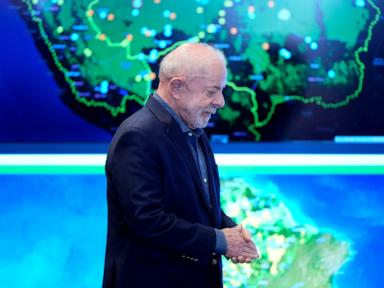
The current administration under President Luiz Inácio Lula da Silva came in with a mandate to stop the bleeding. Suddenly, Mateo’s truck had gas. His team had satellite data that updated in real-time. More importantly, they had the political backing to confiscate cattle, burn illegal mining equipment, and issue fines that actually stuck.
The results of this shift are what Brazil just laid on the table. According to official data from the national space research institute, INPE, deforestation in the Amazon fell by nearly half compared to the previous year.
That is not a minor statistical wobble. That is a massive, tangible shift in the trajectory of the planet's climate health. Millions of trees that were scheduled to become charcoal or sawdust are still standing, breathing out moisture, pulling carbon from the atmosphere.
But when Brazil’s diplomats brought these figures to the international stage, the reception in the United States was chilly.
Washington had already set a mechanism in motion. Citing concerns over environmental degradation and the unfair market advantage gained by agricultural businesses operating on deforested land, American lawmakers had been pushing hard for punitive tariffs on Brazilian imports. Steel, soy, beef—everything was on the chopping block.
To the policymakers in D.C., the tariffs were a righteous tool to force environmental compliance. To the economists and farmers in São Paulo, they looked like something else entirely: protectionism wrapped in a green flag.
The Hidden Cost of a Green Barrier
Consider the economic reality of a farmer in the Brazilian cerrado. Let's call him Lucas. Lucas owns a medium-sized soy farm. He doesn't touch the Amazon; his land has been cleared for three generations. He uses precision agriculture, minimizes his fertilizer runoff, and prides himself on complying with Brazil’s strict Forest Code, which requires landowners in the Amazon biome to preserve up to 80% of their native vegetation.
When the United States threatens broad, sweeping tariffs on Brazilian agricultural products due to Amazonian deforestation, Lucas faces the financial penalty regardless of his practices.
The American argument is that cheap, illegal land grabbers drive down the cost of production in Brazil, allowing all Brazilian exports to undercut American farmers who face different regulatory burdens. By placing a tariff on these goods, Washington claims it is leveling the playing field and punishing environmental criminals.
But the economic machinery is rarely that precise. Tariffs are blunt instruments. They are sledgehammers applied to problems that require scalpels.
When you slap a tariff on Brazilian soy or beef under the guise of saving the rainforest, you don't just hurt the illegal land grabbers in the deep interior. You hurt Lucas. You hurt the legitimate logistics companies, the port workers in Santos, and the global supply chain.
More dangerously, you create a narrative inside Brazil that environmental protection is an existential threat to national sovereignty and economic survival.
When environmentalism is perceived as a weapon used by wealthy northern nations to suppress the economic growth of the global south, the internal political consensus for conservation crumbles. Mateo, the ranger in the forest, finds his job becoming infinitely harder because the local population begins to view him not as a protector of their natural heritage, but as an agent of foreign interests trying to keep them poor.
Turning Data into a Shield
This is why the recent drop in deforestation rates is so critical. Brazil isn't just releasing these numbers to appease environmentalists; they are using them as a shield against economic warfare.
The message from Brasília is clear: The accusation that we are doing nothing is dead. The claim that our exports are subsidized by the destruction of the jungle is factually incorrect. Remove the threat of tariffs.
It is a sophisticated counter-offensive. For decades, Brazil was on the defensive regarding the Amazon. Pictures of burning canopies filled global news feeds, and Brazilian diplomats could do little more than offer weak assurances or defensive arguments about national sovereignty.
Not anymore.
By presenting verified, peer-reviewed satellite data showing a drastic reduction in clear-cutting, Brazil has shifted the burden of proof back onto the United States. If Washington proceeds with tariffs now, it becomes incredibly difficult to argue that the motivation is purely environmental. The mask slips, revealing the familiar face of domestic trade protectionism.
This leaves American policymakers in a tight corner. If they acknowledge the data and back down on the tariffs, they lose a powerful leverage point and risk angering domestic agricultural lobbies that benefit from trade barriers. If they ignore the data and press forward with the restrictions, they alienate a crucial geopolitical partner and signal to the world that even when a developing nation does exactly what the international community demands, it will still be punished.
The Invisible Stakes
We often talk about climate change and trade disputes in the abstract. We talk about percentages, gigatons of carbon, trade deficits, and tariff schedules.
The real story is found in the friction between survival and preservation.
The Amazon is a biome, but it is also home to over 30 million people. They need to eat. They need roads, schools, and hospitals. If the global community wants the forest to remain standing, it cannot treat the region as a giant, untouched museum while penalizing the economic engines that fund its protection.
The drop in deforestation proves that targeted, aggressive state intervention works. It proves that when laws are enforced, the destruction stops.
But that enforcement costs money. It requires satellites, helicopters, armed agents, and economic alternatives for the people living on the frontier. Ironically, the very tariffs threatened by the United States could dry up the revenue streams Brazil needs to keep funding those enforcement efforts.
The chainsaw in Mato Grosso has grown quieter for now. The canopy is holding its breath. Whether it stays that way depends less on the courage of rangers like Mateo, and more on whether the people sitting in the air-conditioned rooms of Washington choose to believe the data, or the politics of the ledger.