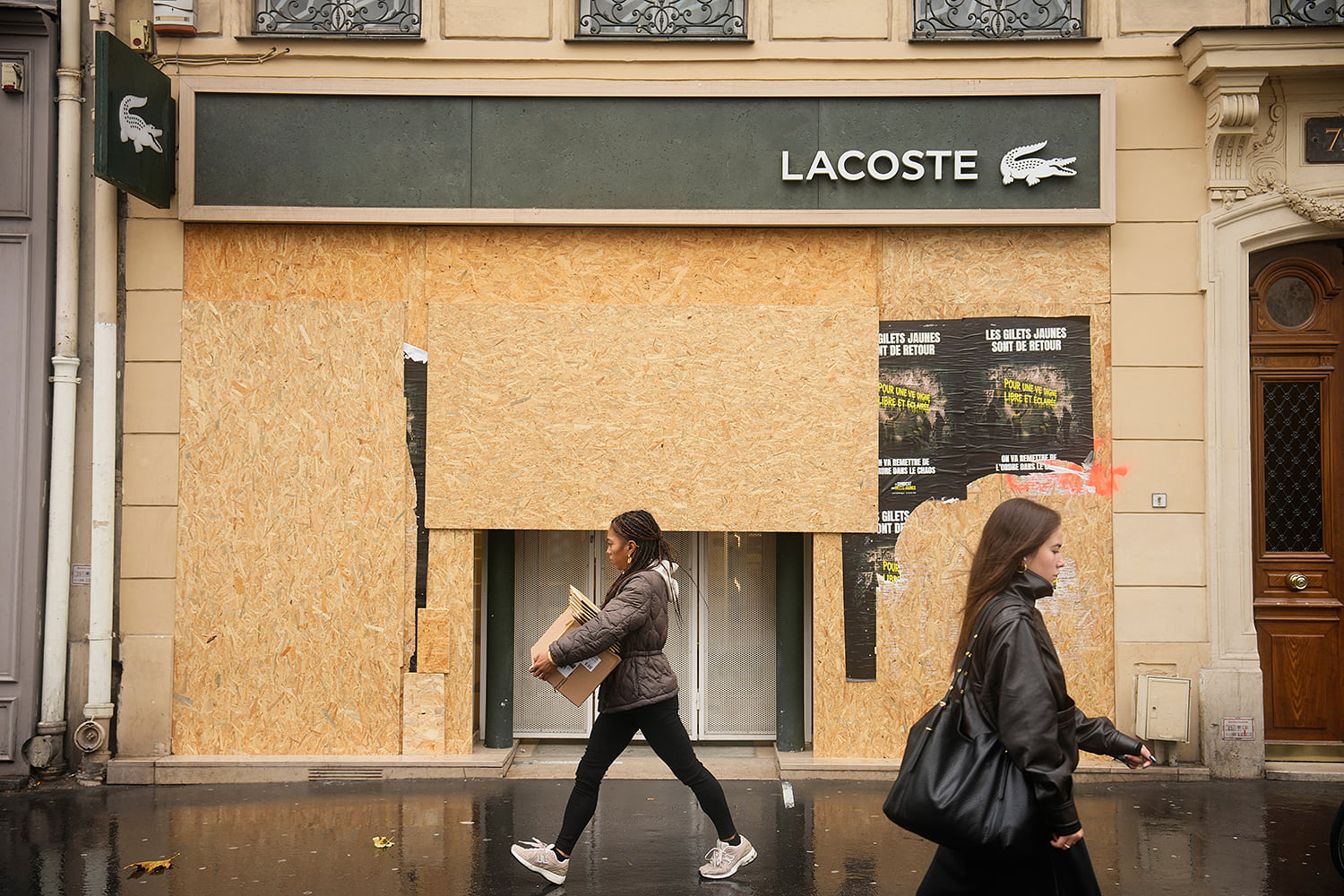
The gas does not smell like a chemical weapon. It smells faintly like burnt sugar and pepper, right before it seizes the back of your throat and convinces your nervous system that you are drowning on dry pavement.
If you have ever stood near the Place de la République when the wind shifts, you know the exact second the mood of a city changes. One moment, there is the rhythmic, almost festive thud of bass drums, the smell of grilling merguez sausages from vendor carts, and the low hum of tens of thousands of voices arguing about inflation, pensions, or the latest austerity budget. The next, there is a sharp, metallic pop-pop-pop from behind a wall of black polycarbonate shields. White canisters arc lazily against the Haussmannian limestone facades. People run, clutching lemons or saline vials to their eyes, while the heavy, armored trucks roll forward to unleash high-pressure jets of freezing water into the crowd. If you liked this piece, you might want to look at: this related article.
To read the standard wire reports about mass protests in France—about police deploying tear gas and water cannons to challenge demonstrators opposing President Emmanuel Macron—is to read a box score of a game nobody seems to understand. Headlines reduce a profound constitutional and existential crisis into familiar theatrical tropes. The French are striking again. The police are charging again. The president is standing firm again.
Look closer at the faces in the crowd, and the caricature dissolves. For another angle on this development, check out the latest update from BBC News.
The Arithmetic of a Broken Promise
Consider a hypothetical composite of the people filling the avenues from Lyon to Nantes—let us call her Claire, a 54-year-old nurse in a public hospital outside Bordeaux. She is not an anarchist. She has never thrown a paving stone in her life. For thirty years, she has lifted patients, worked double shifts through understaffed winters, and paid into a social system built on a straightforward, sacred bargain: you give the state your youth and your spine, and the state guarantees you a dignified exit before your body gives out entirely.
When Emmanuel Macron’s government forced through the raising of the retirement age from 62 to 64—and followed it in subsequent budgets with tighter spending caps on public services and subsidies—it was not merely a line-item adjustment to balance a ledger. To Claire, it felt like someone moving the finish line two miles further down the road just as she was rounding the final bend, knees buckling.
Multiply Claire by three million.
That is the invisible stake behind the barricades. When international observers look at France, they often see a nation allergic to economic reality, clinging to a generous welfare state that demographic math can no longer support. France’s public debt sits above 110 percent of its Gross Domestic Product, and its budget deficit has repeatedly breached European Union thresholds, hovering near 5 to 6 percent in recent fiscal cycles. Macron, a former investment banker who swept into the Élysée Palace in 2017 promising to make France a nimble, pro-business "start-up nation," views these reforms not as cruelty, but as survival. Without raising the workforce participation rate and reining in state expenditure, the argument goes, the entire French social model will collapse under the weight of an aging population.
Both sides are telling the truth. That is what makes the standoff so terrifying.
On one side sits cold macroeconomic arithmetic. On the other sits the lived, bodily reality of millions of people whose wages have been eaten alive by food and energy inflation, and who watch corporate dividends hit record highs while they are told to tighten their belts. When those two truths collide in the street, there is no diplomatic compromise waiting in the wings. There is only friction.
Why the Streets Are the Real Parliament
To understand why these confrontations escalate so quickly into tear gas and water cannons, you have to understand a peculiar flaw in the architecture of modern French democracy.
Think of the French Fifth Republic—designed by Charles de Gaulle in 1958 to end chronic parliamentary paralysis—as a pressure cooker with a welded shut-off valve. The constitution grants the executive branch extraordinary power to bypass a deadlocked legislature. Most famously, Article 49.3 allows the prime minister to ram legislation through the National Assembly without a vote, unless the opposition can cobble together enough disparate factions to pass a vote of no confidence.
Macron’s governments have reached for this constitutional hammer repeatedly, particularly after losing an absolute parliamentary majority in 2022 and plunging into deeper legislative fragmentation following the snap elections of 2024.
When citizens watch major laws pass without a single parliamentary ballot being cast, the ballot box begins to feel like a prop. If the assembly cannot stop a policy that 70 percent of the public opposes, where does the opposition go? It goes to the asphalt. In France, street mobilization is not a breakdown of the democratic process; for centuries, it has been the only reliable check on executive power. From the storming of the Bastille in 1789 to the general strikes of May 1968 and the Yellow Vest uprising that paralyzed roundabouts across the country in 2018, the street is where the social contract is renegotiated.
I still remember standing on the Boulevard Saint-Germain during one of the peak mobilization nights, watching a group of high school students link arms right in front of a line of Compagnies Républicaines de Sécurité—the notorious CRS riot police. The air was thick with acoustic dread. You could hear the heavy, rhythmic tapping of police batons against shields, a psychological drumbeat meant to induce panic before a single step was taken. Nearby, an elderly man in a tweed flat cap stood completely still, holding a cardboard sign that read simply: Respect.
Moments later, a flash-bang grenade detonated twenty yards away. The concussive wave rattled my ribcage. The water cannon opened up, a thick, roaring column of cold water that swept a line of protesters off their feet like bowling pins.
The Anatomy of Escalation
Why does the French state respond with such overwhelming kinetic force?
Part of the answer lies in the transformation of the protests themselves. Alongside peaceful union marches—the disciplined columns of the CGT and CFDT unions with their inflated balloons and brass bands—operates a smaller, fluid fringe of radicalized demonstrators known as the black bloc. Dressed identically in black hoodies, goggles, and respirators, they move like water through the crowd, smashing bank windows, torching luxury storefronts, and hurling projectiles at police lines.
Caught between a deeply unpopular government demanding order and a violent minority seeking chaos are the police officers themselves.
Imagine standing for twelve hours inside thirty pounds of body armor, pelted with paving stones, glass bottles, and Molotov cocktails, knowing that the politicians who ordered you onto the line have lost the trust of the public you are supposed to protect. Police unions in France have repeatedly warned that their officers are exhausted, undertrained in modern de-escalation tactics, and set up to be the human shield for political failure.
Unlike policing models in northern Europe, which rely on dialogue units and dynamic crowd containment to isolate violent individuals without provoking the broader mass, French policing doctrine has historically favored static, defensive lines backed by intermediate-range weapons: tear gas launchers, sting-ball grenades, and high-pressure water cannons. The tragedy of this doctrine is built into its physics. Tear gas does not discriminate between a twenty-year-old throwing a cobblestone and a sixty-year-old retired teacher marching with her union banner. Once the gas settles over an intersection, choking everyone equally, the boundary between peaceful protestor and militant blurs. Fear turns into rage. Spectators become participants.
International human rights organizations, including the Council of Europe and Amnesty International, have raised alarms over the disproportionate use of force during French demonstrations, documenting hundreds of serious injuries—lost eyes, shattered hands, concussions—among demonstrators and journalists alike. Yet the tactic persists, because from the perspective of the Interior Ministry, losing control of the streets of Paris is the ultimate political death sentence.
The Fracture Beneath the Surface
It would be comforting to believe that this is merely a passing storm, a bout of Gallic temper that will subside once the weather warms or the next election cycle begins. That would be a dangerous misreading.
What we are witnessing on the boulevards of Paris, Marseille, and Rennes is a profound crisis of legitimacy that extends far beyond one president’s tenure. Macron was elected twice not because France fell in love with his vision, but largely because he served as a firewall against the far-right National Rally. Millions of voters held their noses and cast a ballot for him to keep Marine Le Pen out of the Élysée Palace.
When a leader mistakes a defensive vote for an enthusiastic mandate, trouble follows.
By pushing through structural changes without building consensus, the presidency has hollowed out the political center. Moderate unions, long the reliable negotiating partners who kept France governable, found themselves ignored and humiliated, leaving them with no choice but to harden their stance. Meanwhile, the political beneficiaries of this stalemate are waiting patiently on the fringes. Every canister of tear gas fired at a nurse or a factory worker becomes campaign material for populist movements on both the hard left and the nationalist right, who tell voters the same seductive story: The system is rigged against you, and only we will burn it down.
I have walked those avenues the morning after the clashes. It is an eerie, disorienting quiet. Municipal workers in bright green jumpsuits sweep up shattered safety glass and charred cardboard. The smell of wet ash lingers in the damp air. Cafes roll up their metal shutters, and commuters step carefully over puddles left by the water cannons on their way to the Metro.
On the surface, the city returns to normal with astonishing speed. The trains run. The bakeries open. The tourists take their photographs beneath the monuments.
Look at the stone walls along the side streets, however, where the black soot from burned barricades has soaked deep into the porous limestone, and you realize that nothing has actually been resolved. The pressure has simply been pushed back underground, waiting for the next spark.


