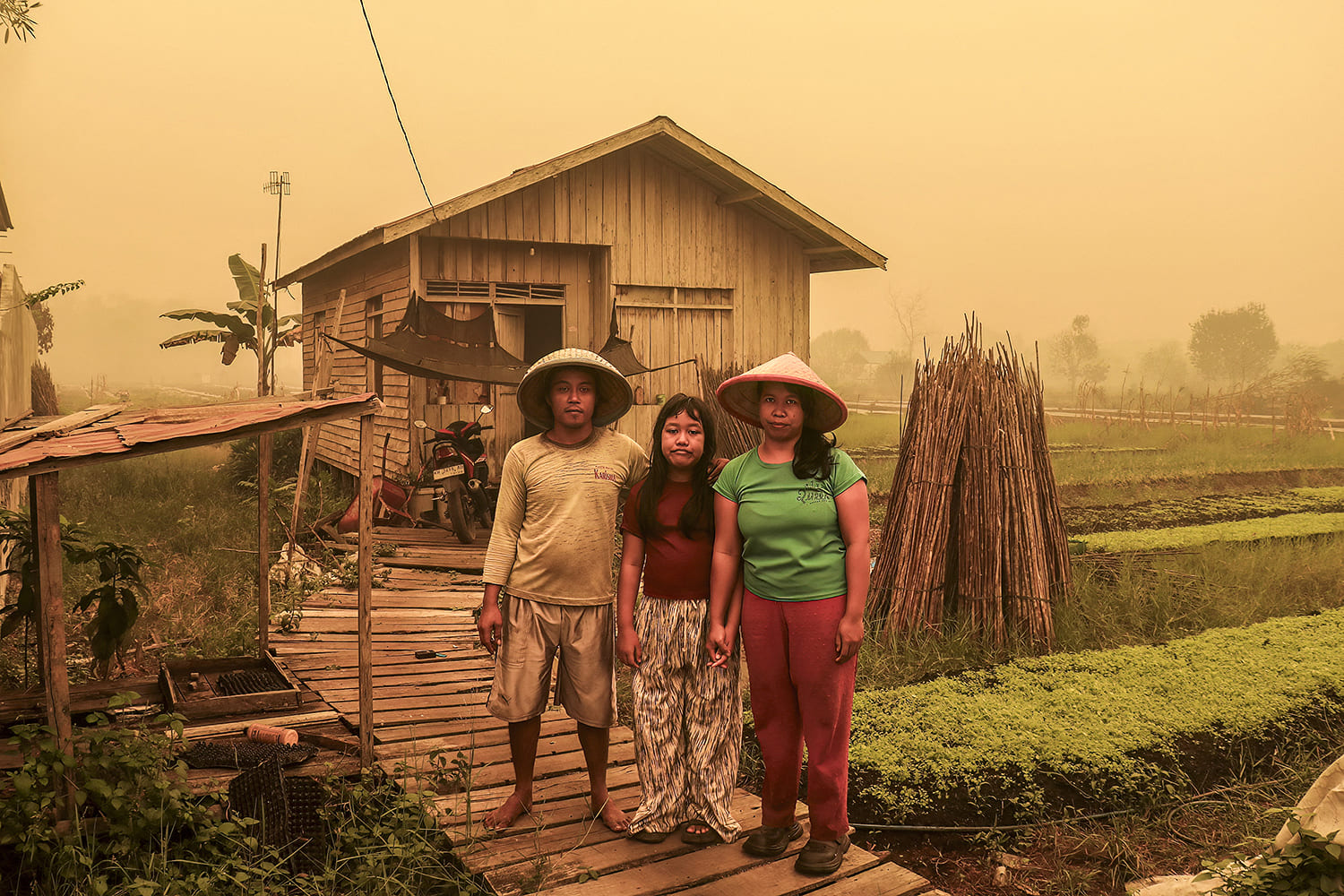
At noon in Jambi province, the streetlights are still on.
There is no sun. There is no blue sky, no horizon, no line where the jungle ends and the atmosphere begins. Instead, there is a heavy, bruised shade of crimson that swallows the world ten feet in front of your face. When residents step onto their front porches to sweep away the fine gray ash that gathers like dead skin on their tiles, they do not look up at clouds. They look into an alien void. Social media posts from the region carry a single, recurring caption that has echoed across the globe: It looks like Mars.
Except Mars does not smell like burning rubber, ancient wood, and melting plastic. And nobody on Mars has to hold a wet cloth over a coughing infant's mouth while praying the electricity holds out long enough to keep a cheap box fan spinning.
Every year, when the dry monsoon winds sweep across the Indonesian archipelago, an invisible war breaks out in the soil beneath Sumatra and Kalimantan. To the outside world, it arrives as a brief headline about haze blowing toward Singapore or Kuala Lumpur, accompanied by satellite maps dotted with angry red triangles. To the millions of people living inside the smoke, it is a slow-motion suffocation that turns their own homes into gas chambers and forces an impossible choice between feeding their families and preserving their lungs.
The Architecture of an Invisible Fire
To understand why the sky turns blood-red over Indonesia, you have to forget everything you know about a normal forest fire.
In California or the Australian outback, fire is a loud, visible monster. It races through treetops, explodes in walls of orange flame, and leaves blackened trunks in its wake. You can point a hose at it. You can see where it begins and where it ends.
The fires burning across Indonesia’s outer islands are nothing like that. They are ghosts.
Consider a hypothetical farmer named Hendra, living on the edge of a drained peatland in Central Kalimantan. For thousands of years, the ground beneath Hendra’s feet was a massive, waterlogged sponge—a tropical peat swamp forest made of partially decayed leaves, roots, and wood packed thirty feet deep. In its natural state, peatland is nearly impossible to burn. It holds water like a reservoir and traps staggering amounts of carbon—more per hectare than almost any other ecosystem on Earth.
But over the last three decades, vast stretches of these swamps were drained. Canals were dug to dry out the earth so industrial plantations and smallholders alike could plant oil palms and pulpwood trees. Once the water is gone, that ancient, spongy soil transforms into a giant block of dry kindling.
When Hendra—or an agricultural clearing crew miles away—lights a small brush fire to clear scrub for the next planting season, the flames do not just stay on the surface. They sink. They burrow downward into the dry peat, traveling underground like a lit fuse inside a mattress. You can douse the surface with water, walk away thinking the fire is dead, and three weeks later, smoke will begin curling out of the dirt half a mile down the road.
Because these underground fires burn at relatively low temperatures without enough oxygen to create bright flames, they produce vastly more smoke per acre than a conventional wildfire. It is thick, oily, and loaded with fine particulate matter—microscopic specks known as PM2.5, thirty times thinner than a human hair. When sunlight hits a dense wall of these particles, the shorter blue wavelengths scatter away, leaving only the long, eerie reds and oranges to filter down to the ground.
That is how you get a Martian sky at midday.
Inside the Red Zone
Numbers lose their meaning quickly when the air quality index breaks the scale.
Health agencies measure air pollution on a scale that typically tops out at 500, a level officially classified as "hazardous" to every living thing. During severe haze events in provinces like Riau, South Sumatra, and Jambi, monitoring stations routinely record readings well over 1,000. At that point, the sensors themselves begin to choke, unable to register just how poisoned the atmosphere has become.
Step inside a clinic in Palembang or Pekanbaru during peak haze season, and the air smells sharply of menthol balm and disinfectant. The waiting rooms are crowded with mothers holding toddlers whose chests heave with a wet, rattling wheeze. Acute respiratory infections spike into the hundreds of thousands within weeks.
For adults, breathing this air feels like standing directly behind the exhaust pipe of an idling diesel truck for months on end. Your eyes burn constantly, watering until your vision blurs. A metallic taste coats the back of your tongue. Every deep breath triggers a dry, hacking cough that leaves your ribs aching by nightfall.
Think about what happens to a human body when PM2.5 enters the bloodstream. Unlike larger dust particles that get trapped in your nose or throat, these microscopic spears bypass every natural defense system you possess. They slip deep into the alveoli of your lungs, cross straight into your blood vessels, and trigger systemic inflammation. Over weeks and months, they thicken the blood, strain the heart, and stunt the lung development of children who have never smoked a cigarette in their lives.
A landmark study by researchers at Harvard and Columbia universities estimated that the catastrophic 2015 haze crisis—one of the worst in modern memory—likely contributed to more than 100,000 premature deaths across Indonesia, Malaysia, and Singapore. Yet on death certificates, the cause is rarely listed as "smoke." It is recorded as heart failure, stroke, pneumonia, or asthma. The haze kills quietly, burying its victims in statistical noise.
The Economics of a Matchstick
It is easy, watching from thousands of miles away through a smartphone screen, to feel a surge of anger and ask a simple question: Why don't they just stop burning?
The answer is tangled in money, desperation, and a global supply chain that touches almost every bathroom cabinet and kitchen pantry on the planet.
Clearing land with fire is dirt cheap. Using bulldozers and excavators to clear a single hectare of tropical scrub costs hundreds of dollars—money that a smallholder farmer scraping by on a few dollars a day simply does not have. A box of matches costs pennies. Worse still, wood ash acts as a free, immediate fertilizer, neutralizing the acidic peat soil just enough to give newly planted crops a fighting start.
Yet blaming poor farmers misses the bigger, darker machinery at work.
For decades, massive pulp-and-paper conglomerates and palm oil enterprises expanded across Sumatra and Borneo at breakneck speed. Palm oil is the invisible backbone of modern consumer life; it is in your shampoo, your chocolate bar, your lipstick, your laundry detergent, and your biofuel. While major corporations officially adopted "zero-burning" policies under intense international pressure, the reality on the ground remains murky. Land boundaries overlap. Subcontractors hire local crews under the table. When fires erupt inside corporate concessions, companies point fingers at encroaching villagers, while villagers point at corporate drainage canals that turned their ancestral wetlands into a tinderbox in the first place.
Law enforcement has historically moved at a glacial pace. Even when courts hand down multi-million-dollar fines to corporations found liable for fires on their land, collecting that money often drags through years of appeals while the next dry season arrives right on schedule.
When Patience Turns to Fury
For years, residents endured the annual smoke with a grim, exhausted resignation. Schools closed. Airports shut down. People taped wet towels over window cracks and waited for the November rains to wash the sky clean.
That quiet endurance has cracked.
Across affected provinces, frustration has spilled out of cramped, smoke-filled living rooms and onto the streets. Students, environmental activists, and ordinary parents wearing N95 masks—when they can afford them—have marched on regional government offices and parliament buildings. In cities like Pekanbaru and Pontianak, protesters have clashed with riot police, demanding not just emergency oxygen tents and free masks, but real criminal accountability for the companies and officials who allowed the peatlands to burn yet again.
Their anger carries a sharp, bitter edge. While local residents choke in toxic darkness, the wealth generated by the plantations around them flows outward—to corporate headquarters in Jakarta, to commodities exchanges in Singapore, and to supermarket shelves in Europe and North America.
When protesters hold up signs reading We Are Not Experimental Rats, they are pointing directly at that imbalance. They are asking why their children’s lungs are treated as an acceptable cost of doing business.
How Do You Put Out an Underground Ocean?
If you want to stop the Martian skies from returning, dumping water from helicopters makes for dramatic television news, but it is mostly theater. Cloud seeding—spraying salt flares into clouds to coax out rain—works only when there are actually moisture-heavy clouds in the sky to seed. Once an underground peat fire is roaring across hundreds of thousands of hectares, human firefighting equipment is like trying to put out a house fire with a squirt gun.
The only real solution happens long before anyone strikes a match. It requires re-wetting the earth.
Across Indonesia, teams of hydrologists, conservationists, and local villagers have been working on a massive, unglamorous engineering project: blocking the drainage canals. By building thousands of wooden and concrete dams across the ditches that bled the peatlands dry, they are forcing rainwater back into the soil, raising the water table until the peat becomes a soggy, fireproof sponge once again.
Where canal blocking is paired with paludiculture—farming native wetland crops like sago, jelutung, and rattan that thrive in wet soil without needing drainage—something remarkable happens. Farmers earn an income. The carbon stays locked underground. And when dry winds blow across the landscape, sparks die on contact with damp earth.
Indonesia has also tightened satellite monitoring, imposed moratoria on new peatland permits, and begun revoking licenses of repeat offenders. In years with wetter weather patterns, fire hotspots have dropped dramatically compared to the apocalyptic peaks of 1997 and 2015.
Yet every time a strong El Niño weather pattern dries out the Pacific, the fragility of that progress is laid bare. A few weeks of drought, a drop in global commodity enforcement, a handful of unblocked canals—and suddenly, the smoke begins seeping through the floorboards again.
The Breath We Share
It is tempting to view Indonesia’s haze crisis as a distant regional tragedy, an unfortunate collision of tropical geography and developing-world growing pains.
That illusion vanishes the moment you trace the smoke upward.
The carbon released when ancient Indonesian peatlands burn does not stay over Sumatra. In a single severe fire season, Indonesia’s daily greenhouse gas emissions can briefly exceed the daily emissions of the entire United States economy. Those invisible plumes drift into the upper atmosphere, wrapping around the globe and trapping heat that melts Arctic sea ice, fuels stronger hurricanes in the Atlantic, and bakes crops in the American Midwest.
Meanwhile, back on the ground in Jambi, a mother wets another cotton cloth in a plastic basin of lukewarm water. Outside her window, the noon sky glows like a dying ember. She presses the damp fabric gently over her sleeping son’s nose and mouth, listening to the shallow, rapid rise and fall of his chest, waiting for the rain.


