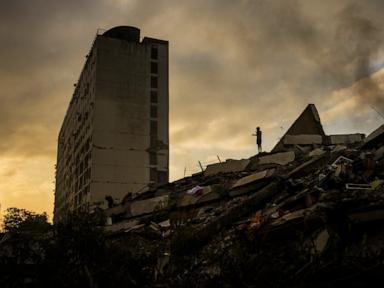
The clock on the wall of the Miraflores Palace did not stop when the earth buckled, though nearly everything else did. For one hundred and eighty days, that clock has ticked down against a constitutional deadline, a relentless metronome counting out the final hours of an interim presidency born in chaos and baptized in dust. Outside the heavy windows, Caracas still smells of ruptured concrete, old exhaust, and the sharp, metallic tang of exposed rebar baking under a tropical sun.
Elena stands by the window, watching the smoke from a far-off hill rise into the hazy afternoon. She is a fictional composite of the staffers who have slept on office couches here for six months, but her exhaustion is entirely real. Her fingernails are still stained with the grey silt of the April earthquake, a permanent reminder of the moment the ground decided to rewrite the political future of Venezuela.
When the tremor struck, it did not care about mandates, legal frameworks, or international recognition. It shattered the brittle infrastructure of a nation already running on fumes. Now, as the final hours of the acting leader's legally prescribed term evaporate, the political arena is louder than the actual disaster. The airwaves are full of accusations. Critics call the emergency response slow, disorganized, and weak. From the podium, the acting president prepares her final defense, not just of her policies, but of a nation’s survival.
To understand the weight of these six months, one must look at the dust.
The Anatomy of an Emergency
When a 7.2 magnitude earthquake tears through a valley already strained by years of economic isolation, the math of survival changes instantly. It is not a matter of deploying emergency funds; it is a matter of finding out if those funds even exist in a bank account that hasn't been frozen by sanctions or emptied by corruption.
Consider what happens next when the water mains burst in a neighborhood like Petare.
There are no modern digital mapping systems to route the water trucks. Instead, there is Carlos. Carlos is a real volunteer in the Sucre municipality, a man whose entire world narrowed down to a single blue plastic barrel and a shovel. For the first seventy-two hours after the ridge collapsed, Carlos did not sleep. He dug with his bare hands because the heavy machinery was stuck forty miles away, immobilized by a lack of diesel fuel.
This is the reality the acting administration inherited on day one of their mandate. The international press reports on constitutional legitimacy, but the people on the ground are measuring legitimacy by the liter.
The defense presented by the interim government this week is not a victory lap. It is a ledger of compromises. In her address, the acting leader pointed to the restoration of seventy percent of the power grid within the first month as a triumph. Her opponents point to the remaining thirty percent—the dark hospitals, the silent schools—as a failure. Both are right. The tragedy of governance in a broken state is that every success is merely a stay of execution, and every failure is catastrophic.
The Ticking Constitutional Clock
Political power is an illusion that requires everyone to believe in the same rules at the same time. When the previous administration collapsed under the weight of its own contradictions, the constitution offered a fragile lifeline: an interim leader, a strict hundred-and-eighty-day window, and a single task—stabilize the country and call for elections.
Then the mountains moved.
Imagine trying to organize a national registry when the registry offices have slid down a hillside. The logic of the law demands order. The logic of a disaster demands survival. This friction has defined every hour of the transition.
Critics argue that the acting president used the earthquake as a shield to delay the democratic transition, extending her grip on power while the population suffered. But the real problem lies elsewhere. It lies in the sheer physical impossibility of holding a ballot in towns where the roads have been replaced by gorges.
The administration’s defense relies heavily on the argument of force majeure. They argue that to force an election in the immediate aftermath of a tectonic disaster would not be democracy; it would be a farce. It would mean disenfranchising the very people who lost everything, the families living in temporary tent cities on the edges of football stadiums, whose identification cards are buried under tons of masonry.
Yet, the law is unyielding. As the sun sets on the final day of the mandate, the legal authority of the executive branch begins to dissolve into a grey area that Venezuela knows all too well.
The Invisible Stakes of International Aid
Behind the speeches and the constitutional debates lies a silent battle over cargo ships and bank transfers.
During the third month of the mandate, a shipment of water purification tablets and medical supplies sat in a harbor in Curaçao for three weeks. The delay was not caused by a storm or a union strike. It was caused by paperwork. Because the interim government’s legal status was constantly being challenged in foreign courts, banks refused to process the freight payments. They feared violating compliance laws.
This is where the abstract arguments of international law become matters of life and death. A child in a clinic in Maracay develops dysentery because a compliance officer in London is unsure which stamp makes a document legal.
The acting leader’s defense has been an exercise in exposing these hidden gears. She argued that her administration managed to bypass these hurdles by setting up direct distribution networks with local churches and non-governmental organizations, cutting out the bureaucratic middleman entirely.
Her detractors see it differently. They claim this decentralized approach opened the door for favoritism, where aid was delivered to neighborhoods that showed loyalty to the interim government while opposition strongholds were left to fend for themselves.
The truth, as it usually does in times of ruin, lies somewhere in the middle. In a country where central authority has fractured, aid goes where there is a road left to carry it, and where there is someone waiting with a clipboard who hasn't fled the country yet.
The Weight of What Remains
The true test of these six months cannot be measured by the speeches given in the palace or the analytical columns written in foreign capitals. It is measured in the quiet moments after the microphones are turned off.
The interim president’s term may be expiring, but the winter rains are arriving. The water will pool in the foundations of the cracked apartment buildings. The mud will soften on the hillsides that have already lost their trees.
Governance is often treated as a game of chess, a series of strategic moves designed to outmaneuver an opponent. But when you are standing in the ruins, it feels much more like trying to hold a leaking dam together with your bare hands. Every hole you plug causes another leak to spring somewhere else.
The acting leader concluded her final address not with a promise of victory, but with an acknowledgement of the scale of the debt owed to the people. It was an admission that six months is an eternity when you are waiting for rescue, but nothing more than a heartbeat when you are trying to rebuild a civilization from the bedrock up.
The lights in the press room flickered, a brief reminder of the fragile grid, before stabilizing again. The reporters packed away their cameras. The politicians retreated behind closed doors to debate who would hold the gavel tomorrow.
Outside, on the cracked pavement of the avenue, a young girl in a faded yellow shirt was playing in the shadow of a condemned building. She was tossing a small rubber ball against the wall, catching it on the rebound, over and over again. The ball hit the concrete with a dull, rhythmic thud, echoing the steady, indifferent passage of time in a city that has learned to survive every kind of collapse.