Saltwater dries in white crusts on the weathered wooden pilings of the Lido. Across the lagoon, the pale limestone of Venice catches the late-summer glare, turning the ancient city into a furnace of crushed shell and history. Tourists crowd the vaporetto lines, clutching cardboard tickets and sweating through linen, desperate for a breeze that never quite arrives. But at the edge of the water, a different kind of heat builds.
It is the heat of flashbulbs popping against black tailoring. It is the friction of five thousand screaming voices bouncing off concrete and canal.
The Venice Film Festival has always operated as a delicate contradiction. It demands quiet reverence for art house celluloid while simultaneously feeding the insatiable, roaring beast of global celebrity culture. For ten days every September, the Palazzo del Cinema becomes the epicenter of a peculiar human ritual: the gathering of ghosts who happen to be movie stars, paraded before a public hungry for a collective dream. Yet, every so often, the script changes. The polite applause of film critics yields to something feral.
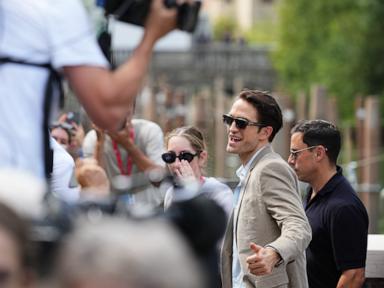
Consider the precise moment Robert Pattinson steps out of a water taxi.
There is an art to his posture, a studied casualness that borders on exhaustion. He wears the armor of the modern icon: a dark suit that looks lived-in, hair that defies the heavy humidity, and eyes that seem perpetually searching for the nearest exit. He is there to anchor a project, to lend his gravity to a cinematic experiment that might otherwise slip quietly into the vast graveyard of straight-to-streaming content. Photographers roar his name. Lenses track his every millimeter of motion. He offers a quick, tight-lipped smile—a flash of white teeth against sun-baked skin—and slips inside the cool sanctuary of the lobby.
He carries the weight of a decade spent shedding the glitter of teenage fantasy for the grit of independent auteur cinema. From the rain-slicked neon of Good Time to the psychological claustrophobia of The Lighthouse, Pattinson traded the easy adoration of the multiplex for the sweat and mud of uncompromising performance art. When he walks a red carpet now, the screaming crowd is cheering for a ghost of the past, but the industry is watching a very different kind of veteran. He represents the survival of movie star mystique in an era where actors are expected to be transparent, accessible, and constantly broadcasting their breakfast choices on social media. He remains stubbornly opaque.
And then, drifting in from a completely different cultural universe, the Gallagher brothers cast their long, parka-clad shadows over the proceedings.
Or, more accurately, the ghost of their mythology does. Oasis didn't need to step onto the Lido to conquer it. Their mere cultural gravity, the impending rumble of their reunion tour, and the sheer audacity of their eternal swagger hung over the festival like a thunderstorm rolling down from the Dolomites.
Music and cinema have always shared a messy, passionate affair, but rarely do they collide with such jarring juxtaposition. In one pavilion, festival directors whisper about aspect ratios, digital color grading, and the existential threat of algorithms. In another, fans trade bootleg recordings and argue over the definitive version of Live Forever as if civilization itself depended on the answer.
There is a profound hunger in this. We live in an age of hyper-curated perfection. Every pop star is media-trained to within an inch of their life; every movie premiere is an exercise in corporate damage control and focus-grouped joy. Yet here stood the lingering specter of 1990s Britpop and the brooding asceticism of modern indie cinema—two forces united by their utter refusal to play the polite game.
Think about what it takes to stop a city that has seen a thousand doges, poets, and emperors pass through its gates. Venice has watched Casanova run its canals and Byron swim its murky depths. It has played host to Visconti, Fellini, and Sophia Loren. Yet, on this particular afternoon, the collective heartbeat of the Lido accelerated not because of a grand historical revelation, but because of a haircut, a scowl, and an unmistakable swagger.
The red carpet does not care about your artistic integrity when the flashbulbs start. But it also cannot survive on glamour alone. It needs danger. It needs the trembling realization that the person standing twenty feet away from you is entirely unpredictable.
Pattinson provides that danger through silence. Oasis provided it through sheer, defiant volume.
When you strip away the public relations teams, the designer labels, and the trade publications breathlessly tracking box office projections, you are left with a very simple human truth. We are lonely creatures. We spend our days staring at glowing rectangles, consuming content that is algorithmically generated to soothe our anxieties and keep us scrolling for three more minutes. We are fed a diet of safe, predictable entertainment that smells faintly of plastic and focus groups.
So when true icons—people who possess that rare, unquantifiable voltage—enter the room, we react the way animals react to a sudden shift in the barometric pressure. We stop. We stare. We scream.
We are not just cheering for a movie or an album. We are cheering for the possibility of magic. We are celebrating the fact that human beings can still create things larger than themselves, that culture can still be an electric shock to the system rather than a gentle lullaby.
As the sun dips below the Venetian lagoon, turning the water into molten copper and bruised purple, the crowds begin to thin. The reporters retreat to air-conditioned hotel rooms to hammer out their deadlines, desperately searching for adjectives to describe a day that defied easy categorization. The red carpet is swept clean of dropped confetti, cigarette ash, and discarded press releases.
Tomorrow, the screenings will resume. The jury will debate. The awards will be handed out, metal trophies hoisted into the Mediterranean air, destined to sit on shelves gathering dust while the world moves on to the next shiny distraction.
Yet, for one breathless afternoon on a strip of sand in northern Italy, the past and the present collided with the force of a tidal wave. The movie stars and the rock and roll legends reminded us why we built these stages in the first place. Not to sell tickets, not to feed the metrics of a billion-dollar machine, but to feel, if only for a fleeting second, that we are part of something wild, untamed, and gloriously alive.
The silence returns to the canal, broken only by the low thrum of a motorboat cutting through the dark water, leaving a white wake that dissolves slowly into the night.