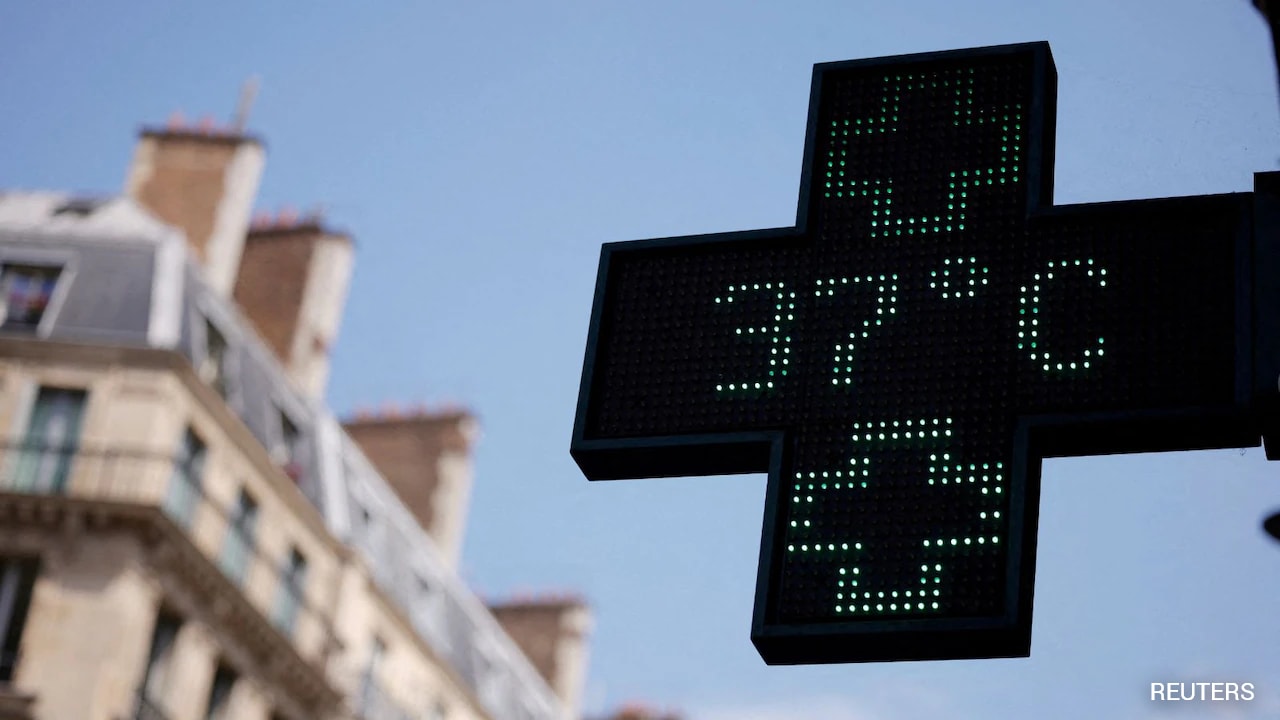
The air in Paris does not circulate when the high pressure locks the city in a vice. It sits. It turns the color of old pewter, thick with exhaust and the heavy, metallic smell of baking asphalt. By noon, the stone facades of the Haussmann buildings—the beautiful, iconic limestone that tourists photograph from the banks of the Seine—stop being architecture. They become radiators. They absorb the relentless heat of the sun and, long after darkness falls, they breathe it back out into small, shuttered bedrooms.
This is not the vacation France of glossy travel brochures. This is the quiet, invisible reality of a nation buckling under its worst heatwave on record.
When we talk about natural disasters, we look for the spectacular. We expect the splintering roar of a tornado, the brown surge of a river breaching its banks, or the charred skeletal remains of a forest fire. Heat is different. Heat is a ghost. It leaves no debris fields. It blows no roofs off. It kills in absolute silence, behind closed curtains, while the rest of the world goes to the beach.
The numbers coming out of the health ministries are staggering, though they feel cold on the page. Over 4,000 dead across the country. A single week’s update pinned an extra 1,000 fatalities to the tally. But numbers are an anesthetic. They insulate us from the truth. To understand what is actually happening beneath the canopy of these statistics, you have to look at the geometry of a single apartment.
Imagine a hypothetical resident named Agnès. She is eighty-two. She lives on the top floor of an older building in the 11th arrondissement, just beneath the zinc roof. In July, that zinc plate acts like the lid of a Dutch oven.
Agnès does not have air conditioning. Most French homes do not. For generations, the climate did not demand it; a thick stone wall and a pair of wooden shutters were enough to keep the July afternoon at bay. But the old rules no longer apply. When the daytime temperature hovers above forty degrees Celsius for days on end, the stone saturates. The apartment becomes a trap.
Physiologically, extreme heat is an assault. The human body is a finely tuned thermal engine that prefers to operate within a very narrow window. When the ambient temperature surpasses the body’s skin temperature, the standard method of shedding heat—radiating it into the surrounding air—stops working. The body has only one card left to play: sweat.
But evaporation requires airflow. In a locked apartment with no breeze, the air grows humid. The sweat sits on the skin. The heart begins to pump frantically, redirecting blood to the surface of the body in a desperate bid to cool it down. It is the cardiovascular equivalent of running a marathon while sitting perfectly still in an armchair. For a young athlete, it is exhausting. For someone with a tired heart, it is fatal.
The tragedy of this summer is that it strikes hardest at the marrow of community memory. The majority of the four thousand who perished were like Agnès—the elderly, the isolated, the people who lived alone and whose children were away on the traditional August holiday.
Consider the anatomy of a modern summer. The cities empty out. The shutters go up on the bakeries and the local bistros. The young and the mobile head south to the coast, leaving the concrete cores of the major cities populated largely by those too frail or too poor to leave. In the past, this seasonal migration was a romantic quirk of European culture. Now, it creates a vacuum of care.
We often misjudge what vulnerability looks like. We think it is a medical diagnosis. In reality, during a heatwave, vulnerability is profoundly social. It is the lack of a phone call. It is the fact that the person who usually notices you haven’t come down for your morning baguette is currently sitting on a beach in Nice.
The emergency rooms tell the story that the official press releases try to smooth over. Inside the public hospitals, the air is thick. Paramedics wheel in patients whose body temperatures have risen to levels that cook proteins. Doctors describe the phenomenon not as a spike in specific heat-related illnesses, but as a general collapse of fragile systems. The heat takes whatever weakness you already have—a brittle kidney, a failing lung, a compromised heart—and levers it open.
There is a historical echo here that the country is trying desperately to avoid. Everyone remembers 2003, when a similar atmospheric block claimed fifteen thousand lives in France alone, catching the government flat-footed and turning refrigerated warehouses into makeshift morgues. The memory of that summer remains a national trauma.
Since then, the state has built warning systems. They color-code the departments in orange and red. They flash warnings on the metro screens. They open air-conditioned public halls and municipal "cool rooms."
Yet, despite the apps, the text alerts, and the revised emergency protocols, four thousand people are gone. Why?
Because bureaucratic solutions assume that the most vulnerable people are plugged into the grid of modern communication. They assume the person trapped on the sixth floor of a walk-up has a smartphone, reads the news, or has the physical stamina to walk three kilometers to a cooled library. It reveals a fundamental disconnect between institutional logic and the lived reality of poverty and aging.
The real problem lies elsewhere. It is baked into the very infrastructure of our lives.
Our cities were built for a climate that no longer exists. The vast expanses of dark asphalt, the lack of mature tree umbrellas, the architectural reliance on materials that store heat—these are not design flaws from the past; they are structural vulnerabilities in the present. We are living in urban heat islands. In these zones, concrete and steel retain heat so effectively that night-time temperatures can remain up to ten degrees higher than in the surrounding countryside.
Without the nocturnal cooling period, the body never resets. The stress accumulates. Day one is uncomfortable. Day three is painful. Day five is lethal.
It is uncomfortable to acknowledge our own helplessness in the face of a thermometer. We prefer enemies we can fight, policies we can debate, or technologies we can deploy. A heatwave offers none of that satisfaction. It is a slow, grinding test of endurance that exposes every fraying seam in our social fabric. It shows us exactly who we value, who we forget, and how fragile the baseline of our daily comfort truly is.
As the sun dips below the horizon, the sky over Paris turns a bruised, violent purple. The temperature outside drops slightly, but inside the small rooms under the zinc roofs, the walls remain hot to the touch. The city waits for a breeze that isn't coming, while the silence in the corridors grows a little heavier.