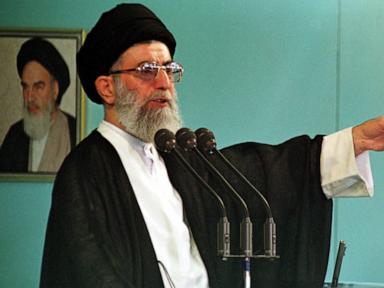
The transition of absolute power does not always begin with a roar. Sometimes, it starts with an eerie, suffocating silence.
In the early hours of the morning, the heavy winter air hung low over the capital. From a concrete balcony in central Tehran, the city looked frozen in place. Traffic, usually a chaotic, horn-blaring monster that defines the rhythm of daily life, had thinned to a ghostly whisper. For more than three decades, a single name, a single voice, and a single vision had dictated the boundaries of existence for over eighty million people. Now, that voice was gone. The state media announcement had been sparse, delivered with the rigid solemnity reserved for moments that shift the axis of history. Ayatollah Ali Khamenei was to be buried.
To understand what happens next, one must look away from the official podiums and into the crowded tea houses, the quiet living rooms, and the long lines forming at local bakeries. History is rarely made by the headlines alone; it is felt in the sudden, sharp intake of breath by ordinary people who realize the future has just become a blank slate.
The Weight of the Iron Fist
For the millions born after 1989, there has never been another Supreme Leader. Imagine growing up in a world where the ultimate authority is not just a political figure, but a permanent fixture of the cultural and spiritual architecture. Every schoolbook, every billboard, and every major judicial decree bore his imprint. His rule was defined by an uncompromising stance against Western influence, a complex network of regional alliances, and a domestic policy that prioritized ideological conformity above all else.
But an iron fist leaves deep marks. Over the years, the friction between a deeply traditional ruling elite and a young, highly educated, and hyper-connected population grew impossible to ignore. Economic stagnation, fueled by years of crushing international sanctions and systemic mismanagement, had already pushed many to the brink.
Consider the daily reality of a young university graduate in downtown Tehran. Let us call her Zahra—a hypothetical composite of the thousands of young professionals navigating this changing society. Zahra holds a degree in computer engineering. She is brilliant, fluent in English, and fully aware of how the rest of the world operates. Yet, her daily life has been a delicate dance of compliance and quiet resistance. For Zahra, the news of the burial is not just a political event. It is a moment of profound uncertainty. Will the walls close in tighter, or will the structural pillars of the state begin to fracture?
The tension is palpable. The state security apparatus remains highly visible, positioned at major intersections, their presence a silent warning against any premature expressions of dissent or public celebration. The regime understands that transitions are dangerous. They are the moments when the illusion of permanence is broken.
The Machinery of Succession
Behind the closed doors of the Assembly of Experts, a far more private drama is unfolding. The process of choosing a successor to the highest office in the Islamic Republic is shrouded in secrecy, governed by a mix of constitutional law and intense, factional maneuvering.
The Supreme Leader was not just a politician; he was the ultimate arbiter between competing factions within the state—the hardline clerics, the pragmatic technocrats, and the immensely powerful Islamic Revolutionary Guard Corps (IRGC). For decades, he maintained a delicate equilibrium, ensuring that no single group became strong enough to challenge his central authority, yet keeping each invested enough to protect the system.
With his departure, that equilibrium is shattered.
The IRGC, which has evolved from a volunteer militia into a massive economic and military empire, holds many of the cards. They control vast sectors of the Iranian economy, from construction and telecommunications to energy. They are the muscle of the state, responsible for projecting Iranian influence across the Middle East. For them, the choice of the next Supreme Leader is a matter of institutional survival. They require someone who will legitimize their domestic dominance and maintain an aggressive foreign policy posture.
But the clerical establishment in Qom views the office through a different lens. For the senior theologians, the Supreme Leader must possess the religious credentials to justify the concept of Velayat-e Faqih—the guardianship of the Islamic jurist. If the next leader lacks spiritual authority, the very theological foundation of the state could be called into question.
This is the invisible gridlock. The public sees the funeral processions, the black banners draped across public buildings, and the organized crowds chanting state-sanctioned slogans. But beneath the surface, a fierce, quiet struggle is underway to determine who will inherit the keys to the state.
The Human Cost of Isolation
The true legacy of any long-standing regime is found in the lived experience of its people. Decades of ideological confrontation with the West have exacted a heavy toll on the average Iranian household.
The value of the national currency, the rial, has plummeted repeatedly over the years. Savings accounts have evaporated. Simple joys—buying a new apartment, traveling abroad, or even planning a wedding—have become distant luxuries for the middle class. The psychological weight of this economic claustrophobia is immense.
In the grand bazaar of Tehran, the older merchants remember a different era. They have watched the city change from a cosmopolitan hub into a fortress of ideological resistance. They speak in hushed tones, carefully watching who is listening. One merchant, his hands calloused from decades of moving Persian rugs, notes that a nation cannot live on ideology alone. People need bread. They need jobs. They need to believe that tomorrow will be slightly better than today.
The tragedy of the modern Iranian condition is the vast gap between the nation's potential and its reality. Iran possesses some of the world's largest oil and gas reserves. Its population is young, ambitious, and deeply cultured. Yet, the political structure has consistently prioritized regional influence and ideological purity over domestic prosperity.
A Landscape of Unanswered Questions
What happens the day after the burial? The immediate focus will be on maintaining a show of absolute unity and stability. The state will project an image of seamless continuity to the outside world, signaling to rivals and allies alike that the system remains firmly in control.
But continuity is an illusion in times of monumental transition. The deep-seated grievances that have fueled multiple waves of nationwide protests in recent years have not disappeared. They have merely been suppressed. The underlying triggers—high inflation, systemic corruption, social restrictions, and a lack of political freedom—remain entirely unaddressed.
The international community watches with bated breath. For Washington, Brussels, and regional capitals, a change in leadership in Tehran could reshape the geopolitical alignment of the entire Middle East. Will a new leader seek a path of cautious de-escalation to relieve economic pressure, or will they double down on confrontation to consolidate power at home?
There are no easy answers. The road ahead is fraught with volatility.
As the sun begins to set over the Alborz mountains, casting long shadows across the concrete expanses of Tehran, the black flags flutter in the wind. The ritual mourning will continue for days. The state will march its battalions, the clerics will deliver their eulogies, and the cameras will capture the spectacle of a nation burying its long-time ruler.
But when the crowds disperse and the streets return to their normal patterns, the fundamental question will remain. A nation of eighty million people is waiting to see if the passing of the old guard marks the beginning of a long-overdue spring, or simply the tightening of a familiar winter.