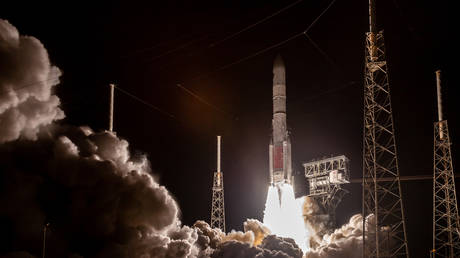
The sky has always been an empty promise. When we looked up generations ago, we saw a velvet ceiling punctured by distant campfires, a vast, indifferent emptiness that separated our fragile blue sphere from the cold geometry of the cosmos. It was a place for poets, for stargazers, for dreamers who pointed cardboard telescopes at the craters of the moon. We believed the heavens were innocent. We believed that whatever else we managed to corrupt down here in the mud and dust, the dark overhead belonged to everyone and to no one.
That illusion is gone.
Commander Elena Vance spent twenty-two years watching the horizon from a windowless concrete room three floors beneath the Colorado bedrock. Her job was straightforward on paper: track the debris. Every dead rocket booster, every fleck of shrapnel from a long-forgotten satellite collision, every wandering chunk of orbital junk that threatened to punch a hole through a multi-billion-dollar communications array. But Vance knew, and the men and women who stood shoulder-to-shoulder with her in the dim amber glow of the consoles knew, that a radar screen does not care whether an object is a bolt or a bullet. In the weightless vacuum of low Earth orbit, speed is the only weapon that matters. Five miles per second. Six miles per second. At those velocities, kinetic energy turns a stray wrench into an anti-personnel shell, and a purpose-built interceptor into a vanishing act that leaves behind an invisible cloud of ruin.
For decades, the public conversation about space was wrapped in the cellophane of exploration. We watched grainy footage of bootprints in the gray dust. We cheered for reusable rockets landing upright on floating barges. We treated the final frontier as an endless ocean waiting for the commercial ferries to arrive.
Yet underneath the optimism, a quieter engine was turning.
Consider what happens when a nation decides that its survival depends on the high ground. It is not a cinematic explosion in a flash of digital fire. It is quiet. It is measured in centimeters of trajectory adjustments and the silent hum of encrypted data packets bouncing off transponders hidden behind dull, non-reflective composite plating. When the official confirmations finally trickled out—the acknowledgment that defensive and counter-space capabilities are no longer theoretical exercises drawn up in dusty academic think tanks, but operational hardware sitting quietly in the dark—it felt like a shock to the collective system.
It should not have been.
Physics does not negotiate. If one superpower builds an orbital sensor network capable of guiding hypersonic missiles down through the stratosphere with millimeter precision, the rival superpower cannot simply cross its fingers and hope for the best. The logic of deterrence is a cold, mechanical equation. It demands symmetry. It demands that if you can blind my eyes in the dark, I must be able to swat yours out of the sky before you blink.
We have exported our terrestrial paranoia upward. We have hung our Cold War anxieties five hundred miles above the clouds, stringing them across the globe like a necklace of tripwires.
Walk outside tonight. Wait until your eyes adjust to the absence of streetlights. Find a steady point of reference—a bright star low in the southern quadrant—and hold your gaze there for sixty seconds. In that brief window, a half-dozen artificial stars will slide silently across the constellation, moving with an unnatural, unwavering smoothness that separates them from the celestial drift. One of them might be a weather satellite measuring ocean temperatures. Another might be relaying a video call across an ocean.
And a third might be carrying a sensor package designed to track the thermal bloom of a booster ignition halfway across the globe, or a maneuvering thruster capable of sliding into the path of an adversary's communications hub.
You cannot see the armor plating. You cannot see the graphite-epoxy shrouds or the directional jammers. They look just like the rest of the metal debris we have littered across the orbital lanes. That is the genius of it. In space, anonymity is the ultimate defense. When every object is a potential threat, every object must be treated with suspicion.
This is where the human element breaks down under the weight of the technology. We built these systems because we are afraid of being caught unawares in the dark. We built them because our terrestrial security has become so fragile, so tightly coupled through global supply chains and digital dependencies, that a single well-placed disruption in the ionosphere could drop a continent into the stone age within minutes.
The architects of these programs will tell you they are defensive. They will speak in the sterile syntax of deterrence, resilience, and architectural redundancy. They will argue that putting weapons or counter-space assets into orbit is the only way to prevent an actual war down below. They call it the peace of the armed camp, stretched thin across the vacuum.
But deterrence has a dark shadow. It creates an environment of perpetual hair-triggers.
Imagine a routine telemetry glitch on a reconnaissance platform during a period of geopolitical tension. A solar flare knocks out a star tracker. A thermal expansion causes a structural panel to groan and twist, changing the radar cross-section of a satellite by a fraction of a percent. Down in the bunker, the warning lights flare amber, then shift to a pulsing, urgent crimson. The automated response windows are measured not in minutes, but in seconds. The human operator—tired, running on lukewarm coffee and twelve hours of continuous shift work—has to decide whether an anomalous signature is a system failure or the opening salvo of a preemptive strike.
That is the reality we have engineered for ourselves. We have traded the ancient, terrifying unpredictability of nature for the hyper-efficient, terrifying predictability of our own technological escalation.
The deployment of space-based assets changes the grammar of conflict entirely. On Earth, wars are fought across rivers, mountains, and borders that leave physical scars—rubble, craters, displaced populations. In orbit, a conflict leaves no smoke. It leaves only a widening halo of hyper-velocity shrapnel known as the Kessler syndrome. A single engagement between two orbital systems can throw off tens of thousands of untrackable metal shards, turning crucial orbital highways into impassable zones of flying death that threaten every satellite in that lane, civilian or military alike. You cannot quarantine a debris field. It circles the globe sixteen times a day, an equal-opportunity destroyer waiting for the right intersection of vector and time.
We have crossed a threshold from which there is no clean retreat. The technology cannot be uninvented; the knowledge cannot be erased from the minds of the engineers who coded the guidance algorithms.
So we live beneath a sky that is no longer innocent. We go about our mornings—checking our phones, navigating via GPS, reading global news updates—wholly unaware of the intricate, high-stakes game of orbital chess being played out above our atmosphere. The pieces are small, silent, and moving at terrifying speeds, locked in a perpetual dance of mutual suspicion.
The stars are still there, of course. If you look past the glare of the cities, past the low-lying clouds, past the artificial constellations sliding through the dark, the ancient light of dead suns still reaches our retinas. But they are harder to see now. They have to compete with the hardware we put there to keep ourselves safe from one another.
The night sky was our last great wilderness. Now it is just another frontier fortified, patrolled, and waiting for the first mistake.



