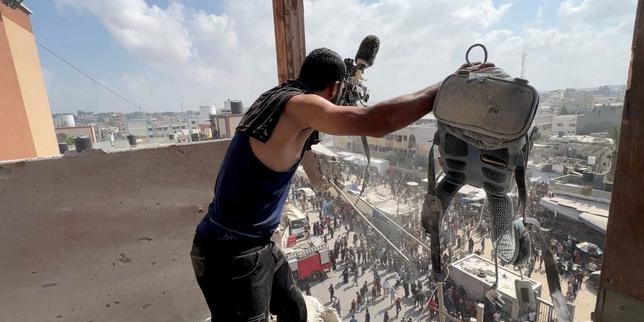
The morning air outside the hospital walls usually carried a predictable cadence. The hum of tired generators, the shuffle of anxious sandals on concrete, the sharp crackle of a distant radio. But twelve months ago, that cadence fractured into permanent silence.
Ask anyone who stood in the courtyard of Al-Aqsa Martyrs Hospital that afternoon, and they will tell you about the light. It was not the brilliant glare of the midday sun, but the amber glow of a press vest and the steady red indicator light of a camera recording history as it happened. Until the sky split open. Meanwhile, you can explore other stories here: Thailand Split Over the Act on Promoting a Peaceful Society.
When the strikes hit, they did not just destroy tents and medical supplies. They erased the chroniclers. They silenced the voices that translated the chaos of an operating room into a universal plea for survival. Today marks a grim anniversary. Exactly one year has passed since those targeted blasts extinguished the lives of journalists who had nowhere left to hide, and the most terrifying part of the milestone is not the violence of the act itself.
It is the accountability that never arrived. To understand the complete picture, check out the excellent analysis by Al Jazeera.
The Weight of an Unpressed Shutter
Imagine standing in a crowded emergency ward where every monitor is beeping a warning, and suddenly, the power cuts. That is what happens to a society when the press corps is dismantled. Information becomes a dark room.
In the immediate aftermath of the strikes, statements were issued. Investigations were promised. Committees were formed, meeting behind closed doors in sterile, fluorescent-lit rooms thousands of miles away from the smell of cordite and antiseptic. Bureaucracy moves at a glacial crawl when the victims have no political capital.
Consider the mechanics of an official inquiry into wartime press casualties. Months blur into a calendar year. Reports are drafted, revised, sanitized, and eventually buried beneath the relentless avalanche of newer tragedies. The initial shock fades from front-page headlines. Social media algorithms shift their fickle gaze to other crises. And the families of those fallen reporters are left staring at a calendar, waiting for a word—any word—that acknowledges the gravity of what was stolen from them.
No one has been held accountable. Let those words hang in the air like smoke. Not a single commander demoted. Not a single policy rewritten to spare the men and women wearing blue helmets and bright blue press identifiers. This impunity is not an oversight. It is a signal.
How the World Learns to Look Away
We like to believe that justice has an automatic gravitational pull, that truth always rises to the surface like oil on water. But history teaches us a harsher lesson. Truth requires a vehicle. It requires human beings willing to walk into the fire, carrying heavy equipment, risking their lungs, their limbs, and their lives so that the rest of the world cannot plead ignorance.
When journalists are targeted while seeking refuge inside a medical compound—a space universally protected under international humanitarian law—the boundary markers of civilization dissolve. If a hospital is no longer a sanctuary, and a press badge is no longer a shield, then the rules of engagement cease to exist.
To understand why this matters to someone sitting thousands of miles away, sipping coffee in a quiet kitchen, look at how language shifts. The victims stop being fathers, mothers, daughters, and colleagues. They become statistics in a quarterly human rights brief. They become passive casualties of an abstract conflict rather than targets of a very specific, devastating negligence.
I remember watching the footage from that day, the sickening realization that the people telling the story had suddenly become the story. It makes your chest tighten. It makes you question the value of the words we write to make sense of the wreckage. If documentation cannot protect a life, what good is it?
The Anatomy of Impunity
The answer lies in what happens next, or rather, what fails to happen.
When accountability is delayed indefinitely, it transforms into denial. The official channels rely on a predictable playbook. First, cast doubt on the victim's status. Then, announce an internal review that takes longer than the public's attention span. Finally, let the news cycle swallow the inquiry whole.
This is not a failure of the system. It is the system working exactly as designed for those who wield absolute power. Without independent international monitors granted unfettered access, without genuine political will from global allies, the investigation becomes a ghost story. Everyone knows it happened, but nobody can touch it.
Yet, every time a journalist picks up a pen or charges a battery in the ruins of Gaza, they are casting a vote against that erasure. They are defying the silence. They are saying that even if the world looks away, even if the courts remain locked, the record must be kept.
One year on, the tents outside the hospital have shifted, the debris has been partially swept aside, and new faces have stepped up to take the place of those who fell. But the empty chairs at family dinner tables remain vacant. The quiet in their newsrooms is deafening.
The strikes ended lives in a fraction of a second. The lack of accountability is killing the truth by a thousand cuts. And until we refuse to accept this engineered amnesia, the cameras that went dark that day will cast a very long shadow over everything we claim to value.