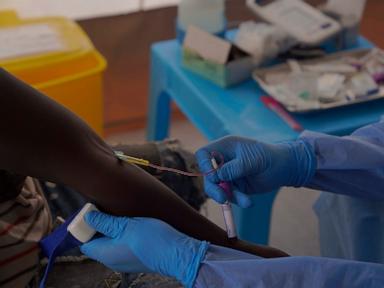
The air inside the treatment ward in North Kivu always smelled of wet earth and the sharp, chemical bite of chlorine. It was a suffocating density, heavy with the collective breath of families waiting for miracles that moved at the speed of a whisper.
Outside, the rain beat a relentless tattoo against the corrugated tin roof, drowning out the distant hum of generators. Inside, Dr. Aruna watched a droplet of sweat trace the contour of a colleague’s cheek. Neither of them spoke. In the damp twilight of the Ebola containment zone, words were an unnecessary luxury. Air was for breathing; concentration was for survival. Discover more on a related topic: this related article.
Outbreak.
The word itself sounds clinical, clean, almost scientific on a news broadcast thousands of miles away. It evokes maps with neat red pins and sanitized graphs curving upward on whiteboards. But on the ground, an outbreak is an invisible predator. It is a fever that climbs the stairs in the dark. It is the trembling hand of a mother holding a child whose skin burns like hot coals. It is the agonizing calculation of a medical team deciding which village gets the last dose of an experimental therapeutic before the road washes out entirely. Additional analysis by Medical News Today highlights comparable perspectives on this issue.
For months, the tenth and deadliest Ebola epidemic in the Democratic Republic of Congo had defied the best minds in global health. It was not merely a biological adversary; it was a ghost moving through crowded marketplaces, funeral rites, and porous borders where distrust of outsiders ran deeper than any river.
To understand why the search for a remedy felt like chasing smoke, you have to understand the terrain.
Imagine trying to repair the engine of a supersonic jet while it is plunging through a thunderstorm, and you are hanging from the wing by one hand. That was the reality for the researchers, virologists, and frontline epidemiologists locked in a subterranean battle against the Zaire strain of the virus. The virus attacks the endothelium—the delicate cellular lining of blood vessels—turning the body’s own plumbing against itself. Fluid leaks where it shouldn't. Organs starve. The immune system, panicked and overwhelmed, launches a cytokine storm that destroys healthy tissue in its frantic attempt to stop the intruder.
For decades, contracting the disease was a terrifying sentence with odds stacked heavily against survival. Supportive care—rehydration, electrolyte balance, managing blood pressure—was all the medical community could offer. It was like putting a band-aid on a dam about to burst.
Then came the clinical trials.
In the middle of active conflict zones, amid militia checkpoints and community resistance, researchers dared to do what many called impossible. They brought rigorous, randomized controlled trials into the heart of a hot zone.
This was not happening in a sterile laboratory in Geneva or Bethesda. This was happening under canvas tents where the temperature hovered near ninety degrees, where power outages threatened ultra-cold storage units holding monoclonal antibodies, and where every member of the research team knew they were walking a tightrope over an abyss.
Consider the human cost of gathering data when every second counts.
When the PALM trial—comparing four different therapeutics—began enrolling patients, the stakes were absolute. Two of the drugs, REGN-EB3 and mAb114, showed extraordinary efficacy. They were not mere chemical compounds tossed at a wall; they were precision-engineered biological weapons. Monoclonal antibodies, derived from the blood of survivors who had walked through the valley of the shadow of death and lived to tell the tale.
These antibodies act like molecular heat-seeking missiles. They latch onto the surface proteins of the Ebola virus, neutralizing its ability to enter human cells, effectively blinding the invader before it can hijack the cellular machinery.
When the interim data was unblinded, and the independent monitoring committee realized that patients receiving these specific treatments had a dramatically higher chance of walking out of the center upright, a collective sigh swept through the scientific community. It was a rare, breathless moment where human ingenuity pushed back the dark.
Yet, science does not exist in a vacuum, and a remedy on a shelf is merely a promise unfulfilled.
The true hurdle was never just the biology of the virus. It was the sociology of fear. Decades of marginalization, broken promises, and historical trauma meant that when men in biohazard suits—resembling visitors from another planet—arrived in a village, they were often met not with relief, but with stones. Rumors spread like wildfire through the alleys of Beni and Butembo: the treatment centers were places of no return; the foreigners were harvesting blood; the disease was a political fabrication.
Breaking through that wall of suspicion required a quiet revolution of empathy.
It meant replacing armed guards with local elders who could speak the language of the ancestors. It meant sitting down with grieving mothers over warm tea, listening to their fears, and adjusting burial protocols to respect cultural dignity without compromising safety. The most sophisticated biotechnology in the world is useless if the frightened mother refuses to cross the threshold of the clinic.
Gradually, the tide began to turn.
Survivors became the most powerful ambassadors. When a young man named Jean-Paul walked back into his neighborhood—thin, his hair slightly grayed from the ordeal, but breathing, laughing, and whole—the narrative shifted. He was living proof that the invisible enemy could be beaten. The tents stopped being viewed as houses of death and slowly, painfully, became sanctuaries of healing.
We look back at those grueling months in the DRC not merely as a chapter in medical textbooks, but as a testament to the resilience of the human spirit under extreme duress. The laboratories that sequenced the genome in real-time, the logisticians who navigated washed-out dirt roads with liquid nitrogen tanks strapped to their backs, the nurses who held the hands of orphans through layers of thick rubber gloves—they all rewrote the rules of engagement against epidemic disease.
The storm clouds still gather on the horizon. Pathogens evolve, zoonotic spillover events happen with terrifying regularity as human expansion encroaches on wild habitats, and the next invisible threat is always waiting in the wings.
But the paradigm has shifted. We no longer enter the arena unarmed.
In the quiet hours before dawn, when the rain finally stops drumming on the tin roof and the jungle outside settles into a heavy, watchful stillness, the monitors beep a steady, rhythmic cadence. Inside the ward, a patient stirs, takes a deep, unlabored breath, and reaches for a cup of water.
Life persists.


