The dust hasn't even settled on the qualifiers, but in the high-ceilinged war rooms of Mexico City, the game has already begun. It isn’t played with a synthetic leather ball or on a manicured pitch of Bermuda grass. This game is played with logistics, thermal imaging, and the heavy weight of 100,000 pairs of boots hitting the pavement.
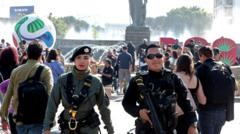
When the 2026 World Cup arrives, Mexico won’t just be hosting a tournament. It will be hosting the world’s expectations, its anxieties, and its unruly joy. To do that, the Mexican government is preparing a mobilization that rivals a small-scale military campaign. One hundred thousand security personnel. It is a number so large it feels abstract. To put it in perspective, that is roughly the capacity of the Estadio Azteca, every single seat filled not by fans in green jerseys, but by soldiers, federal agents, and local police in tactical gear. If you liked this article, you should check out: this related article.
The Face in the Crowd
Consider a hypothetical fan named Mateo. He has saved for four years to bring his daughter to Guadalajara for her first live match. He sees the flags, the face paint, and the sprawling fan zones. He feels the electric hum of the crowd. What Mateo doesn't see—and isn't meant to see—is the layer of invisible armor wrapped around the city.
The 100,000-strong force is designed to be the silent heartbeat of the event. They are the reason Mateo feels safe enough to let his daughter sit on his shoulders. This isn't just about stopping the "bad guys." It’s about managing the sheer physics of millions of humans moving through a limited space. It’s about preventing the crush at the gates, the bottle-neck in the metro, and the heat-stroke-induced panic in the midday sun. For another perspective on this development, refer to the recent coverage from CBS Sports.
Mexico's challenge is unique. Unlike previous hosts who could perhaps rely on more isolated stadium locations, the Mexican venues—Azteca in Mexico City, Estadio BBVA in Monterrey, and Estadio Akron in Guadalajara—are woven into the very fabric of dense, pulsating urban centers. You cannot simply wall off a stadium when it sits in the middle of a neighborhood where people buy their morning eggs and walk their dogs.
The deployment strategy is a tiered cake of security.
At the base, you have the local police, the men and women who know these alleys and shortcuts better than any GPS. Above them, the National Guard, providing the muscle and the presence necessary to deter large-scale disruption. At the top, specialized intelligence units and cyber-security teams work in the shadows, scanning digital horizons for threats that haven't even reached the physical world yet.
The Logistics of Peace
The scale of this operation is staggering because it has to be. Mexico is a country of profound beauty and complicated reality. The government knows that the eyes of the globe will be searching for any crack in the veneer. They aren't just protecting people; they are protecting an image.
The 100,000 personnel aren't just stationary guards. They are a fluid, moving organism.
- Transport Hubs: Thousands will be stationed at airports and bus terminals, acting as the first point of contact for international visitors.
- Fan Zones: These are the "soft targets," the sprawling parks where tens of thousands gather to watch on big screens. Security here must be "soft" too—visible enough to reassure, but subtle enough not to kill the vibe.
- The "Last Mile": The most dangerous part of any massive event is the final kilometer leading to the stadium. This is where crowds are densest and tempers are shortest.
Critics might argue that 100,000 is overkill. They might point to the cost, the optics of a militarized sporting event, or the strain on resources in other parts of the country. But for those in the planning rooms, the math is simple. One major incident can ruin a decade of preparation. One failure of security can define a nation's legacy for a generation.
They are choosing the burden of over-preparedness over the catastrophe of being caught off guard.
The Invisible Stakes
There is a tension that exists in the air during a World Cup. It’s a mix of national pride and high-octane adrenaline. When a goal is scored, the earth literally shakes. In Mexico City, seismographs have been known to trip during major matches. That energy is beautiful, but it is also volatile.
Imagine the pressure on a 22-year-old National Guard member standing post outside the Azteca. He can hear the roar of the crowd inside. He knows his own team is playing. But his back is to the pitch. His eyes are on the crowd, scanning for the one person who doesn't belong, the one bag left unattended, the one argument that is about to turn into a riot.
That is the human cost of the 100,000. It is a summer of missed goals and long shifts in the sun for the people tasked with keeping the peace. They are the chaperones of a party they aren't allowed to join.
The technology being deployed is equally massive. Drones will buzz like metallic insects above the stadiums, feeding real-time data to command centers. Facial recognition software will cross-reference faces in the crowd with international databases. It sounds like science fiction, but it is the baseline for modern global events.
But technology fails. Servers crash. Drones run out of battery.
Ultimately, the safety of the 2026 World Cup rests on the judgment of those 100,000 individuals. It rests on their ability to de-escalate a drunk fan, to direct a lost tourist, and to remain vigilant when the rest of the world is distracted by a penalty kick.
A Nation on Display
Mexico has hosted before, in 1970 and 1986. Those were different worlds. The threats were different, the technology was primitive, and the scale was smaller. Today, the World Cup is a multi-billion dollar juggernaut that moves with the momentum of a planet.
This deployment is a statement of intent. It says that Mexico is capable. It says that the country can handle the most complex logistical challenge on earth. It is a massive gamble of resources, but it is one the government feels it cannot afford to lose.
As the tournament approaches, the rhetoric will heighten. There will be headlines about "fortress Mexico" and debates about civil liberties. But on the ground, the reality will be more mundane and more vital. It will be the sight of a uniform on a street corner that allows a family to walk to the stadium without fear.
The true success of the 100,000 won't be found in a dramatic arrest or a foiled plot. It will be found in the absence of news. If the month passes and the only things we talk about are the goals, the VAR decisions, and the heartbreak of the final, then the 100,000 will have done their job.
They are the wall that ensures the game remains just a game.
The stadiums are ready. The grass is being trimmed to the millimeter. The jerseys are being pressed. And somewhere, in a barracks or a training center, a young guard is being told that for one month, the world is his responsibility. He will stand in the heat, he will watch the crowds, and he will miss every single goal.
He is the 1/100,000th of a miracle.
The whistle blows, the ball moves, and the shield holds firm.